On July 6th, Microsoft announced a sweeping round of layoffs for their Xbox division. The tech giant would cut 3200 jobs in total, with half of those firings taking effect immediately and the other half planned to take effect over the following year. This round of layoffs—the largest of the year so far—indicates that the hostile employment landscape that workers have experienced since 2022 shows no signs of recovering.
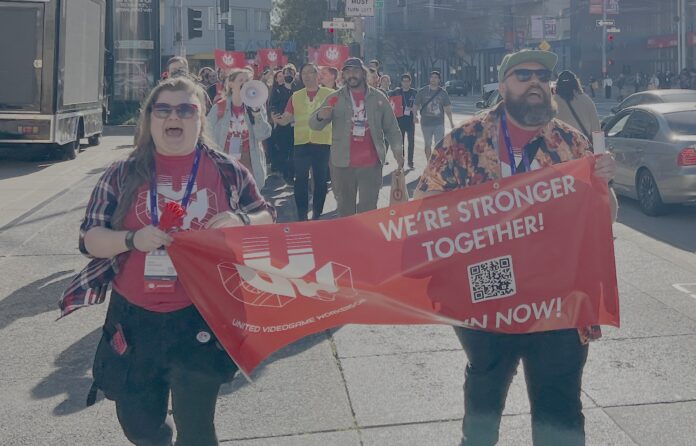
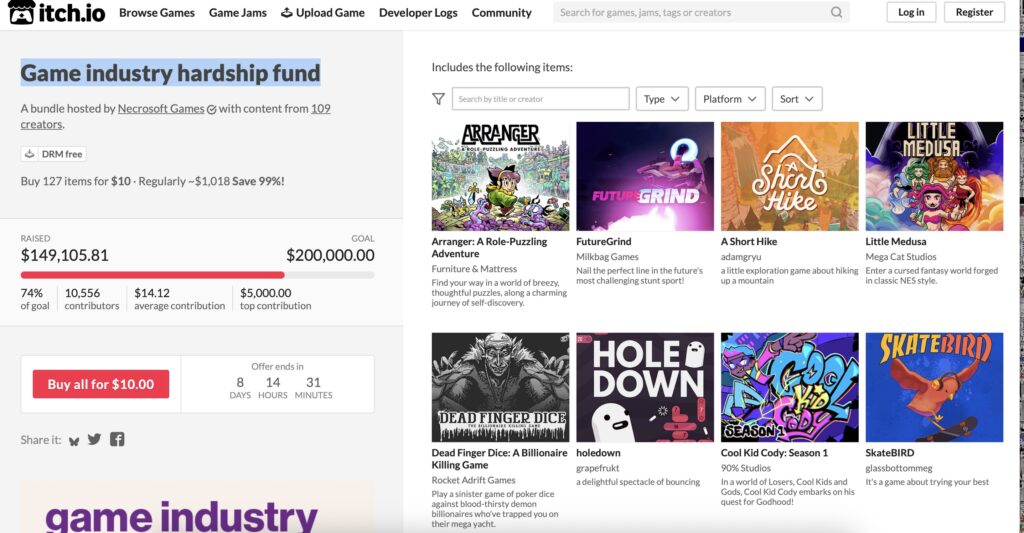
Meanwhile, on July 1st, the United Videogame Workers labor organization announced the launch of their Hardship Fund, a mutual aid initiative aimed at supporting workers across the industry who have been laid off. And on Thursday, July 30, Oakland-based developer and director of Necrosoft Games Brandon Sheffield—who has organized past fundraisers for Ukrainian citizens and survivors of the 2025 wildfires, among other causes—announced the launch of a fundraising bundle, offered through August 13, with all proceeds going directly to the Hardship Fund. In its first four days, the bundle raised over $100,000.
Taken together, the seeming collapse of large conglomerates like Xbox and the rise of worker-led efforts to support each other in the absence of a larger safety net raise some interesting questions. In an era of mass unemployment, how can game developers respond to industry conditions? Could mutual aid efforts help to build a better future for the industry, and what kinds of challenges arise from that model? What could—or should—the game industry look like moving forward?
According to Sherveen Uduwana, the treasurer of the UVW, the Hardship Fund comes out of a need to address workers’ immediate needs. “Seeing the layoffs happening year after year, and coupling that with the positive news of union organizing, there’s a bittersweet element. The workers that are getting laid off are often not immediately benefiting from that. And I hadn’t been seeing a short-term solution for people that are immediately impacted,” he says. “When I was running for the treasurer position, I said, ‘We should do a hardship fund.’ It was, to me, one of the big things we wanted to do this year.”
The fund was timed to launch at the beginning of July because, in years past, the rollover of the fiscal year has coincided with new waves of layoffs; however, Uduwana says, “We did not know for sure the actual scale of the Xbox layoffs… It ended up being a lot bigger than we were planning.” Perhaps as a result, applications to receive funds have slightly outpaced their projections.
As for the bundle, Sheffield says that the UVW initially approached him last year, but since the organization has only existed since 2025, he wanted to see more evidence of what they were capable of. After Uduwana helped to organize a smaller fund through Game Devs of Color Expo, Sheffield decided to help out. “All I needed to know was that they could do it,” he says.
From Uduwana’s perspective, the earlier fund offered useful information on what it means to put together such an initiative—both in terms of logistics, and in the softer, more ephemeral aspects of community-building.
“Community trust is crucial for doing any kind of initiative like this because it involves large amounts of money, it involves people sharing personal info, people sharing a lot of vulnerable information about what they’re going through,” he says. “One of the big things that made me very excited about the UVW was the opportunity to build a labor organization that could be very impactful in building trust among game workers and allowing us to actually support people.”

But trust can seem in short supply. When asked if there have been any challenges in putting together the bundle, Sheffield says, “I think game developers were less excited about this one. Which is very odd… It is an interesting scenario because we have indie developers essentially supporting larger game developers that have been let go. That really was unusual.”
Of course, that’s not to say that only larger developers have been affected; the scale of the Microsoft layoffs grabs headlines, but indie developers aren’t immune. “It hasn’t made the news as much, but a lot of venerable, smaller indie studios have closed this year,” Sheffield says. (For instance: Ivy Road, a studio founded by Stanley Parable co-creator Davey Wreden, put out the acclaimed Wanderstop last year. But they failed to find funding for their next project, and shut their doors this past March.)
This is an isolating environment; if no one has a job, no one has money to spare. “I think there is a lot of concern that we’re passing the same $5 around,” Sheffield says. “There’s a lot of truth to that because not a lot of people in the creative space have money anymore.”
But it is still possible for developers to connect and help each other. On a local level, Sheffield says, “Going to local meetups, and creating a local meetup, can be helpful in terms of feeling that sense of community, feeling like you’re not alone. Even if we don’t all have money, there are little ways that we can try to boost each other.”
And Uduwana says that awareness of workers’ struggles is reaching a broader group of people: “A lot of people, game workers and fans of video games included, are very aware of what has been going on. We’ve had a lot more success in challenging people to imagine an industry where we don’t fire all of our workers because one game has failed. I think those conversations have been far more productive, especially in the last year or two, than I’ve been able to have in prior years.”
Looking toward the future, Sheffield nods to companies like Innersloth, whose Outersloth game fund directly contributes to smaller developers looking to make unique work, as one potential path; he also notes that other countries have a more robust arts grant program for game developers.
“People want to make things, and they will make things if their bills are paid,” he says. “That’s all that’s really required for people to make art.” And Uduwana imagines an industry with more robust labor protections so that developers will be more insulated the next time an industry crash comes around. “I do think there is an end to this period. We’re in this position now because there [was] not enough worker power to build a strong union movement [in the past],” he says.
“Thankfully, I feel like we do have that this time around… What’s being built right now is definitely going to be in the DNA of what the games worker movement looks like in 10 years.” Though their focuses are different, for both Sheffield and Uduwana, the future of the games industry will require collaboration and community.
And, perhaps, initiatives like the Hardship Fund can help to build out some of that community infrastructure in the present. “There was a question of how much we can actually allocate towards [the Fund] in terms of budget. And we decided it’s important to do things that have impact, even if we don’t necessarily have 100% of the impact we want to have,” Uduwana says. “One of the key elements of our strategy is showing what is possible through organizing. The Hardship Fund is a great example.”
You can fine more info about the UVW-CWA Game Worker Hardship Fund here. Brandon Sheffield’s Game industry hardship fund bundle to support the fund is available until August 13 here.