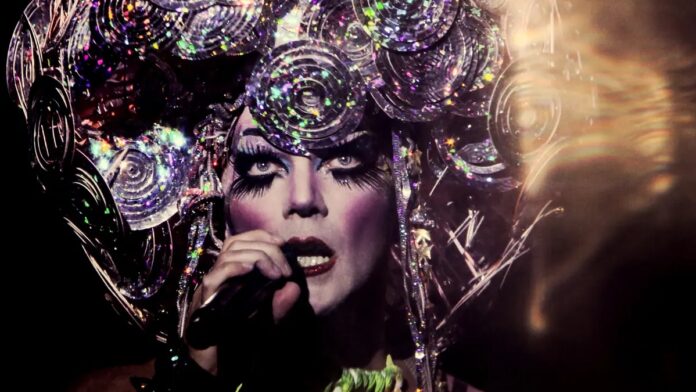
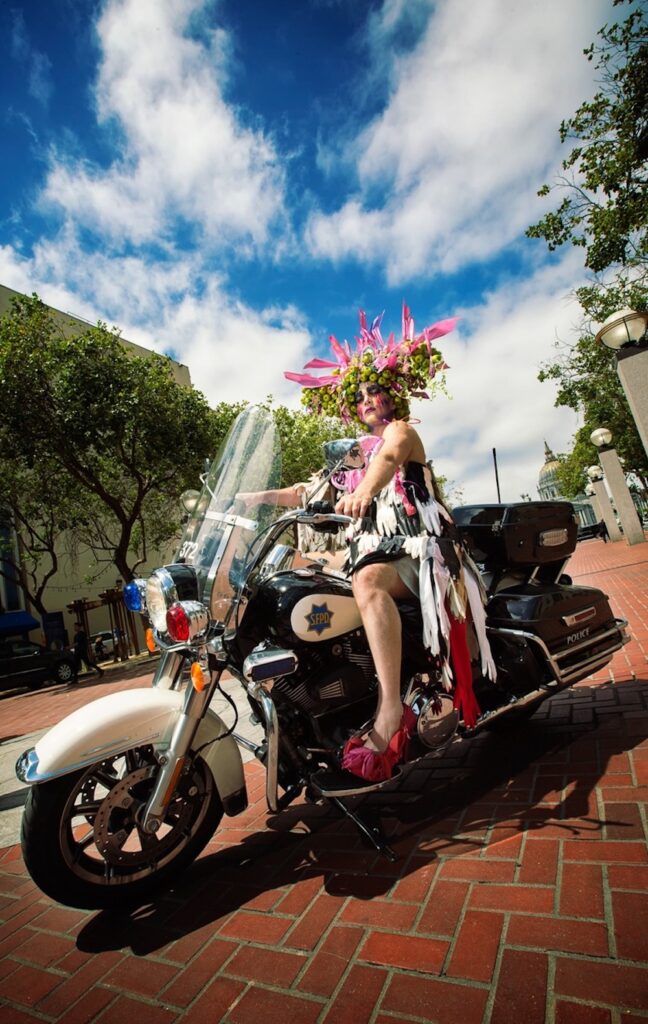
People often scramble for the perfect adjective to describe performance artist, songwriter, director, singer, playwright and actor Taylor Mac. Popular choices include “singular,” “joyful,” and “maximalist.”
Certainly, the latter word may be applied to the truckload of awards Mac has taken home, which includes a MacArthur Genius Grant, the International Ibsen Award, the Kennedy Prize, a Guggenheim, and two Obies. The holy honor of the Sisters of Perpetual Indulgence bestowing sainthood on them also deserves a mention.
Mac’s works include The Lily’s Revenge, a five-hour play with 36 cast members about, among other things, a lily’s fight against nostalgia, and Hir (a family drama that reimagined parts of Sam Shepard’s Buried Child), which were both at San Francisco’s Magic Theatre. The playwrights’s Bark of Millions: A Rock Opera Meditation on Queerness came to Cal Performances in 2024.
Mac grew up in Stockton and came to San Francisco for the first time as a teenager for the 1983 AIDS March. That experience is what inspired A 24-Decade History of Popular Music, a finalist for the Pulitzer Prize for drama. It was presented in its entirety over four performances at the Curran Theatre in 2017.
On Fri/6, Mac is back at the Curran with a new concert, Tender Heart Revolution. The occasion marks the release of their first book—a songbook named Bark of Millions: Queer Songs for the Living Library of the Deviant Theme, with music by Matt Ray and lyrics by Mac.
The artist talked with 48 Hills by phone about maintaining a tender heart during rising fascism, singing to a bully rather than punching them in the face, why we need a queer songbook, and using all of ourselves to prevent atrophy.
48HILLS I read somewhere that Bark of Millions has the fierce elation of a Pride Parade. Is that how you think of it?
TAYLOR MAC I was at this World Pride in 2019, and it was the year that they split into two parades, and one was the anti-capitalist parade. The other was the “go-go boys on Coca-Cola floats” parade. I thought, I want to hang out with the go-go Boys, I want to sell Coca-Cola. I want to be with all the drag queens and the fun, and I don’t want it to just be about activism. But also, fun is activism. I felt like I didn’t belong at either parade that year, and I thought, “Well, why don’t I make my own parade?”
Every song in the show will be its own float in a way. It has 50 songs inspired by 50 different queer people from history, and now we’ve turned it into a songbook.
48HILLS How did you and Matt Ray decide to do that?
TAYLOR MAC I work in the ephemeral arts primarily, and I always long for things to be in the world. And there is some activism in this. It’s the first queer songbook to be published by a major publisher in the history of the world. People can learn a song and then forget about it on their bookshelf, and then a year later go, “Oh, there’s this book,” and then learn another song, and so it’s something that can be part of your life—instead of just an evening at the theater that you remember, and maybe as part of your life via your memories, but not necessarily something that allows you to have a daily practice with it, or a monthly or a yearly practice with it.
48HILLS Did you immediately know what you wanted the book to be?
TAYLOR MAC The form of the book took shape through us working on it. Matt Ray composed the music, I wrote the lyrics, and I also wrote all these essays for the book about queerness. So, it’s kind of a treatise on queerness, or a giant meditation on queerness. One of the things we learned is that some people read sheet music and some people just read lyrics. A lot of singers don’t read music, so they just want the lyrics, and they learn from their ear. So we thought, that’ll be good, to have one book that has all the sheet music in it, and one book that just has all the lyrics and the essays in it. Then people can use both books at the same time. So, it comes in a compendium, and you can invite your friend over who plays the guitar, and you can sing along with them. You can use as you wish, instead of dictating that it all be musical notation. The notation’s gorgeous, but there’s something quite wonderful about being able to read the poetry of the lyrics without a lot of squiggly lines around it.
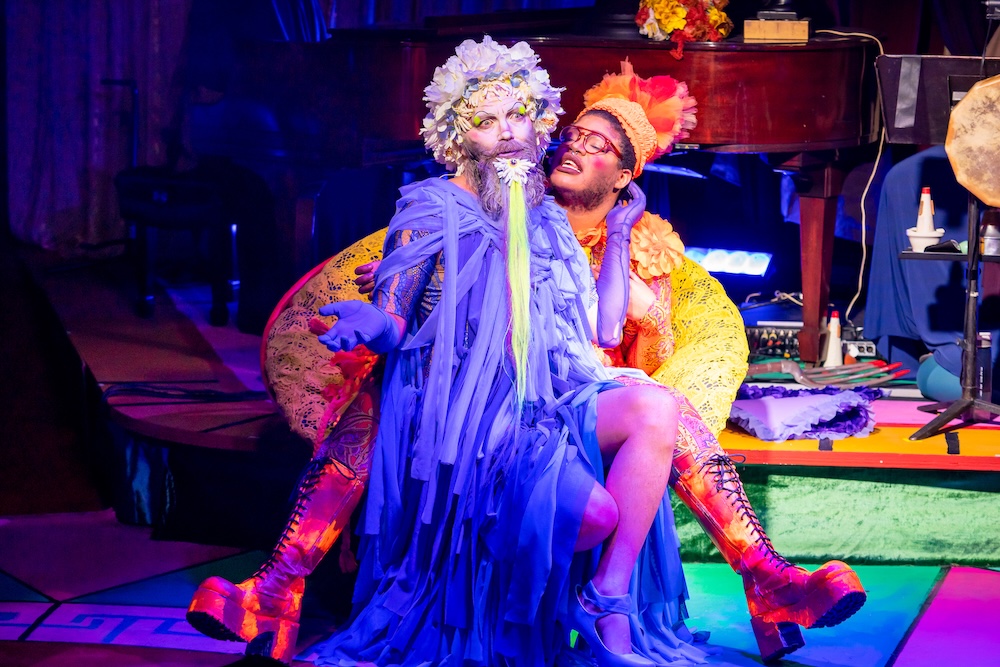
48HILLS You were part of the October 30 Philip Glass event at Stanford Live Arts. What does Glass mean to you?
TAYLOR MAC He is part of the lineage of Mabou Mines, which is the avant-garde experimental theater pulse of New York. Sonically, he’s such a dream. But this is primarily an Allen Ginsburg evening. We are doing Philip Glass, but it’s about celebrating Allen Ginsberg, who is of course one of the great queers of all time. I’m doing some poems of Allen’s. I wrote one that was inspired by “Wichita Vortex,” one of his poems. Then I’m singing a Bob Dylan song, because Ginsberg did the liner notes for Bob Dylan’s Desire album. I’m going to sing “Isis.”
48HILLS Tell me about Tender Heart Revolution, your concert coming to the Curran Theatre Fri/6.
TAYLOR MAC It’s brand-new. We’re doing a couple songs from A 24-Decade History of Popular Music, this big, long show I made that we did at the Curran many years ago. We’re going to do two songs from that show, and we’re doing a bunch of songs from Bark of Millions, because we’ve got the book that’s just been released, and a couple new things. It’s really me, in concert.
I call it Tender Heart Revolution because in this time of rising fascism, I just feel like the conventional wisdom I got when I was a kid was “punch the bully in the face,” or “you have to fight back, you have to stand up for yourself.” No one ever took me aside and said, “Revolution can happen by maintaining your tender heart.” I don’t want to become a fascist or an authoritarian in order to defeat them. I’m interested in how to maintain a tender heart in this too-tough world. I think you do that by singing songs and gathering people together and sharing art.
48HILLS I heard you being interviewed by Zach Stafford on the podcast “Vibe Check,” and you said something about how curiosity was the way to survive in this time.
TAYLOR MAC It is a form of liberation. Just ask questions about the world and people, and why is our president as horrible as he is? I mean, there are five million reasons, and they can all benefit you. It won’t change him, but it can benefit you to ask the questions and to wonder, it can calm your nervous system down. Our great queer icon Socrates gave us this method, which is just to constantly ask questions. You know, it’s not “I think therefore I am.” It’s “I doubt, therefore I think, therefore I am.” There’s no such thing as faith without doubt, and so it’s all about wondering about the world. That’s the thing about writing queer songs all inspired by different queer people from world history. I think it’s not representation. I don’t know how to represent myself on a stage, let alone another person, let alone an entire demographic. But I can wonder about people and their circumstances, and I can ask questions in song about them, and I can try to inspire other people to do the same about themselves and the universe.
48HILLS You have won so many awards, but it seems like you still have to fight to get things made.
TAYLOR MAC I think it’s because I’m not a capitalist. I have this book, but I don’t think of it as something I just want people to buy. I think of it as an offering to try to help make the world better. I didn’t grow up with queer songs in the church or queer songs around the campfire or at school or even on the radio. I think that there’s a lot of pain as a result of that. I didn’t grow up with a queer songbook, and it’s the first time a queer songbook has been published by a major publisher. All of us didn’t grow up with these things, and I see a problem in the world.
I say we’re squashing ourselves. We’re not allowing ourselves to dig deep. Why are there 5,000 stories about songs about Jesus, but the only song about Ra, the sun god—that I know—is the one I wrote? Millions of people worship the genderqueer god called named Ra.
I keep saying on this on this book tour, that straight is a human abstraction. There’s nothing straight in the universe. Everything is curved, everything’s wobbly. Of course, that’s geometry. But you apply it to gender and sexuality, and suddenly everything starts to make sense.
When people say that queerness isn’t natural, what they’re saying is they want to control nature. They’re saying that nature isn’t natural, and they’re trying to make it straight, which is a man-made concept. It’s like we all need to be liberated from the ways that society and churches and governments have oppressed us, or even our parents. Everybody needs that liberation, because there is expansion in all of us. We’re all able to be bigger than we allow ourselves to be.
48HILLS That word, “expansive,” keeps coming up to describe you and your work. Was that a guiding principle for you, or just how things turned out?
TAYLOR MAC I’ve made 30 full-length works in my career, and only three of them have been longer than two hours. But I’ve definitely gotten this reputation for doing durational work—because the durational stuff has gotten more attention. But I love the durational work, and I love the idea of thinking of yourself as part of the universe which is very large, ever-growing, and ever-expanding. If we’re actually part of the universe, aren’t we ever-expanding as well?
I grew up in Stockton, California, where everyone was told to be one thing, and in a country where we’re supposed to root for one team and one god, and there’s a lot of tribalism and shrinking yourself down to something as opposed to opening yourself up to the to the larger world and the larger possibilities. So, I think the expansiveness that you’re talking about is a reaction to a childhood of being squished. I’m just trying to breathe. My friend is a doctor, and she went and studied cadavers, and she got to touch people’s lungs. Most of them were atrophied, because people don’t use the full width and depth of their lung capacity, so that extra space just dies off as we get older. You can apply that metaphor to everything in our lives. It’s important that we use all of us in order to not atrophy.
TAYLOR MAC: TENDER HEART REVOLUTION Fri/6, 7:30pm. Curran Theatre, SF. More info and tickets here.