This is Drama Masks, a Bay Area performing arts column from a born San Franciscan and longtime theatre artist in an N95 mask. I talk venue safety and dramatic substance, or the lack thereof.
The first time SF Opera ever cancelled a show was when JFK was killed. The company had travelled to LA to perform Pikovaya Dama when the news came out of Dallas. The first Opera in the Park cancellation was in 1990, due to a labor dispute. The one and only time it’s ever cancelled a season was in 2020, because everything got cancelled in 2020.
That’s what it takes for the company to call things off: presidential assassinations; worldwide pandemics, and yes, labor disputes.
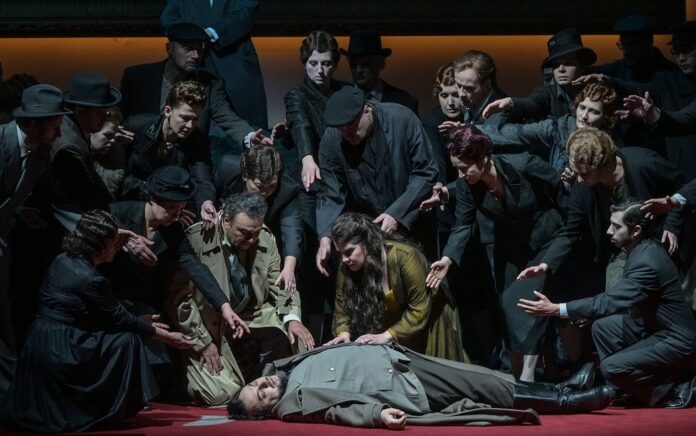
I write these words just hours after the company called off the opening performances of Simon Bocanegra and Mary, Queen of Scots due to its current dispute with its orchestra over an effort to effectively cut the orchestra’s pay by 20%, via a five-year wage freeze which the Opera says is necessary in the current economic climate.
Official statements have, quite frankly, read as a little callous: “[W]e must adjust to the changing realities of the arts, and we cannot sustain a compensation structure that originated 45 years ago without bringing it into alignment with current reality.”
Even before an official strike had been authorized, 48 Hills had been contacted by Save SF Opera, “an independent citizen-led effort started by San Francisco Opera audience members and supporters concerned about the ongoing contract dispute between the Opera and its Orchestra.” Though the organization didn’t reply for comment by press time, it claims to have gathered over 250 signatures from SFO patrons fully supporting the orchestra.
Someone who did reply was Larissa Archer, a fellow SF-born arts critic and patron whose long relationship to SFO has seen her handing out program booklets as a child to the occasional gig as a supernumerary. She’s a staple of the company’s opening night galas. Her mother, Masha Archer, spent decades selling her hand-crafted “art-to-wear” necklaces in the Opera House before SFO abruptly ended the relationship this year.
Larissa had just come back from Burning Man when she heard about the strike. Neither the announcement nor the reaction by SFO brass surprised her.

“[I’m] not surprised they turned comments off on their social media posts about it,” she told me. “It looks to me like the board and donors have given themselves more and more perks over the years—only tolerable if the artists that actually make the opera mean something are compensated comfortably.
“The donors wanted the original opera shop area for their own exclusive lounge, and took it. They took the opening night gala out of the house, where the celebration felt like it was for everybody, and sequestered it away across the street [at City Hall] for themselves alone.”
In a post-DOGE US, thousands of organizations have to fight for even less water from a dried-up well of donors. Nevertheless, board members of those organizations continue to live the high life as the working artists struggle.
“I just read that [General Director Matthew] Shilvock’s pay has risen by several hundred thousands [of] dollars over the past few years,” Larissa says. “What does the Opera or city, get out of any of this? If your artists are unhappy, you have failed.”
As of this writing, the season hasn’t been cancelled (already-purchased tickets can be transferred, donated, or fully refunded), but with the premieres of both season openers indefinitely delayed, a full cancellation isn’t off the table.
CROWDED FIRE PRESENTS MANNING WEST COAST PREMIERE
Trauma can be a lot like cooking: Everyone’s convinced their way is the only right way. Death has already touched the characters of Benjamin Benne’s Manning (West Coast premiere through September 26 at Potrero Stage, SF) before we ever meet them. The ways they deal with that death are as funny as they are sad and confounding. Also, there’s a giant zucchini, which may or may not be the resurrected family matriarch.
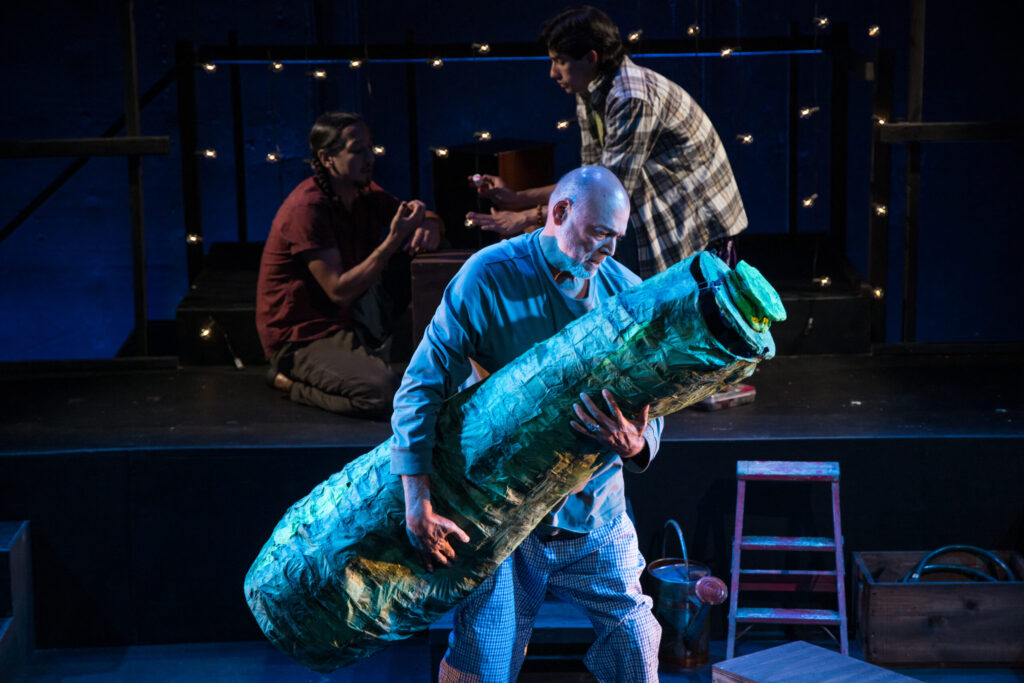
Retired chef Julio (Michael Torres) seems to have raised his boys to be cooks because he couldn’t make them into soldiers. His gay vegan son Freddy (Alonso Melgoza) maintains the garden formerly tended to by Ana (Michele Apriña Leavy), his late mother and Julio’s wife. After spreading her ashes in the garden, the aforementioned zucchini pops out, to the surprise of both men and Freddy’s meat-loving falconer brother Sebastian (Caleb Andrew Cabrera).
The oversized courgette becomes the proxy for the trio’s shared grief, individual memories, and some unseen garden rodents. It’s also something Julio quite literally refuses to let go.
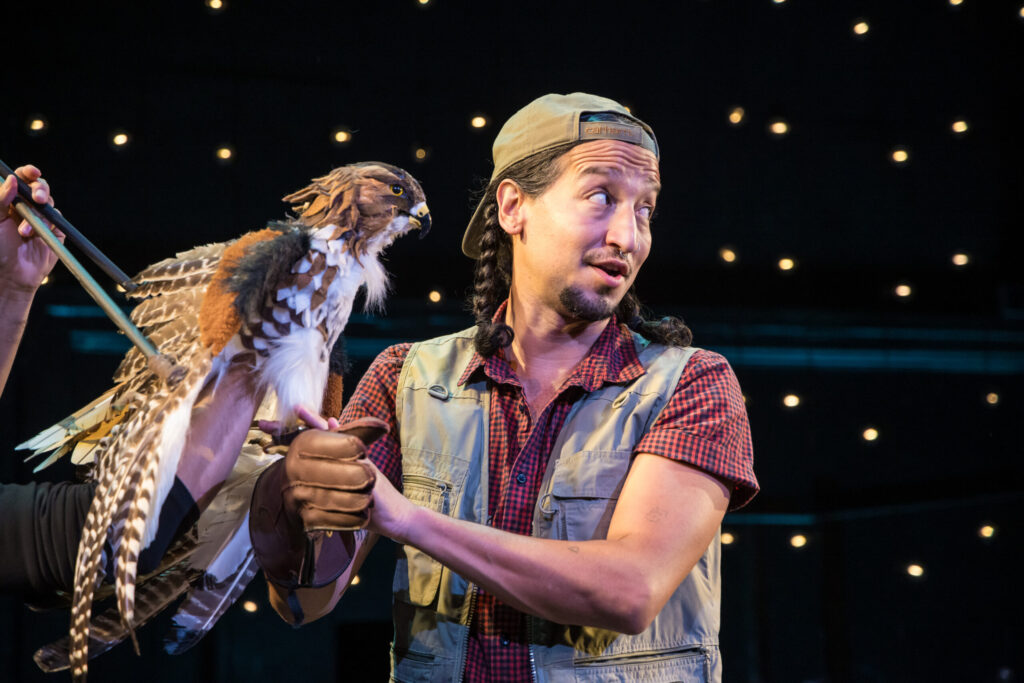
The real stars of Aidin Walker’s production are the designs: the minimalist set by Carlos-Antonio Aceves; the papier-mâché zucchini by Maria Zurita Ontiveros; and, of course, the falcon puppet by Ontiveros and Ixtlán, operated onstage by the latter. Add in composer Sarah Jiang’s arresting live score. It isn’t that the characters lack appeal, but the magical realism of this world requires no suspension of disbelief, which I say with praise.
CO² levels weren’t the highest I’ve seen at the Potrero, with my Aranet4 peaking around 1,498ppm near the end of the 80-minute show. The next mask-required show will be the 3pm matinée on September 19.
Although it tries to hard for a happy ending, Benne’s works as a metaphor for how grief can be inexplicable. The show is empathetic without being depressing, and the production values alone are reason enough to seek it out.
MANNING’s West Coast premiere runs through September 26 at the Potrero Stage, SF. Tickets and further info here.
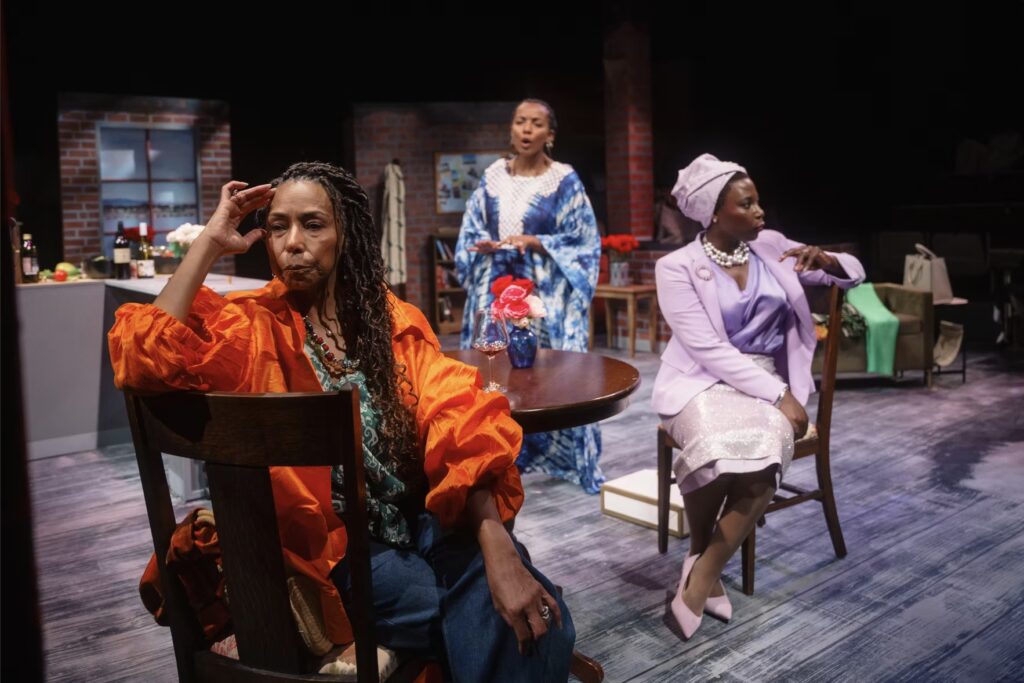
AFRICAN STEW ROLLING WORLD PREMIERE BY LORRAINE HANSBERRY THEATRE
The two things working against African Stew (rolling world premiere, meaning the play’s being produced in cooperation with other companies, through September 27 at The Magic Theatre, SF) are its opening and closing scenes. That’s when playwright Lisa B. Thompson (The Black Feminist Guide to the Human Body) leans too much into overly expository dialogue and genre cliche.
Between those scenes, however, is a razor-sharp comedy that puts a unique, Black Oakland spin on the Guess Who’s Coming to Dinner? trope. (After all, that film was set in SF.) This time, Black American Jules (Sundiata Ayinde) opens her Oakland loft to her parents (Margo Hall and Ron Chapman), her Nigerian fiance Ken (Titus VanHook), and his parents (ShawnJ West and Jeunée Simon). Cultures clash, insults are spoken, dinner may or may not be finished on time.
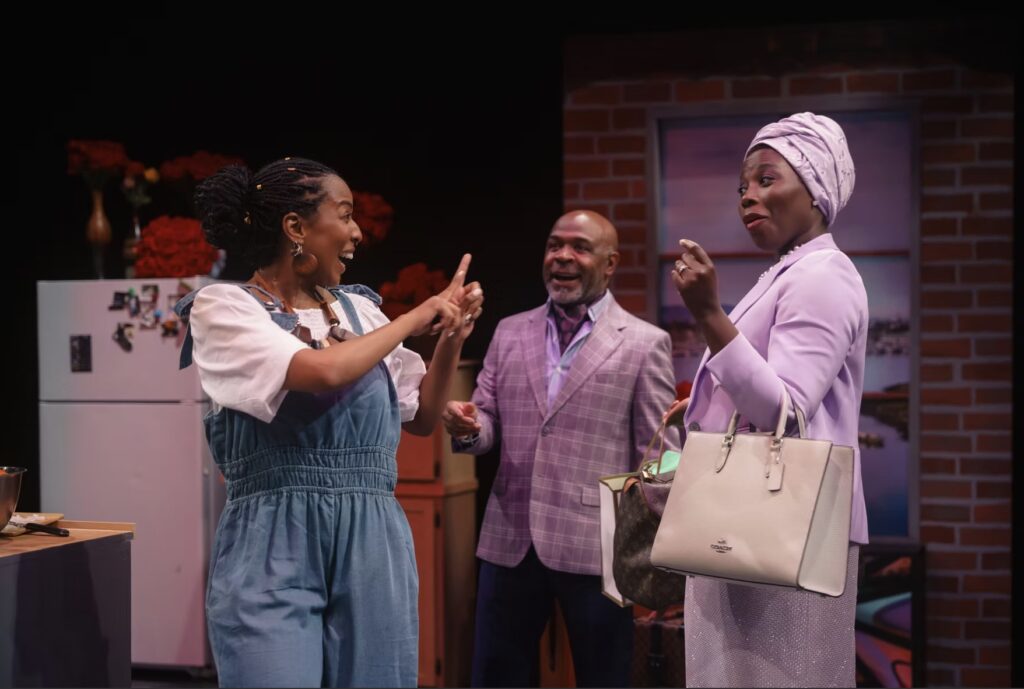
The ”meat” of Thompson’s script works due to its “Yes, I went there” attitude toward the uneasy relationship between Black Americans and Black Africans. Intellectually, we know that the slave trade and centuries colonialism are to blame for that divide, but there’s a difference between an on-paper concept and people living their lives in the world they were given. Sticking to the latter is what gives the play its heart.
Whatever The Magic Theatre’s done to its HVAC recently is working. This show continues the recent trend of ppm levels hovering in the mid-700s during the show.
At its best, African Stew works as a show works as a fly-on-the-wall dramatization of what Black folks say when no one’s around, even to other Black people. That it does so with so much affection makes it more than worthy of an audience’s attention.
AFRICAN STEW’s rolling world premiere runs through September 27 at The Magic Theatre, SF. Tickets and further info here.