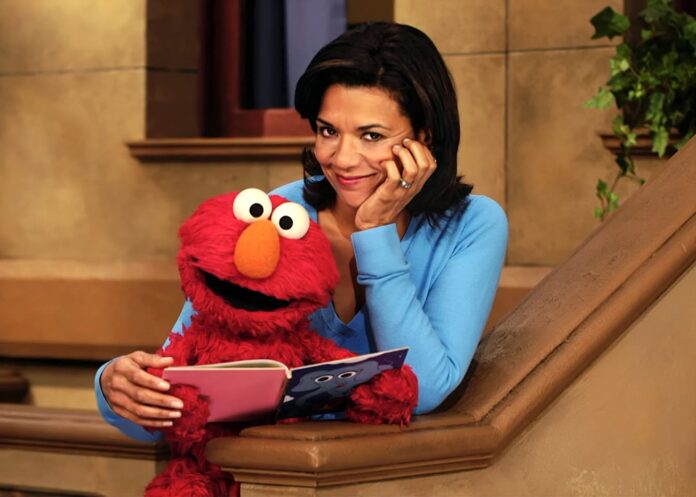
What a moment for SF Latino Film Festival (Thu/22-November 1)to return, as ICE raids Central Valley agricultural fields—apparently our POTUS does not eat produce, though at times he could be classified as a vegetable—and draws guns on US citizens in downtown SF. Cine+Mas’ 18th edition of its annual showcase also opens with a film celebrating multiculturalism, public education, and public television… three more things that are in a right-wing political chokehold at present.
That unfortunate relevancy aside, Eddie Bustamente’s Street Smart: Lessons from a TV Icon is its own happy place, a paean to the career and influence of four-decade Sesame Street performer Sonia Manzano. The Bronx-raised child of Puerto Rican emigres, she did not get much encouragement at home or elsewhere once she got interested in acting. Still, she kept being in the right place at the right time, her first big break coming when as a college student she was cast in the original Carnegie Mellon production of Godspell—then transferred with it to a very long-running Off-Broadway run.
During that stint she tried out for the Muppets-powered PBS show that would revolutionize children’s television. Joining the (human) cast during its third season, she’d make a huge impression on viewers as Sesame Street resident Maria, providing a cool, accessible Latina role model. She was so identified with the character, many believed Manzano was really married to her TV beau Luis, played by Emilio Delgado.
Fewer were aware of the 15 Emmys she won for the show were as a contributing writer. Her other accomplishments include creating the ongoing, semi-autobiographical kids’ animated series Alma’s Family, about a six-year-old girl… whose Puerto Rican family lives in the Bronx. With input from various colleagues and fans, as well as myriad archival clips, original animation sequences and some dramatized sequences, Street Smart gives off what a festival opener is generally meant to: good vibes.
Also mixing animation and other elements in a nonfiction package is Sundance prizewinner TheyDream, William D. Caballero’s imaginative portrait of his own frequently beleaguered Puerto Rican family. Other documentary features in Latino Fest this year include ones about shamanic eco-activism in Brazil (Maxita), youthful Guatemalan art-as-protest (Comparsa), a transgender journey from Mexico to California then back again (Libertad), a Ecuadoran woman’s work helping north-bound migrants (Carmela and the Walkers), and a starry tribute to Mexican-American musicmaking (Bird of Four Hundred Voices).
Among narrative features is the official closing night selection Cara Pura, Bruno Irizarry’s seriocomedy about a man (Jencarlos Canela) struggling to save his family’s historied hotel after Hurricane Maria’s 2017 devastation. Also from Puerto Rico is Michelle Malley Campos’ Foreigner, which finds a young teacher’s forced exile to Taiwan after a scandal. Alberto Utrera’s Spanish Ownerships is a black comedy in which a younger couple desperate for more space get a great deal on a huge flat—but they can only occupy it when the exasperating current tenant dies.
Comedy in a lighter key is offered by Clara Martinez-Lazaro Almeda’s Strawberry Lips, wherein a reunion between childhood friends takes some highly unexpected turns. Henrique Dantas’ Garden of Silences finds an Italy-raised oncologist returning to his native Brazil, where his parents suffered greatly under the dictatorship. In a similar vein, Paula de Luque’s B&W Escritor has a journalist probing a particularly heinous crime during the mid-1950s era of military coup: A roundup and slaughter of men who it turns out weren’t even connected to the political opposition.
One of the most intriguing fiction features is Argentine writer-director Karla Badillo’s debut Oca, a religious (or perhaps anti-religious) allegory whose disparate characters are all heading for one reason or another down dusty rural roads to San Vicente, hoping to implore the newly-appointed archbishop. Among them is Rafaela (Natalia Solian), a young nun whose convent is so neglected, it no longer has a roof. There’s also a group of argumentative villagers, a rich lady with chauffeur, an AWOL pilot, and his furious superior. Not everything works, but Oca is a fresh and ambitious mix of barbed social commentary, gentle humor and magical realism.

SF Latino Fest also features several shorts programs and some free screenings (including an outdoor one of the 2023 U.S. sci-fi fantasy Blue Beetle on Sat/24). The festival runs Thursday/22-Nov. 1 at various San Francisco locations, with some selections also available On Demand. For full schedule, program and ticket info, go here.
Those who prefer their film festivals to be all “virtual” are in luck, as this week also brings the 13th edition of the SF-based Legacy Film Festival on Aging. Running this Fri/23 through November 22, it offers a full month of streaming titles—shorts, features, documentaries, narratives—dealing in one way or another with the triumphs and trials of seniority. There are movies about artists and activists, the fight against ageist beauty standards, intergenerational bonds, pressing health issues, and more. The 2006 Been Rich All My Life, a full-length portrait of five Harlem Renaissance chorines still tap-dancing into their antiquity, will be accessible for free. For full info, go here.
This week is particularly heavy on promising new releases that were not available for preview by deadline. They include the heavily awards-favored Spanish gay epic La Bola Negra, Taika Waititi’s sci-fi Kazuo Ishiguro adaptation Klara and the Sun, South Korean director Lee Chang-dong’s (Poetry, Burning) multiple Venice prize-winner Possible Love, Sacha Baron Cohen’s cinge-y comeback vehicle Ali G: Who Iz I?, acclaimed stop-motion animation fantasy Wildwood, and DC Comics-drawn horror Clayface. (The latter would not excite much anticipation if it weren’t directed by Mike Watkins, whose first feature Eden Lake was among the more harrowing thrillers of the last twenty years.)
A couple films we have seen are getting special screening events over the next few days, with filmmakers in person. Jack Macinnes and Itab Azzam’s documentary One in a Million, which won the Audience Award at Sundance this year, is a powerful film about immigration, its causes, and its pitfalls. Israa is just a little girl when her family gets bombed out of Syria by civil war. They successively land in Turkey, then Greece, then Germany, where westernization creates new problems between generations. Shot over a decade’s course, it’s a complex, fascinatingly intimate portrait of the political becoming very personal indeed. Macinnes and Israa will hold post-screening Q&A’s at the Elmwood, Roxie (both Sat/24), Rafael Film Center, and UNAFF in Palo Alto (both Sun/25).
On Thu/22 writer-director Zach Clark will visit the Bay Area to present his 2023 The Becomers, a whimsically wayward spin on Invasion of the Body Snatchers in which shape-shifting space aliens try humanity on for size—and find our species a poor fit. Sparks’ Russell Mael is this absurdist, exquisite-corpse-like tale’s voiceover narrator. Clark will be in discussion with critic AS Hamrah at Oakland’s Shapeshifters Cinema, info here.
Some new releases:
Wicker
There have been quite a number of movies in recent years that sought to reinvent fairy tales (or sometimes just the familiar conventions of fairy tales) in grown-up modern terms. But few have been as satisfying as this sophomore feature from writer-directors Alex Huston Fischer and Eleanor Wilson, adapting a short story by Ursula Wills. Olivia Colman plays resident Fisherwoman to a vaguely medieval village in vaguely mittle-Europa, where everyone else is also known solely by their societal role. She’s accustomed to slurs, as an unlovely spinster with an, er, professional odor.
But one day something stirs in her, and she commissions the surprised Basket Weaver (Peter Dinklage, seldom better) to “make me a husband.” Even more surprisingly, he delivers. The Wicker Man (Alexander Skarsgard) shortly arriving at her doorstep may not be flesh and blood, but he is handy, devoted, and apparently stellar in the sack. So much so that soon the local “wives are all aflutter,” plainly jealous of a spouse so unlike their boorish own. Chief among this resentful lot is the Tailor’s Wife (Elizabeth Debicki), just the sort of princessy Karen to view someone else’s happiness as a sin she must punish.
A multinational production shot in Hungary, Wicker makes tart points of a tacitly feminist and/or political nature without belaboring them in the least. It is funny sans cruelty, surprisingly poignant when things turn more serious, and capable of pulling off a complicatedly kinda-sorta happy ending that feels just right. Opening in theaters nationwide Fri/23, it is one of the year’s most winning unexpected pleasures.
Fjord
The biggest long-term star of the Romanian New Wave that started about 20 years ago, writer-director Cristian Mungiu makes the inevitable move to multinational, largely English-language cinema with this latest effort. The Gheorghius are a devout Christian family consisting of father Mihai (Sebastian Stan), mother Lisbet (Renate Reinsve), teens Elia (Vanessa Ceban) and Emmanuel (Jonathan Ciprian Breazu), plus two grade-school-aged children and a baby who’s still breast-feeding. At the start they’ve just moved from Bucharest (where the couple met) to Lisbet’s hometown, a picturesque, minuscule Norwegian hamlet surrounded by fjords and mountains.
Initially things go very well: The community is welcoming, the parents get good jobs, the family is comfortable in their new church. The rather sheltered teens acquire an exciting new friend in next-door-neighbor Noora (Henrikke Lund-Olsen), mildly-rebellious only child to headmaster Mats (Markus Tonseth) and nonpracticing lawyer Mia (Lisa Carlehed). But benignly tolerated differences in culture, language (English is everyone’s common ground), and religious observance or non-observance suddenly become a chasm when school staff notice bruises on Elia’s body.
She got them from a rough-housing argument with her brother that neither party viewed as any big deal. But it is misunderstood that this is an indicator of parental abuse, and to the entire family’s bewilderment, all the children are abruptly removed to foster care while an “investigation” takes place that seems very much biased against the Gheorghius. As bureaucracy drags that separation on, it becomes something of an international incident, with fed-up Mihai gaining public support from media and religious sources back home in Romania.
Mungiu is a master storyteller whose methodical pacing over 146 minutes never grows slack. But compelling as it is, Fjord—which won the Palme d’Or at Cannes, as did his devastating 2007 abortion drama 4 Months, 3 Weeks and 2 Days—arguably takes on more ideas than it can fully develop. Disbelief must be suspended that authorities would rush to remove children from a home (against their will, even) on such flimsy evidence, then seemingly not bother to ask them to clarify what happened re: Elia’s bruising.
Are Norwegian Child Protective Services really this reckless in their advocacy? Despite the director’s muted, astute style, at times the film verges on a reactionary indictment of “progressive” secular society, as the family’s Christian faith gets treated as cultish, and their mild child disciplining deliberately misrepresented as monstrous.
The somewhat messy end result can be a little frustrating—Thomas Vinterberg’s 2012 Danish The Hunt remains a more sharply focused dramatization of a similar false-accusation scenario—but it is no less absorbing for that. Fjord opens in Bay Area theaters including the Kabuki, Alamo New Mission, Elmwood and Smith Rafael on Fri/23.
A Talent for Murder
Though she died over three decades ago, Patricia Highsmith is as popular as ever, her books frequently adapted for the screen. This latest from director Anton Corbijn (Control), however, is from a stage play by Joanna Murray-Smith that utilizes the late scribe as a character in its own original fiction.
In 1995, a US publisher dispatches young assistant Edward (Alden Ehrenreich) to Switzerland, where the misanthropic American-expat authoress is living a reclusive existence. He’s charged with getting her to sign a new contract and, hopefully, pen a new best-seller starring her signature antihero, the insinuating sociopath Tom Ripley.
Highsmith (Helen Mirren) abhors visitors, particularly from her native land and/or publishing companies. After ordering him to leave a dozen times, however, she allows Edward to stay, rather like a cat might linger in play with a terrified mouse. However, this guest might have his own scheming side, particularly in regard to his Ripley-like interactions with an heiress (Olivia Cooke) he met on his way here.
Mirren, who played another cantankerous real-life literary figure in 1999’s The Passion of Ayn Rand, is in glint-eyed good form here. But the young leads lacks the glamorous frisson required, while Corbijn often seems more interested in the tony locations utilized than the script’s attempted intricacies of plot or psychology. In the end, this is a cozier “mystery” than Highsmith ever wrote, a bit predictably pat in its twists as well as the way in which stories-within-the-story begin to blur. It’s okay, but the kind of enterprise that overestimates its own cleverness. A Talent for Murder opens in theaters nationwide Fri/23.