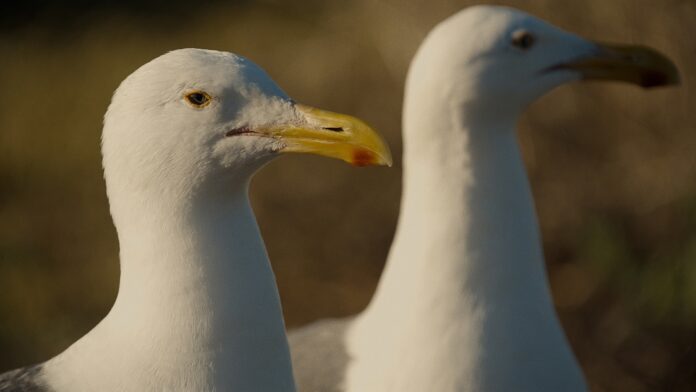
You probably haven’t listened the actual song of the lesbian seagull, as the sounds gulls make tend not to be melodious. But you may have heard the song about lesbian seagulls, an admiring ode to female gull couples, their flying and fishing abilities, and their nurturing and nesting instincts.
It flirted with American pop culture, if briefly, on late-night TV and in a cartoon, and even hit the top 40 in Australia and New Zealand. The story of the lesbian seagull has been mined for amusement, but it is not fictive or folly. It’s based in science—a finding that took place on a volcanic Californian island, as history would have it, while gay and lesbian humans went public to fight for liberation and validation. If conservatives decried homosexuality as unnatural, lesbian seagulls could care less, Not only did they exist, their families were more bountiful.
With lightness and grace, Elliott Kennerson and Angel Morris’s new documentary Love Birds explores all of this, and in the process reveals a more complex love story—that of George Hunt and Molly Warner, the biologists who discovered nesting pairs of female gulls in the early 1970s, and whose lives were turned upside-down by the national attention their discovery drew.
Love Birds, which screens at the Roxie Cinema Thu/19, is under Oscar consideration for Best Documentary Short Film, and has won 13 awards while screening at 40 film festivals since last year. I recently discussed the movie with Kennerson, who has received regional Emmys for his contributions to nature programs on public television.
48 HILLS Tell me about the roots of your love of film, love of nature, and how the two merged. Are there any aspects of your youth and upbringing that led you on this path?
ELLIOTT KENNERSON I grew up before cell phones or even the internet, so playtime was either TV, Atari, or wiffleball. I wasn’t a big-time outdoor kid. And I wanted to live in the city. I was also a theater kid, and for a long time I thought live performance was the real heroic artistic act. I still think that! But when I worked in TV in my first job out of college, I quickly saw the continuities between live performance and broadcast, which broke me into the idea of being a filmmaker.
I began engaging with nature later in life than most people who do these kinds of films. I had a bit of an early midlife crisis around 30 in NYC, and decided to move to Montana for natural history film school. It was exciting and even scary at that age to do things like hike and camp and ski for the first time. I look at nature with awe and reverence, the kind reserved for dangerous forces that also promise great joy. Now I surf, which is my constant check-in with nature and its generosity and power.
48 HILLS In one recent interview, you observe that comparatively there aren’t as many LGBTQ+ people working in the subset of environmental film. Does Love Birds have any kin as a nature film? Do you and Angel feel a particular sense of collaborative freedom as queer filmmakers?
ELLIOTT KENNERSON Natural history film has a long storytelling tradition of relying on human gender cliches when talking about animal reproduction. Myth and fable are some of its OG sources, so we still get a lot of Mama Bear and Papa Bear in the genre. I’m not against anthropomorphism, generally, except when it’s incorrect, and especially when it’s thoughtlessly deployed as gender modeling, particularly against young audiences. Lately, there’s been more attention on queerness in nature, with shows like Queer Planet (2023), Animal Pride (2025), and the film Second Nature (2026), which is narrated by Eliot Page.
Angel and I found each other at a small production company in San Diego while working on a national PBS series. We certainly gravitated to each other because we’re in the LGBTQ+ community. We’re also 20 years apart in age, from different generations, which has been an education for both of us. Yes, I do think we felt the license to tell this story the way we wanted to tell it. We had to work, somewhat, to draw our participants out of their scientific mindsets around what they’d accomplished and help them see how important it was to the history of LGBTQ+ liberation.
48 HILLS Love Birds is showing at the Roxie with an excerpt from the iconic San Francisco documentary The Wild Parrots of Telegraph Hill, and the post-screening Q&A will be moderated by that film’s director, Judy Irving. Is her work an inspiration?
ELLIOTT KENNERSON Yes. Wild Parrots came out the year, 2003, I started natural history film school, and the year I finished film school, 2009, I moved to San Francisco and set out to find her. She consented to meet me for lunch in North Beach, and we’ve been in contact off and on ever since. I’m so honored she accepted the invitation to do this Q&A! All of Judy’s films are about the ways humans and nature define each other, whether it’s through an emotional relationship like in Wild Parrots, or an environmental story like her early film Dark Circle, which won the Grand Prize for documentary at Sundance and a national Emmy in 1982.
When you make nature films, you always have to ask the question of how visible you’re going to let humans be in the frame. So much natural history pretends like you can cut people from the picture. Courageously, Judy doesn’t shy from their inseparability. Above all, I love her work for its focus on birds, one of my own favorite film subjects.
48 HILLS Though stylistically Wild Parrots and Love Birds are quite different, they share some elements, such as couples whose lives focus on birds. That a relationship bloomed between Irving and her human subject, Mark Bittner, is a big reveal at the end of her documentary. In contrast, you had to interview and collaborate with George Hunt and Molly Warner to tell the story of their relationship, which was impacted by sexism as it shifted from marriage to divorce/separation before returning as friendship. Was it a delicate process to depict this, and did you and/or them make any discoveries along the way?
ELLIOTT KENNERSON Angel and I set out to make quite a different film than what we eventually finished. We thought it would be a nice science-y film about the lesbian seagulls, with George in the role of expert—end of story. But when we approached him, George insisted right away that we include Molly. As it turned out, he does genuinely give her the credit she deserves for the discovery. The more we talked with both of them, the more the emotional lines of the story that predated and post-dated the finding, the story of their relationship, moved to the film’s center. As we built trust with them, we observed them complete their own processing of past events and see each other differently. And yes, it was a delicate process, in which both George and Molly were brave and generous with us.
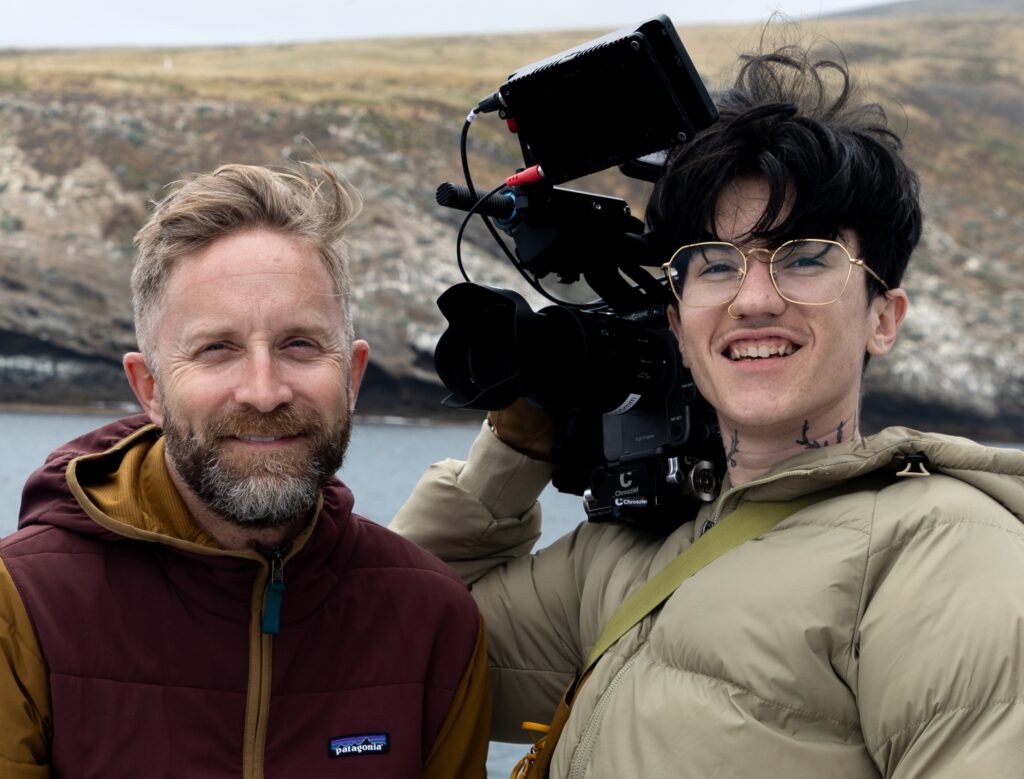
48 HILLS Molly says of George, “He started off as a bird guy. He’s still a bird guy.” Would you say bird-lovers or birdwatchers have any shared characteristics?
ELLIOTT KENNERSON People always ask me if I’m a birder myself. I’m not, really, but I do like people who are. So I’m not a birdwatcher, more of a birder-watcher! I love the way they are so focused on detail, when it comes to identification and taxonomies, and I love how much joy they experience in the pursuit. Most people like mammals because they can be cute and cuddly and look human. But birds are aliens, and definitely not so pet-able. I also admire how birders get such satisfaction from afar. They don’t need to own a living being in order to love it. That’s noble.
48 HILLS Are there any distinct facets to filming gulls, in relation to shooting footage of other birds?
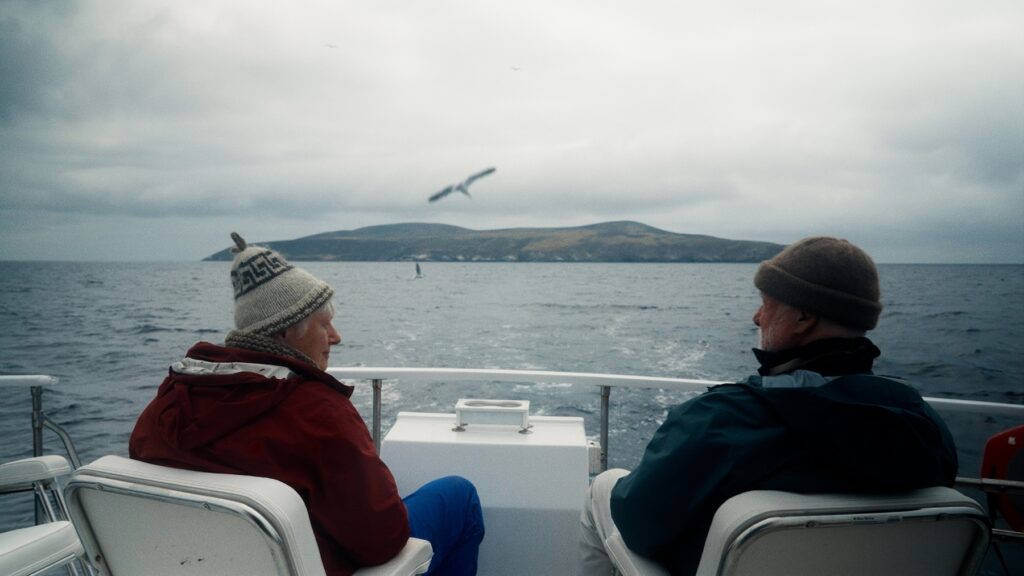
ELLIOTT KENNERSON We went to Santa Barbara Island during filming, but it was closed to the public because of the pelicans roosting there. So we filmed seagulls on Anacapa Island, which is less barren. You can get to Anacapa on a public ferry. It has a campground, but no running water, and a lighthouse that you can’t approach because it’s so loud that it can blow out your ears. We spent two nights amidst the island’s huge seagull colony, during breeding season. It was quite something to see the gulls on their own turf, rather than in their role of “rats with wings” in our world. They were confident, powerful, and outspoken, very much occupied with the business of growing the colony—a process full of violence, sexual promiscuity, and cannibalism—but united in their suspicion of us.
48 HILLS The presence and voice of the lesbian historian Lillian Faderman in the movie is a coup. She brings a liberation context to the lesbian seagull phenomenon within popular culture, which could have been treated glibly. I love her droll remark about lesbians “getting some attention finally.” How did you come to choose her as the main other voice besides those of George and Molly? Did she enjoy discussing the subject?
ELLIOTT KENNERSON Lillian is the author of several history books that are real page-turners on many topics of gay history, including 20th century lesbian life, a biography of Harvey Milk, and her great survey The Gay Revolution. But interviewing her wasn’t my first idea for how to give context to George and Molly’s discovery. I initially hoped that someone they knew back in the 1970s, someone gay or lesbian, would help us with that part of the film through their own recollections. There were several candidates, but I wasn’t getting what I thought we needed from the pre-interviews. None of their friends were, after all, historians!
At the same time, I was reading The Gay Revolution for my research. One day I went into a lesbian-owned bookstore in San Diego called Bluestocking to see if I could pick up some of Lillian’s other titles. As I was checking out, the shop owner casually remarked that Lillian lived in San Diego. She was, it turned out, easy to contact, willing to work with us, very conveniently located, and one hell of an interview. The conversation ranged widely: She was so much more knowledgeable than I could have ever dreamed, especially about the long history of science’s reticence to acknowledge homosexuality, which goes back to the Middle Ages. She was delighted to share, and a delight herself.
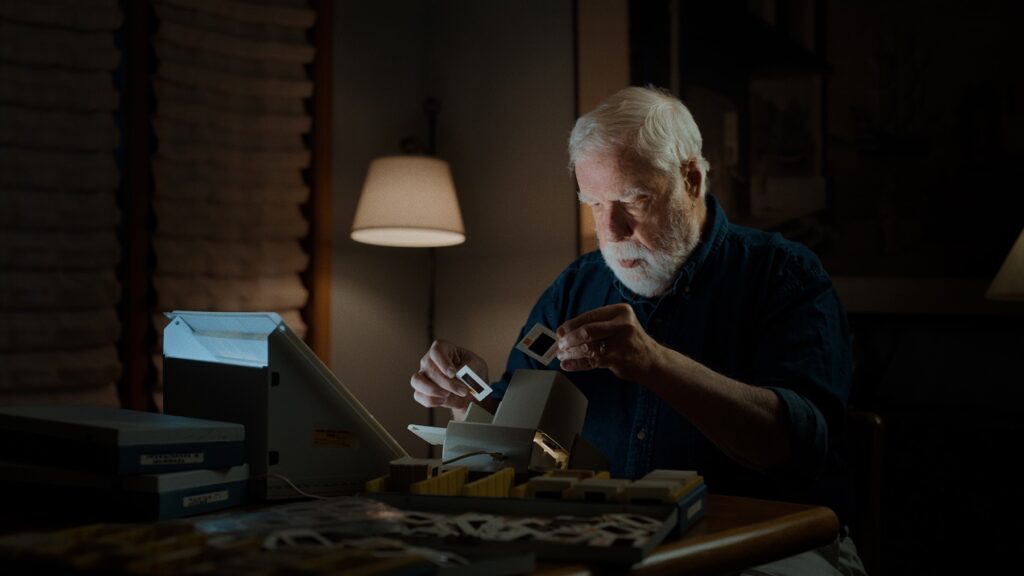
48 HILLS Something I appreciate about the movie is its emphasis on the physical presence of archival material—the sound and sheen of a Kodak Carousel 4200 slide projector for example, or the use of typewriters in creating captions and credits, There’s also a strong contrast between the old black-and-white photos of the nascent University of California Irvine’s corporate architecture, and the masculine narration of its newsreels, versus the film’s vintage and contemporary shots of Santa Barbara Island and its turbulent surrounding waters. It makes the difference between George’s and Molly’s paths palpable.
ELLIOTT KENNERSON I’m so glad you picked up on all of that. In an early cut, the island itself was much more of a character in the film. I break my documentary scripts into chapters, and the opening one was named for the guiding image that I held in my mind to help me with that characterization: “Paradise Island.” The reference, if anyone doesn’t know, is to the name of Wonder Woman’s home in the original 1970s television show. I wanted to characterize our seagulls’ island as a place where magical, mysterious, female things happened, far from the eyes of the world, and especially of men.
And as you noticed, the masculine manifests in the university setting, where all those men sit around inside bizarre fascistic buildings and anatomize the world. Luckily we found an early documentary about the founding of UC Irvine, a fascinating story unto itself, as well as behind-the-scenes footage of Planet of the Apes being filmed there, which is a near-perfect cultural document from exactly the right time period.
We wanted to give the viewer a richer sense of the time by using actual tech from the era and filming it—we call such shots “practicals” or “evocatives”—rather than taking the approach of going full-screen on all the archival material. Here again we lucked out: When we first began working with George, he let us know he had some slides. But he didn’t say they numbered in the thousands and encompassed not only his career but decades of his personal life. I borrowed the projector and the nifty tabletop slide viewer that makes those satisfying clicks from a friend whose family were also slide-takers.
48 HILLS Love Birds comes full circle, from David Letterman playing an excerpt from Tom Wilson Weinberg’s “Lesbian Seagull” on his TV show, at the film’s very beginning, to your own footage of Weinberg performing the song, at the end. What was it like to meet and work with him?
ELLIOTT KENNERSON I first heard Tom Wilson Weinberg’s song “Lesbian Seagull” when it was used as a joke in the Beavis and Butthead movie that came out in the 1990s. When the Beavis and Butthead creators used the song, which they re-recorded with Englebert Humperdinck, they didn’t ask Tom permission. We decided not to go that route.
Tom was a bit hard to track down, but it turns out he still plays cabaret on the regular in Provincetown, Mass. He was delighted at our interest and generously agreed to perform the song live for us, which we filmed in Ptown’s Unitarian Universalist Church. The original score pulls in motifs from the song as well. My dream for the next phase of Love Birds isn’t to make the Hollywood movie about George and Molly, but to make the Broadway musical of their story, with Tom’s song as its heart. I also see actors in full-size seagull costumes dancing across the stage.
48 HILLS One of the last captions in Love Birds says, “Today, scientists have identified homosexual behavior in hundreds of species.” Do you have any future film plans that intersect with that fact?
ELLIOTT KENNERSON If I ever decide to make another film about gay animals, luckily we have a great resource in the book Biological Exuberance, edited by Bruce Bagemihl, which compiles most if not all of the scientific papers about homosexuality in nature up to its publication in 1999. I think we are due for a volume two of that particular resource!
LOVE BIRDS. Thu/19, 4pm. Roxie Theater, SF. www.roxie.com.