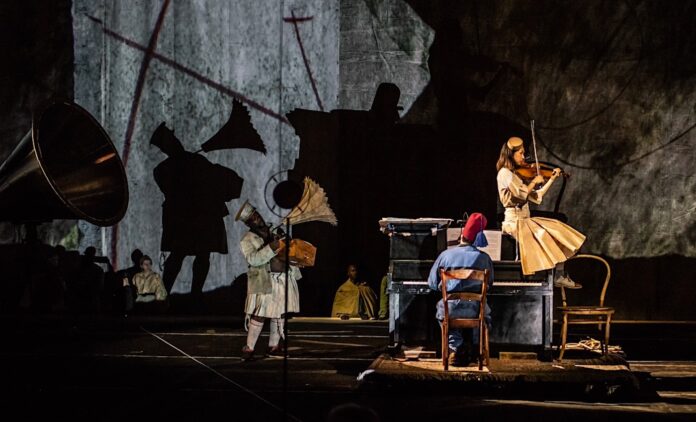
Whether speaking with South African artist William Kentridge across continents and oceans in 2023 about Sybil, or this week—from locations mere miles apart in the East Bay—about the West Coast premiere of The Head & The Load (Thu/12-Sun/15, Henry J. Kaiser Center for the Arts, Oakland), geographical distances dissolve. Kentridge’s vibrant energy, roving intellect, and immediate eloquence march across any borders; his visceral phrases land like nearby thunderclaps.
The Head & The Load premiered in 2018 at the Tate Modern’s Turbine Hall in London, and had its only US performances at New York City’s Park Avenue Armory later the same year. As part of his five-year residency at Cal Performances, it follows Sybil and The Great Yes, The Great No (2025). The 90-minute production draws its title from a Ghanian proverb: “The head and the load are the troubles of the neck.”
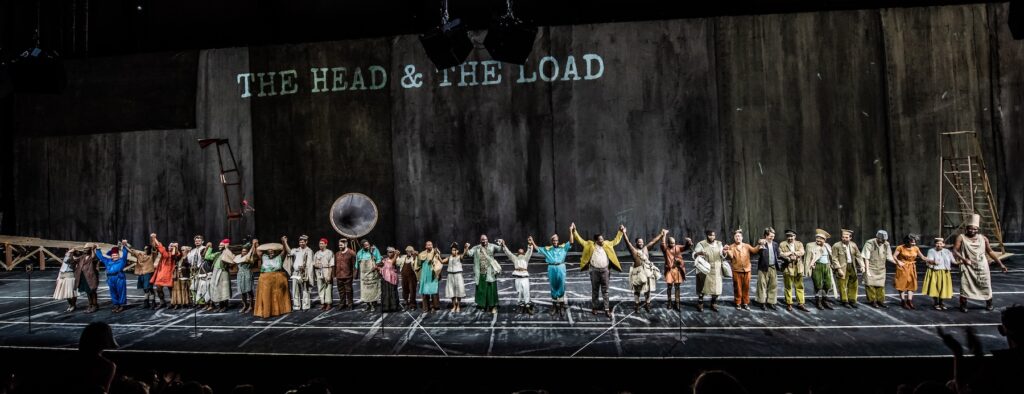
Like his other acclaimed works, it is art of monumental scale, with dance, projection, speech, song, shadow play, costumes, and music coming together in a grand and affecting spectacle that addresses history, colonialism, race, and much more.
In this case, Kentridge and his creative team (including composers Philip Miller and Thuthuka Sibisi) use their tools to tell the largely untold story of more than two million Africans who worked, fought, risked their lives, or actually died in World War I. Traditional traditional African songs intermingle with World War I-era avant-garde European works by Hindemith and Schoenberg, texts by Dada poets and anticolonial authors in multiple languages merge.
The production is so massive it exceeded the enormous size of Zellerbach Hall, presenter Cal Performances’ usual venue. Which explains why it’s being presented on an immense 180-foot stage, specially constructed at the Kaiser Center’s arena. Kentridge spoke to 48 Hills about the undertaking from a 16th-floor hotel room overlooking the Oakland harbor.
48 HILLS The Head & The Load has been described as a historical pageant, but so much of this era, especially in terms of its African participants, has been forgotten, or obscured. I’m interested in your thoughts on historical ignorance as a form of deliberate construction. Is it constant throughout history, or something that rises and falls during certain eras?
WILLIAM KENTRIDGE There are different kinds of (historical) ignorance. The one that I’m sure persists is the deliberate hiding of facts. The [Nazi] Germans attempt to blow up the crematoria to not let people know what had been done there, as an extreme example. The English colonial administrators said specifically, lest their deeds merit recognition, that their actions should not be recorded, with reference to African soldiers in the First World War. So those are very deliberate acts of saying we need to not have this information out in the public, either because we’re ashamed of it or because it doesn’t coincide with our understanding of ourselves.
A second one is through ignoring or obliterating people’s presences, in the sense of saying we don’t need African soldiers to take part in the 1919 victory parade because they were not important in the war. Or saying there’s no real need to put up memorials with the names of Black people who were killed in the war, unlike every English village, again, because we don’t value these names the same.
And there’s this ignorance of not putting facts together, of knowing different facts but keeping them in separate compartments. World War I, the trenches, the English war poets, and then knowing about Lawrence of Arabia at the corner of the war in the Middle East, but never really putting these together. Even knowing about what was happening in Southern Africa in the First World War.
And then there’s that of knowing all these different things, but still being drawn by the romance of one to the exclusion of the other. Endless films and stories of the trenches in the Western Front become the whole of the First World War. I think similar things are very likely to have occurred. There’s always particular heroic stories told of particular wars or battles. We like to bring a huge social conflict down to an individual.
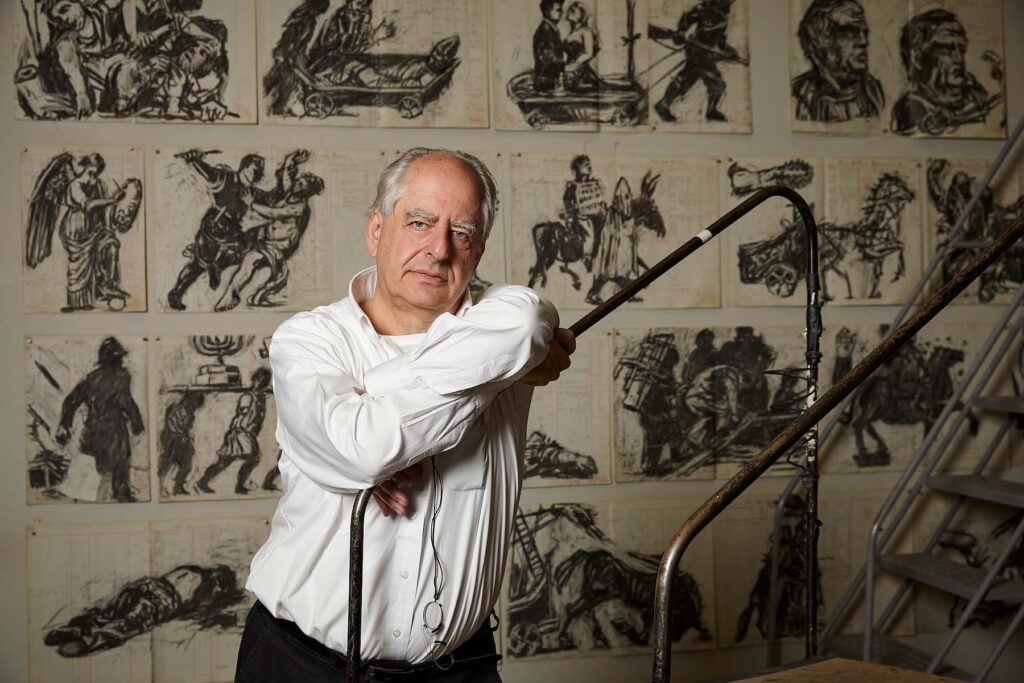
48 HILLS In what ways did you explore this idea of intentional “blindness” in The Head & the Load? What questions do you ask about the role humans play in shaping history, including its distortions and exclusions?
WILLIAM KENTRIDGE What way does ignorance disrupt political, social, cultural, and modern intentional blight? Sometimes in the play we quote directly from the Wilfred Owen poem “Anthem for Doomed Youth”—one of the most well-known in the English-speaking world from poems about the First World War—which kind of takes the place of so much other knowledge.
One’s brain is filled with this and similar poems to exclusion of other stories. So we tried it in different ways. We translated it into bad French, as if being recited by a French gunnery officer who vaguely remembers the cadence and the words. It goes on like this, getting less and less coherent. So that’s one way of disrupting those. But I think also the way the performance is fragmentary, we go through different fragments, and from these fragments, the audience is invited to construct a kind of coherent image of Africa in the First World War, the couriers in the First World War, without being given a clear route map or a clear lecture.
At one point I was interested in making a lecture to put in the middle of the opera, and I was shouted down by all the other people working on it, saying, you’ve done all this work to try to not have to have a simple lecture to tell the story. Let’s have confidence in our way of working. I acceded to their good wisdom.
48 HILLS How did you select specific images, text, or music as most effective for conveying a given message?
WILLIAM KENTRIDGE Here I think you’ve got the question completely back to front. We don’t start with a specific question and say, how do we best illustrate it? We work in the absolutely opposite direction. We say we have an 85-foot stage. What would we like to put on the stage? Let’s put something that’s military because it’s in an armory. It has to relate to Africa because I know there will be African performers from Johannesburg taking part. So the war and Africa, and let’s then look at the First World War.
We go from that way outward so that when the piece is done, we say what are the questions it raises, not how do we illustrate our known answers to these questions we have in advance. The whole making of the piece is the exploration, discovering our own ignorances, fighting against those ignorances, and discovering the questions we should have known at the beginning.
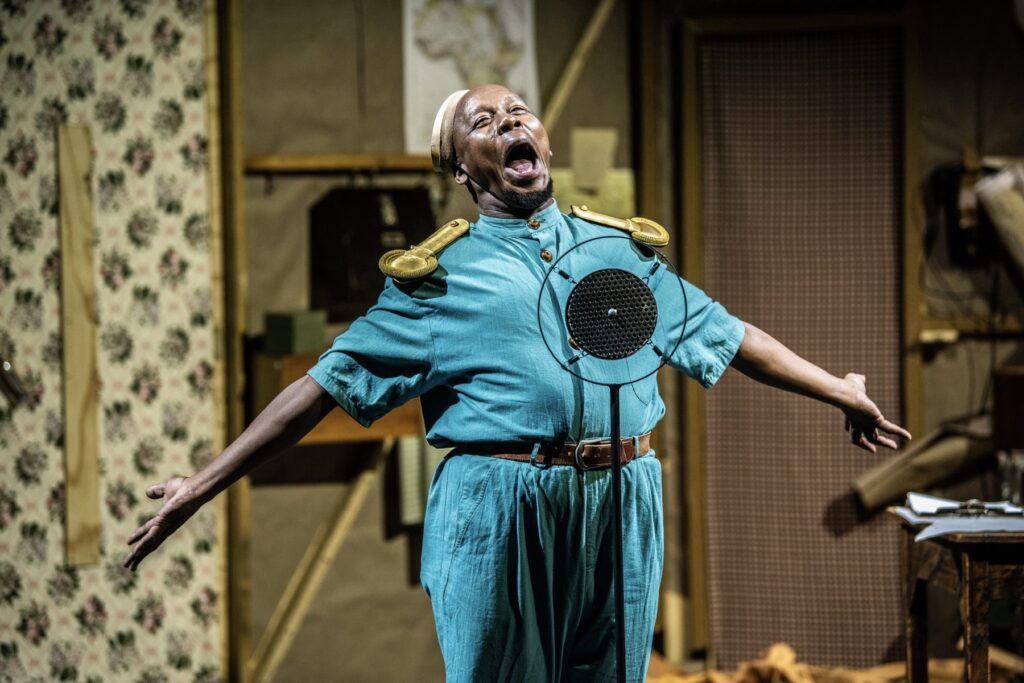
48 HILLS Was the exclusion of Africans from citizenship after the war among those questions you “should have known at the beginning“?
WILLIAM KENTRIDGE The thing that was most egregious is that people expected they would become citizens when they’d shown their devotion to Englishness or Frenchness. That the French or the English would recognize them as citizens—and they absolutely didn’t. In South Africa, people who were really too willing to give up their lives for this idea of being part of the British Commonwealth ended up being given a bicycle or an overcoat.
But the paradoxes are what’s strange, because even with that as a slap in the face, there are people in our company who remember their grandfather’s overcoat as being a thing of extreme preciousness, not to be touched by anyone else, because that was shown he’d been in the Great War. So I think it was the paradoxes that interested me most. The conflict between African leaders who said this is not a war for us, this is a war for Europeans, we should have nothing to do with it, and other leaders who said, no, we want to take part in this war so we can show you we’re part of France or Britain, and we demand the right to offer our harvest of devotion, as they put it.
And then we discovered this theme when we were working with movement workshops, trying to get the conflict between wanting to go and not wanting to go. It was an exercise of two dancers, of trying to salute and not being able to, something in them that resists the military and something that wants the military. And that we found a physical spasm of the body that kind of reflects a spasm of history. That was a key moment for us in unlocking the emotional heart of the piece.
48 HILLS In regards to developing the score, tell me about this emotional discovery and how it flowed or transcribed itself from choreographed movement to music and sound.
WILLIAM KENTRIDGE The very first day of working on the music of the piece, we met with a group of musicians called the Knights in New York. We said we were working on this military piece, and we experimented. We said, could we make the sound of a machine gun with a bow on a double bass? Could we get the hiss of the gramophone record going round and round when the needle’s finished tracking the melody? How do we make the sound of tinnitus? So these are the questions we played with rather than thinking what’s a big melodic theme to go through the piece.
And then we said, what are pieces of modernist European music that were being written at the time of the First World War? What was the kind of music in Africa at the time of the First World War? And pulled different strains out, and the composers then wrote music around this.
48 HILLS When this work premiered in 2018, Russia had not invaded Ukraine, the war in Gaza had not started. Are there ways in which viewing this work about war is now changed?
WILLIAM KENTRIDGE The piece itself is formed. The projections aren’t adjusted. The actors will be on the same stage. There are some new performers each time we perform it because it’s a large cast and there’s obviously attrition. But the piece is essentially the same. If it looks different, all that one can say is that the people looking at it have changed, and that things you didn’t notice first time around eight years ago are much more present now.
So, post-Gaza, post-Ukraine. There was somebody who came up to me and said, this is the most powerful anti-war play I’ve seen. I said, that’s interesting because not once in the 18 months of making the piece was the term anti-war ever mentioned by anyone in any of the workshops in any context. The piece relies on the associations that its audience brings to it for its full richness to emerge and to exist in its fullest form.
48 HILLS The last time we spoke, you mentioned the difficulty of holding onto your first impulse. How did you hang onto your first impulses in The Head & The Load?
WILLIAM KENTRIDGE Well, the first impulse in this piece, the first question, was how do we deal with the 180-foot stage? And then I remembered that we’d just finished doing a processional piece in Rome that went across a 1500-foot stage, a 500-meter stage. And so I said, oh, we could do this just as a kind of miniature procession, a military procession across this very wide stage. And that was the starting point that we hung on to.
But as we did it, we realized that however slowly people walked, at whatever dead speed they moved, the procession across a 180-foot stage was going to take five minutes. And what were we going to do for the other 85? So the founding image of this procession across the stage, procession to war, gradually shrunk and was fragmented, and it becomes one moment, an important moment, in the center of the piece, but it’s by no means the whole piece. If that was the whole piece, it would be very, very thin. But hopefully it still has an important role.
Sometimes the founding impulse has to be abandoned. You discover all the other things you’ve needed to support it become more interesting. In this case, that first impulse of the procession, the military procession, or procession of the carriers across the stage, is still there.
CAL PERFORMANCES PRESENTS WILLIAM KENTRIDGE’S THE HEAD & THE LOAD Thu/12-Sun/15, Henry J. Kaiser Center for the Arts, Oakland. More info here.