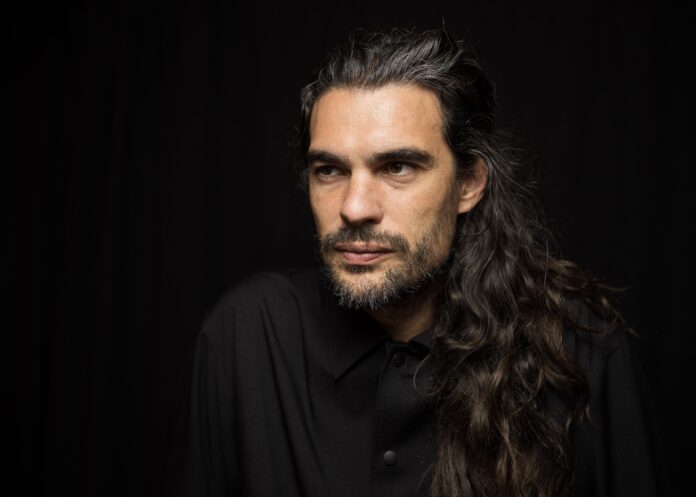
“In cinema, the proportion of images and sounds can be an esoteric weapon. No matter the viewer’s cultural background, if the images and sounds have the right proportions, they can penetrate the human metabolism,” reveals Paris-born Galician filmmaker and true mystic Oliver Laxe. (Warning: some spoilers ahead.)
Winner of the Jury Prize at the 78th Cannes Film Festival last year and nominated for Best International Feature and Best Sound at the 98th Academy Awards last month, Laxe’s latest feature, Sirât (opening Fri/20), ominously begins with an epigram from Arabic scripture. It reads: “The Sirât bridge connects paradise and hell. Whoever ventures across must know its path is narrower than a strand of hair and sharper than a sword.”
Taken from Islamic eschatology, sirât—or “path”—evokes the metaphysical journey that the film’s protagonist, Luis, embarks on as he and his son arrive at a free party movement-esque rave in the scorched southern Moroccan desert in search of his missing daughter. The father-son duo traverses the sleepless affairs in the barren, blazing wilderness, accompanied by a motley crew of misfit ravers and a pulsating techno soundtrack by David “Kangding Ray” Letellier. The atmosphere evoked is raw, jagged, and unbound by convention, making for one of the most fascinating releases of recent years.
Drawing on transcendental cinema influences like Bresson, Kiarostami, and Tarkovsky as well as Laxe’s own practices in Islamic Sufism and Gestalt psychotherapy, Sirât successfully adapts esoteric concepts for a popular audience—while resisting the current tidal wave of “Netflix-ified” didactic filmmaking. Laxe, a lasting believer in the inherent power of movies, says “We’re in a time when (corporations) have a strong influence on cinema. But we have to remember the specific, genuine tools that cinema has to evoke things, to shake the spectator, to transform them.”
Unsurprisingly, when asked about his thoughts regarding artificial intelligence in the artistic process, he’s quite indifferent. Taking the position of a staunch humanist, he says, “I’m not really interested in AI. It’s not that I am against it, but I don’t care much about it. I know that a poem will only be a poem when it is made by a human being. Imagine a point where someone is talking about his pain, his fragility. It doesn’t have the same effect if he’s just a machine making it. Someone can only feel things if he is real. So I’m not worried.”
While it feels blasphemous to ask such a visceral filmmaker like Laxe about AI, it seems unavoidable to address, given that the film is making its Bay Area theatrical opening this week in the tech hub that is San Francisco. But he confidently concludes, “I radically believe in the soul. So what has no soul, I don’t care about.”
San Francisco also has deep, historical roots in political protest and action. Similar to people outside the screen, the film’s ravers’ lives of dancing and rituals are periodically interrupted by radio broadcasts of a fictional war and looming threats of apocalypse. To the characters’ real-life counterparts listening to the real-life wars and atrocities on their devices who are wondering what to do in response, Laxe says, “What I hear from my masters is that we don’t have to do much. We just have to go to the countryside—to live, to listen, to whisper, to worship, to pray—and to wait for the system to shift.”
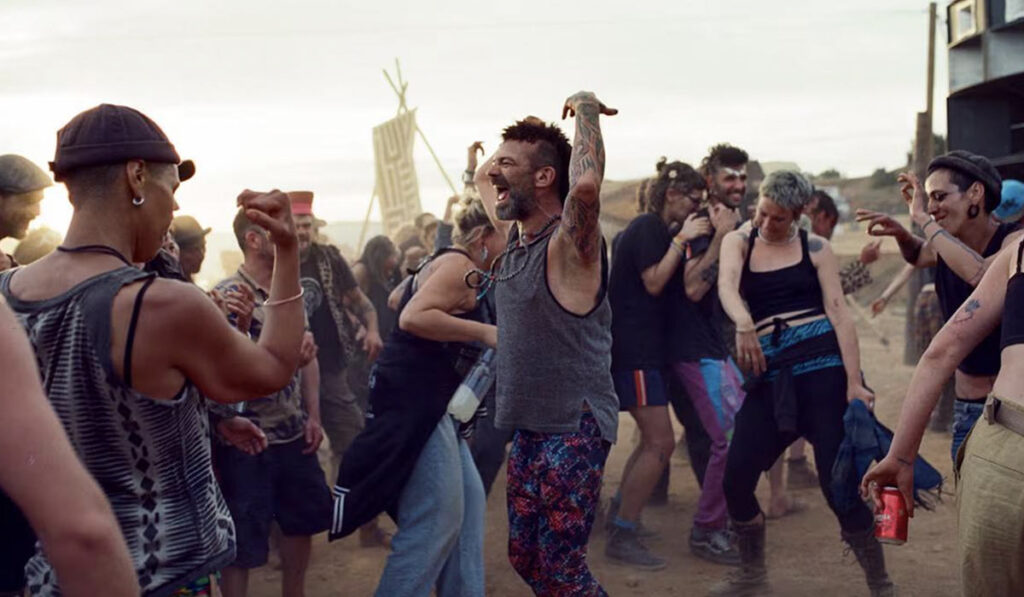
He further relates his answer to the film’s characters as he continues, “I think about what ravers are doing, and what the characters in Sirât do, too. They just turn off the radio, you know? Because why listen to the same song again and again and again? They know, and we know, that this kind of worry isn’t sustainable. We know the world has to change, and it will change. So we’re waiting.”

And yet, Laxe rejects outright escapism. He explains that no, the ravers are not fleeing reality when they turn off the radio to dance. He clarifies that “We don’t have to escape. It’s just better not to connect too much to social media, to the news, you know? There’s nothing new we can really learn. We already know everything. So it’s not escapism. It’s more like trying not to be trapped inside this dualistic, dialectical world.”
Far more important amid the threat of impending catastrophe is the importance of love and service to one another. “Everybody has to serve in their own way. That’s one of the most powerful weapons: to love sincerely, to take care, to serve, to do everything as if it were an art form… Doing it with your heart—this is the way,” he proclaims. In the end, he emphasizes that “We have to be in this world. It’s a difficult balance where we have to be engaged and connected, but we also have to take care of ourselves and be protected, too.”
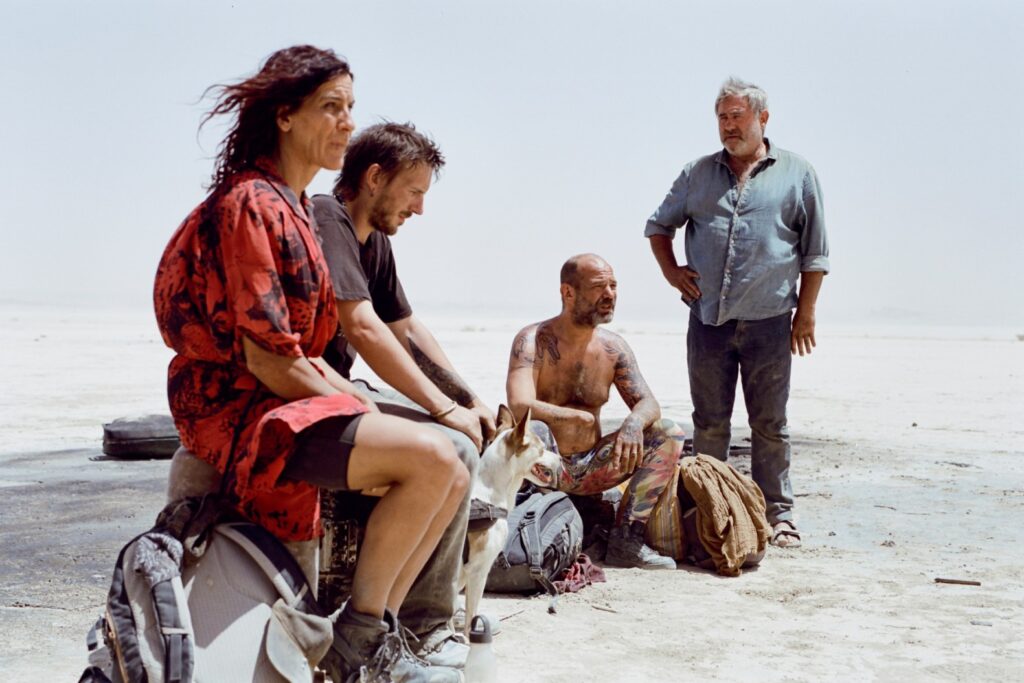
When the question of the “colonial gaze” arises concerning the film’s premise of European characters seeking transcendence in the African Sahara, Laxe gets pensive: “The desert doesn’t know about floods and the divine doesn’t know about countries, you know? So I think these ravers have a sincere interest in (the land). They speak in Arabic, and they know a few words in Arabic. Tell me, how many people learn the language of the countries they visit today? Not many.”
When the characters of Sirât suffer in the desert, it’s nothing to do with their nationality—it’s just the way life tests people. “I think the characters in Sirât die with dignity. The last thing they’re doing before dying is something connected to their values, not their ego. So, yeah, they’re not escaping. Life isn’t judging them or making them pay for something. It’s just the way life has to test you.”
Staying on the topic of how life tests people in both the film and mundane reality, Laxe declares that “Everything is a sirât—everything is a path. Everything that happens in your life is a test. Obviously, this is a film, you know, so it’s an allegory, and it’s a tale… It’s about the decisions you have to make in life. And the question is: When we have to make decisions, are we connected to our ego, or are we connected to our essence—or both? And what are the proportions: more toward essence, or more toward ego?”
“So in a way,” he observes, “we are pushed more and more to look inside. It is the only political and countercultural solution that we have—to look inside, no matter what you are doing. And also because having a normal life is the most mature way of living, too. I mean, I’m just a filmmaker—an artist—so that means I’m someone really connected to my ego. So I’m not certified to give this kind of advice to people,” he adds.
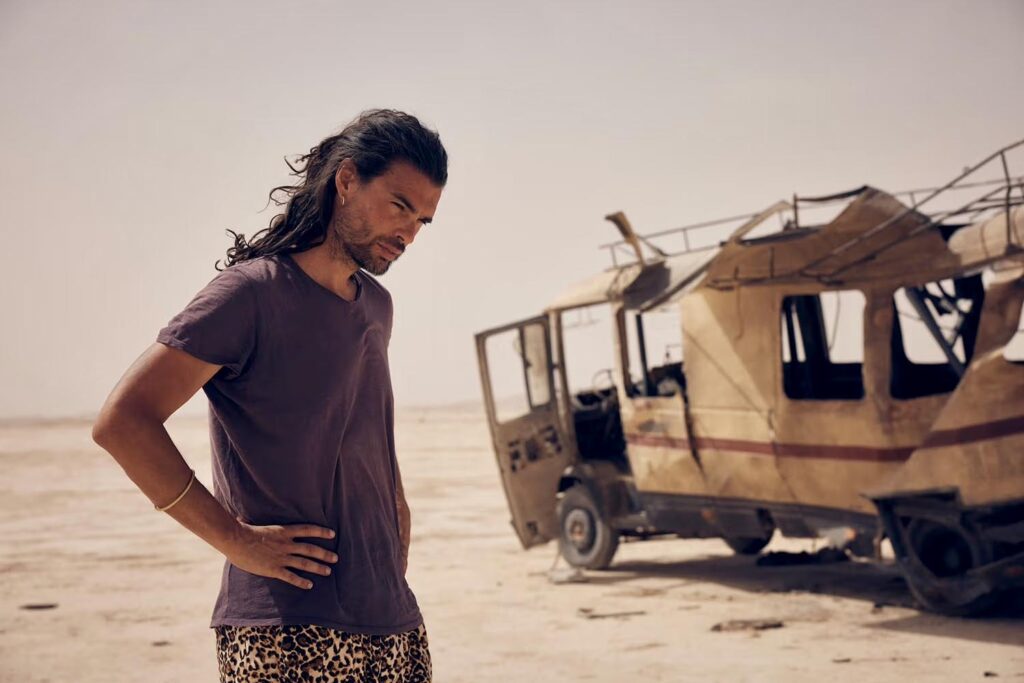
“The only thing I can do is, through my work, to push people to look inside.” Laxe says that the key audience takeaway from Sirât is the importance of introspection and self-awareness—the idea that “when people know themselves, they become more free. It’s as simple as that.” He further reflects, “When you make a film, you know yourself, right? You know who you are, and it’s tough.”
Asked about his thoughts on San Francisco’s evolution from a place of radical creativity and individuality to one of sterile, technological optimization, Laxe takes a thoughtful pause. After a moment, he breaks the silence. “I want to say it’s strange—San Francisco was once really a place for spirituality. I’m very influenced by the work done here in the ’60s and ’70s: what Stanislav Grof did with LSD psychotherapy and holotropic breathing, the work of Claudio Naranjo and Oscar Ichazo with the Enneagram, the use of psychedelics in psychotherapy and the work of Gestalt therapy with Fritz Perls. I don’t know what it is now, but in the ’70s it was a place of light.”
He continues, “Now it’s true, it’s becoming a little bit ‘zeros and ones,’ with this new god—technology. And we’re questioning people’s taste: Can they tell the difference between what’s true and what’s fake? Sometimes we get so used to eating bad bread with sugar that it becomes hard to taste anything else.”
But ultimately, Laxe remains hopeful of the future for the arts, San Francisco, and humanity at large. “But that’s one of the good news of Sirât, which is that everybody feels something. People are shaken by it. So we have to trust people more—people are really, really sensitive. These times are difficult, but they will pass, hopefully,” he earnestly confides. “We artists have to give good news. Today, more than ever.”
SIRÂT opens Fri/20 at AMC Kabuki, SF, and February 27 at Rialto Cinemas Elmwood, Berkeley; AMC Bay Street 16, Emeryville; Smith Rafael Film Center, San Rafael.