Our government may currently be actively attacking or rattling its sabres at seemingly half the world, but here in the Bay Area we still cling to notions of achieving cultural understanding between nations, rather than the philosophy of “bombs away.” This week brings another slew of events celebrating international cinema, from returning annual festivals to one-off retrospective screenings.
This weekend sees the start of the 23rd San Francisco Greek Film Festival, which since 2004 has provided a local showcase for new screen work from the “cradle of Western civilization” still most associated with its contributions to arts and ideas in the ancient world. This latest edition brings together eight fictive features, sixteen documentaries of various length, and nine narrative shorts. The opening night selection on Sat/14 is Yannis Economides’ Broken Vein, a taut suspense drama about a businessman whose financial straits drive him to some extreme, and disastrous, decisions. Eight days later on Sat/21 the fest closes with another, albeit less lethal, tale of economic duress: Amerissa Basta’s Life In A Beat has as its protagonist a 20-year-old Athenian desperate to move out of her quarrelsome family’s cramped flat, only to discover she’s being downsized out of the supermarket job she’d hoped would fund her independence. Both nights will feature a post-screening reception, and filmmaking talent in person.
Other highlights include two features of LGBTQI+ interest, mock-doc The Great Massacre of Alimos and Sapphic romance Bearcave; two seriocomedies about middle-aged heroines ignoring their titles’ advice, Smaragda: I Got Thick Skin and I Can’t Jump and Don’t Laugh, They’ll See You; and Rooster, in which a not-so-humble janitor determines nothing will stop him from enrolling his 6-year-old son in an elite private school. The majority of the festival’s nonfiction content will be accessible online, including films about female mountaineers (7 Summits), a 90-year-old ceramicist (Valentinos), the Greek Civil War (White Mountains), a world-class long distance runner (Karibu), modern Greek paganism (True to Our Inner Daemon), and more. The in-person shows March 14-21 all take place at SF’s Delancey Screening Room. For more info on that schedule, and the on/off-line program in general, go here.
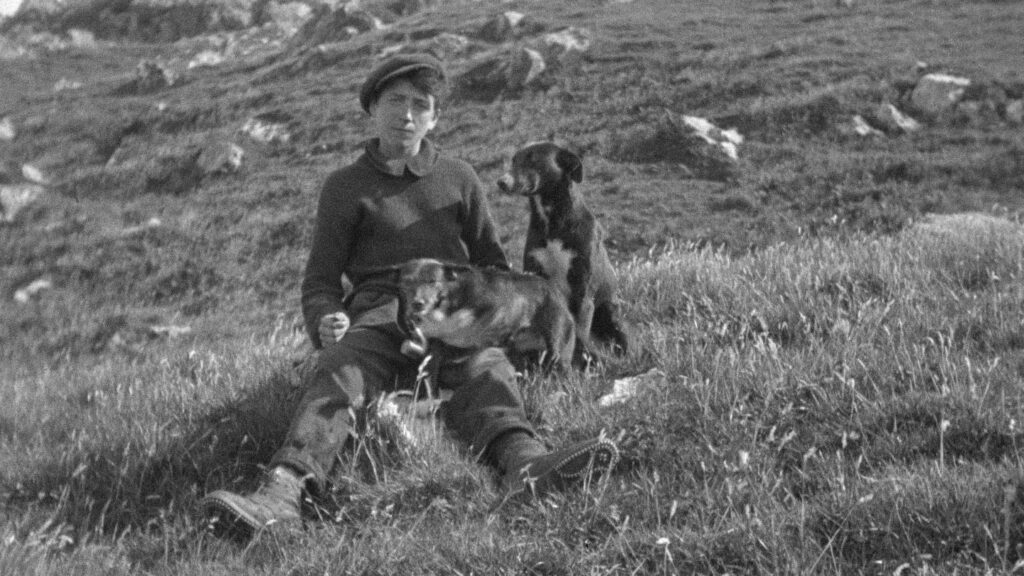
Another nation famed for coastline and culture will enjoy a look backward at the Roxie Thu/12 with the San Francisco Film Preserve and Consulate General of Ireland’s co-presentation of “Early Irish Films.” These recently restored silent-era rarities, companied live by traditional musicians Cormac Gannon and Kyle Alden, offer a glimpse of the “Emerald Isle” in the medium’s infancy. 1912 narrative short You Remember Ellen, adapted from “national bard” Thomas More’s poem, portrays a farming lass from a “lowly shed” who casts her lot in marriage to a well-mannered apparent hobo. (Surprise! It turns out he’s a nobleman in disguise, complete with ancestral castle.) Canadian-born, U.S.-based Sidney Olcott was one of the most successful early film directors, notable especially for his location shooting—he made numerous projects in County Kerry before WW1 broke out.
That is also one among several settings explored in “The Gault Collection,” a series of ethnographic miniatures 1925-26 by ornithologist Benjamin True Gault. In addition to capturing regional aviary life, his fine camera eye caught street scenes in urban Cork, horse races, hunts, country dances, potato harvesting, and so forth. The occasional automobile aside, these hundred-year-old vignettes could be mistaken for the 19th or 18th century. More info on the program is here.
Turning from the silent to the sonic, Berkeley’s BAMPFA is commencing this week a short series entitled “Impulses and Abstractions: Sound and Music in 1960s French Cinema.” The practitioners of the Nouvelle Vague wanted to break free of all staid prior commercial conventions, their innovations extending beyond the narrative and visual to encompass deliberately fragmented sound editing and utilization of more daringly modern composers. Among the latter were Francis Seyrig’s contribution to Alain Resnais’ 1961 Last Year at Marienbad (which opens the series this Sat/14), Pierre Barbaud’s for the same director’s stylish 1957 industrial short Le chant du styrene, and Michel Legrand’s mix of songs and instrumental music on Agnes Varda’s 1962 Cleo from 5 to 7.
Also on the “Modest of Cinematic Sound: Short Films” bill (with Styrene) on Fri/20 are experiments by Jean Mitry (1951’s tone poem Images pour Debussy) and Chris Marker (the famous 1962 sci-fi abstraction La jetee), plus Jacques Panijel’s little-seen October in Paris, a 70-minute documentary indictment of the violence visited on emigres during Algeria’s fight for independence from France. The interviewees’ testimonies of police targeting and brutal abuse, not excluding torture, are all too eerily reminiscent of today’s ICE abduction stories.
Finally, the series ends on Sun/29 with an almost equally rare title, Jacques Rivette’s first feature Paris Belongs To Us/Paris Nous Appartient—which might be more widely regarded as a pioneering New Wave milestone had it not taken three years to be released after filming ended. Its cryptic mystery involves a small theater group, possible murders and suicides, and hints of a “worldwide conspiracy” tying all that and more together. Typically for Rivette, however, this paranoid scenario is not propelled by onscreen action or violence, but young people talking in nondescript apartments. The score by Philippe Arthuys in collaboration with Ivo Malec, with guitar by Jean Borredon, is among its most assertive stylistic elements. Info on the whole Impulses and Abstractions series, running March 14-29, is here.
Casting a wider geographic net is the Cinequest Film & Creativity Festival, the South Bay’s largest and oldest such affair, which has been operating since 1990. Cinequest recognized immediately that it was operating in the heart of Silicon Valley, reaching out to engage the tech community in various ways from the start. But the principal emphasis remains on plain old movies, heavy on indie U.S. features but also encompassing new work from around the world, including full-length, short, documentary, narrative, animation, comedies, thrillers, et al.
There’s also customarily a single silent-era classic: This time (on Fri/13 at the California Theatre, a restored 1927 movie palace in downtown San Jose) it’s the original 1925 Ben-Hur, an epic whose troubled production nearly sank then-new studio MGM before becoming one of the biggest hits of the decade. Dennis James will accompany the 155-minute spectacle on the Mighty Wurlitzer. This year’s in-person Maverick Spirit Award winners will be actors Steve Zahn (who co-stars with daughter Audrey and Ethan Hawke in Rick Gomez’s She Dances, which he also co-wrote) on Sat/14, and Viveca A. Fox (whose new crime drama Plan C from writer-director Scott Anthony Cavalheiro world-premieres here). Both tribute-screenings take place on Sat/14 at the California.
The closing night features on Sun/22 are Steven Soderbergh’s art-world satire The Christophers, with Ian McKellan and Michaela Coel, and Maddie’s Secret from comedian turned writer/director/star John Early. Already in progress as of Tues/10, Cinequest runs through March 22 at various venues in San Jose and Mountain View. For full schedule/program info, go here.
Brief takes on some new films opening in regular theaters this weekend:
My Father’s Shadow
This dynamic first feature from Akinola Davies Jr. is set in 1993 Nigeria, when the first presidential election was held since the military coup of a decade prior. Most people are excited over the possibility of a new, less repressive regime—but they underestimate the determination and violence with which extant powers might resist any such changeover. However, those concerns are a remote abstraction to Akin (Godwin Chiemerie Egbo) and Remi (Chibuike Marvellous Egbo), the grade-school-aged sons of Folarin (Sope Dirisu). They are thrilled to find him back in their village, then dismayed to realize he’s leaving almost immediately again. (Their mother barely reacts, suggesting she’s become accustomed to a mostly-absentee husband.)
As the boys are desperate for time with dad, he reluctantly agrees to bring them along on a short trip back to Lagos—where his primary mission is to collect the wages he hasn’t been paid for six months now. But the journey itself becomes something of an ordeal, and once in the bustling city, the lads discover some surprising things about their parent’s “other life.” Those revelations will fade into the background, however, once the election results trigger riots and military violence this trio will be lucky to survive.
Davies Jr. takes occasional stylistic gambles that don’t quite work. But those are minor flaws—for the most part, My Father’s Shadow has a mix of propulsion and intimacy that is striking as well as involving. The father-sons dynamic might remind you a bit of the Mahershala Ali scenes in Moonlight, with their surprising paternal tenderness from an outwardly tough character. And Dirisu, a British actor of Nigerian heritage who’s hitherto best known for TV work (Gangs of London, Slow Horses), has magnetism to burn—he carries the film with the ease of a natural-born star. It opens Fri/13 at SF’s Roxie Theater.
Documentary Portraits: Andre Ricciardi, Billy Preston
Two late, larger-than-life figures get memorialized in new nonfiction features. Tony Benna’s Andre Is An Idiot is about a Bay Area advertising whiz and artist whose past “complex relationships with drugs and alcohol” turn out to be but minor, debatable missteps beside what emerges as his biggest mistake: Not getting a colonoscopy at age 50, because he has an aversion to doctors (and cops).
A year later, he’s diagnosed with Stage 4 cancer. Andre Ricciardi is a relentless class-clown type disinclined to take that dire news with any more seriousness than he’s applied to anything else so far. He married his wife so she could get a green card; they appeared on The Newlywed Game, and then fell in love. He is friends with Tommy Chong, who is seen here—along with stop-motion animation and other antic elements. A Sundance prize-winner, this autobiographical memorial celebrates its subject’s idiosyncrasies to a degree that may irk as well as charm some viewers. But as Sinatra once sang, there is no question: Andre Ricciardi did it his way. The film opens Fri/13 at SF’s Roxie and the Smith Rafael Film Center in Marin.
Another extroverted personality—at least in performance—is paid tribute in Paris Barclay’s Billy Preston: That’s the Way God Planned It. Preston was a keyboard prodigy from age 3 who was raised in Los Angeles’ remarkable 1950s African-American gospel music community. At twelve he was appearing with Nat King Cole on TV and in the movie St. Louis Blues; at 15 he was backing Little Richard on tour in Europe. That was when he met the then-unknown Beatles, an opening act in Hamburg. When he re-encountered them in 1969, near their breakup point, he proved such an asset in the studio he was dubbed “the fifth Beatle,” playing on both Abbey Road and Let It Be. He was featured in George Harrison’s all-star Concert for Bangladesh; had a lengthy recording and concert run with the Rolling Stones; further collaborated with everyone from Ray Charles to Streisand, Clapton, Patti LaBelle and many, many more.
The starriest of side-men, Preston also released a couple dozen albums as a solo act, scoring some hits (notably early 1970s chart-toppers “Will It Go Round in Circles” and “”Nothing From Nothing”). But as he bounced from label to label, that career never quite stabilized, and eventually he proved his own worst enemy—there were drug and alcohol problems, tax woes, prosecutions for insurance fraud, DUI, sexual assault, and so forth. He remained an effortlessly charismatic presence onstage, yet the offstage reality kept getting darker.
Veteran TV and music video director/producer Barclay suggests that Preston was forever undermined by dueling impulses. He was a closeted gay man schooled by the don’t-ask-don’t-tell gospel world, where homosexuality was much present yet publicly condemned. His ebullient personality hid a self-destructive streak, scarred by apparent childhood sexual abuse. He was never forthcoming about those or any other private issues during his life, so there’s a lot of Monday-morning-quarterbacking from various interviewees here.
But That’s the Way God Planned It is well worth seeing for the incredible range and quality of archival musical performances, which span decades and myriad styles—Preston could seemingly make himself at home in any genre. The film plays Sat/14 at Marin’s Smith Rafael Film Center, then Sat/21-Sun/22 at SF’s 4 Star Theater and March 31 at Berkeley’s Elmwood.