48 Hills tech reporter Leah Isobel was at the 2026 GDC Festival of Gaming (formerly Game Developers’ Conference), March 9-13 at the Moscone Center. Read her first dispatch about game-worker unionization efforts here, and stay tuned for more coverage this week.
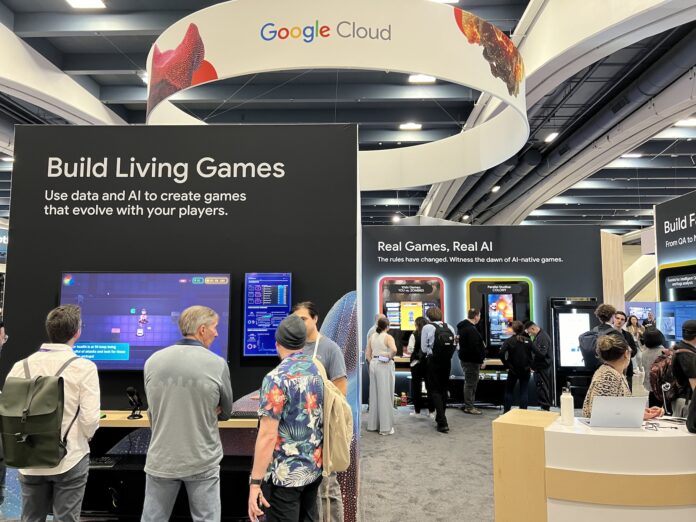
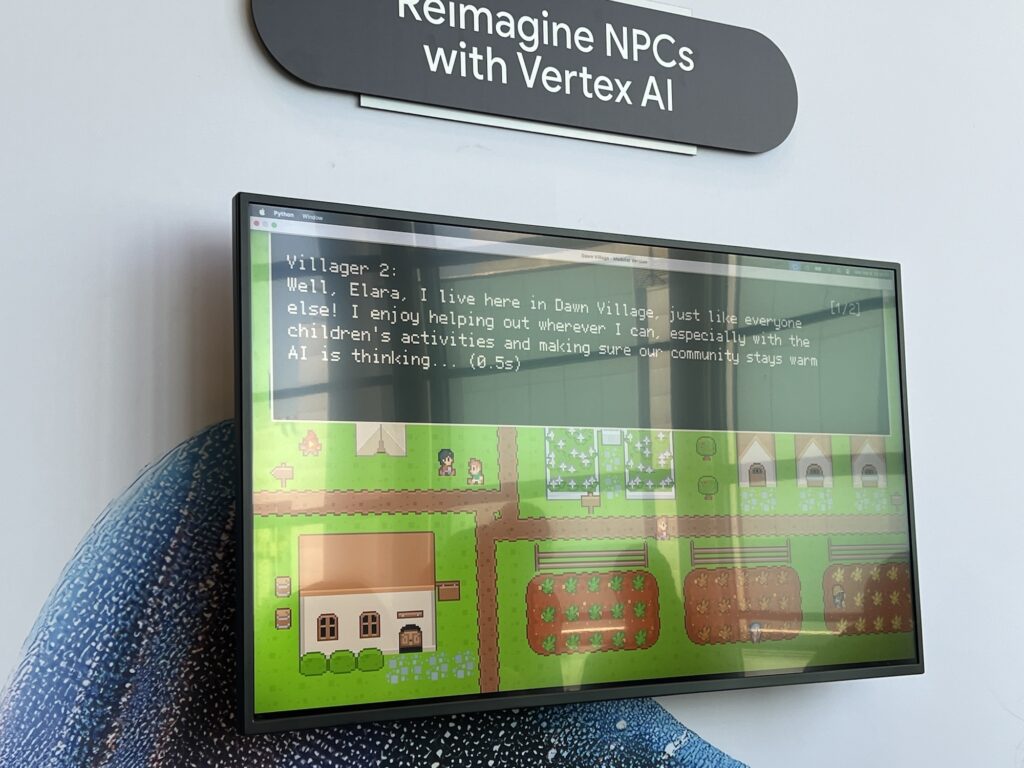
On the first day of this year’s 2026 GDC Festival of Gaming, I saw a social media post describing a demo at Google’s AI booth. The post showed a generic-looking pixel-based RPG, but the real meat of it was in the dialogue: All of the text spoken by the non-player characters in the demo was live-generated by AI.
Normally, I would go out of my way to avoid such an experience. But, given the glut of AI-related content at the conference this year (I counted over 60 separate talks and events on the schedule, not to mention the many AI companies with booths on the show floor or advertised on banners strung up across the convention halls), I figured it was my journalistic duty to at least engage with the stuff. So, with a couple of hours to kill between other events, I headed to the demo kiosk.
While I waited for my turn to try it out, a Google representative told me that Google’s proprietary AI, Gemini, would generate the text based on my prompts. I saw the player ahead of me interact with an obsequious shopkeeper who “sold” them two items (the demo was only meant to show off Gemini’s text-generation capabilities, so there were no items, no currency to buy them with, and no inventory menu in which to access them), while a timer on the screen counted up how long it took the AI to generate each response.
When it was my turn, I tried to see how long I could make the AI think about each response. I walked up to another NPC; first, they simply said “Hello,” and on further interaction tried to direct me to other points of interest in the demo. I was having none of it. I asked for their name, which they gave as “Elara”—the same name that a different character had given to the player in front of me—and then asked them for the history of the village. The AI paused for about two seconds to generate eight pages of text that ended with the awkward phrase, “It’s a long history, beginning.”
Three days later, I sat down for an interview with Hilary Mason and Matt Brandwein. Mason and Brandwein met when the former’s machine-learning research company, Fast Forward Labs, was acquired by the cloud services company Cloudera; the two then left to start their current venture, Hidden Door, which their website describes as “where role-play meets fanfic.” In it, players can select a pre-established world and play through a short story arc within that world, hitting predetermined story and character beats that the company’s AI model organizes based on the information players enter.
Mason and Brandwein are quite specific about what AI does and does not do on their platform. “We always joke, ‘It’s like artisanal AI,’” Mason explains. “All of our plots are actually handwritten because we want control over, like, what does a great meet-cute look like in this story? What are the kinds of beats that might happen? And then we feed that, combined with the player’s choices about their character, and the setup of what came before and the vibes of this world, to create the story text.”
This structure, she says, is meant to harness the capabilities of AI technology while avoiding its pitfalls: “I would say [large language models, the textual aspect of AI] are aspirationally mid. At best, they are distilling out what is common in the underlying dataset… At Hidden Door, we’re essentially asking the LLM to do a translation problem, not a generation problem. We do that because LLMs are innately bad at creative storytelling, but they’re very good at moving or styling information with very specific instructions.”

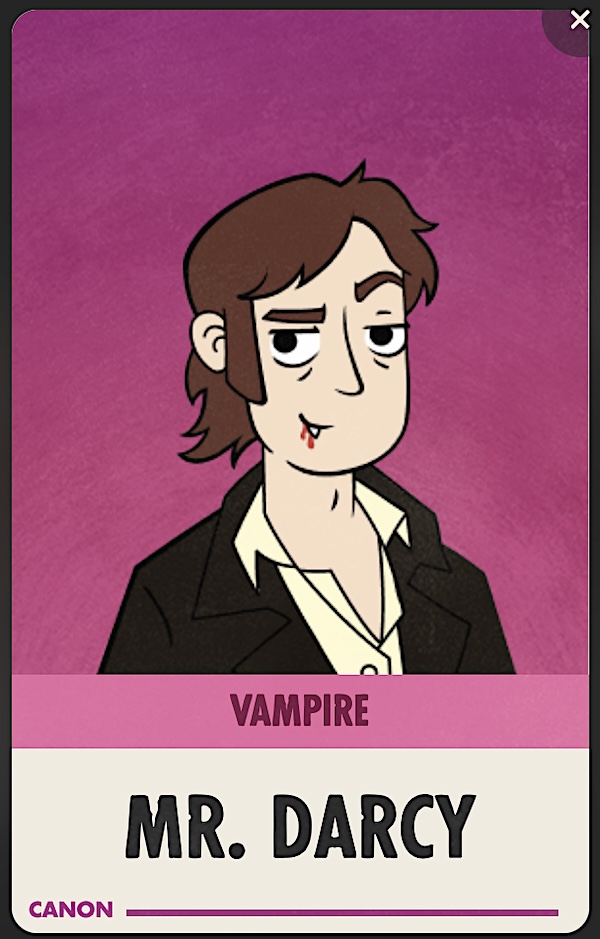
In my own experience playing with their system, I could see the process at work. I first chose to play with the Pride & Prejudice module, setting it in Brooklyn and throwing in a “toon” modifier out of curiosity. The system created a story set at a Regency-style ball attended by my character; the “Brooklyn” modifier seemed to be the reason for a “lord” character with an anachronistic flat-brimmed baseball cap and thick moustache, while the “toon” modifier, I guess, made my role-playing options zanier. Those role-playing options were produced, like clockwork, after every two paragraphs of generated text, giving me one more interaction to move to the next beat in the scene.
I found this structure somewhat rigid, especially since the appeal of fanfiction is the freedom it offers; for instance, I once read a Twilight fanfiction that paired Edward with Harry Potter and Jacob with Draco Malfoy, sprawling across locations and events from both series. Hidden Door’s predictable structure precludes that sort of unexpected goofiness, which is more or less by design. “Fanfiction is wonderful, but also it’s a blank sheet of paper you have to bring your whole idea set to,” Brandwein says. “There’s a lot of people who want to step into a world but need some scaffolding.”
That scaffolding also ends up making the experience more palatable to IP-holders, as it means that players can only go off the rails of a story in a way that’s predetermined by the platform. Brandwein continues, “It became obvious that we had an opportunity to work with authors, movie studios, TV properties, game properties. We license the work, we share revenue, we bring the fans together. And that’s an affordance specifically because of the architecture.”
Mason and Brandwein describe this experience as safer and more conscientious than the laissez-faire style of generative AI currently garnering mainstream attention and controversy. I suppose that’s true. Hidden Door’s regimented design keeps tight boundaries on the player’s experience, clearly distinguishing fantasy from reality, which makes it seem (to my non-expert perspective) unlikely to induce AI psychosis; and both Mason and Brandwein use the language of safe spaces to talk about their work, which stands in contrast with, say, Grok describing itself as “MechaHitler” or Meta’s AI chatbot making advances toward underage users.
But the impersonal aspect of AI—the way it necessitates a mechanical pattern of interaction—makes Hidden Door’s storytelling feel less customizable, less active and surprising, than actual fanfic writing or tabletop roleplaying. It’s a much flatter experience, which doesn’t always serve the stories it tells.
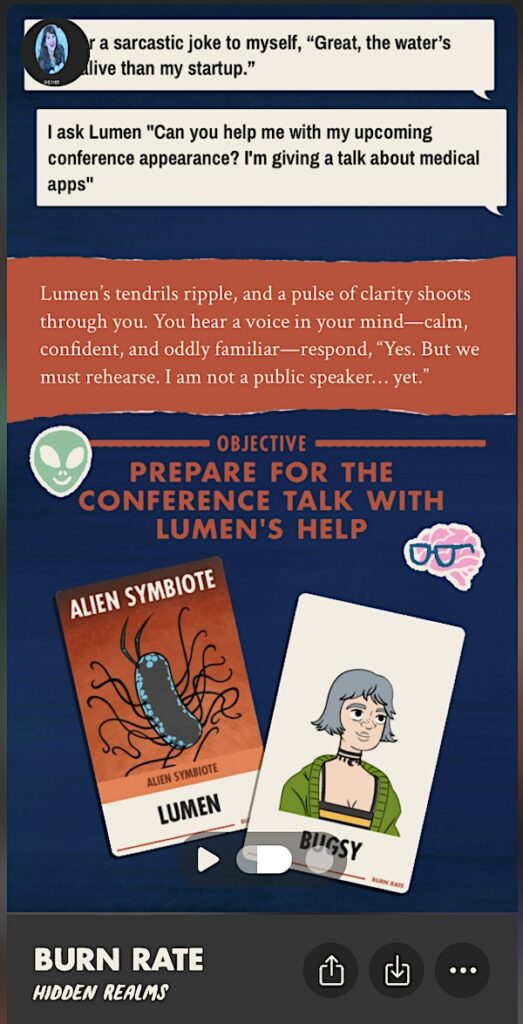
“Burn Rate,” one of the original story-worlds that Hidden Door has produced for the platform, is described as “a dark comedy set in San Francisco’s startup ecosystem.” In my experience, however, it didn’t seem all that dark. My character arrived at a coworking space, discovered that the Wi-Fi was down, and went to the server room to reboot it. There was a bubbly intern named Mira who offered me coffee six separate times, a quirky guy on roller skates, and a lot of writing about posting memes in a Slack channel; the plot came across to me as a low-impact delivery system for this kind of techie quirk. It felt more like a romanticization of the tech world than a satire of it.
I haven’t lived in San Francisco for very long, but even I know that tech’s ubiquity here is contentious, and that’s without considering Silicon Valley’s rightward swing in the last few years. Because of this context, I felt that the shallowness of “Burn Rate” acquired an ideological dimension. Hidden Door’s platform is meant to be a safe space—but who is it safe for?
In my conversation with Mason and Brandwein, I asked if they had any concerns about how “Burn Rate” might be received, given how controversial tech’s presence in the Bay can be. They seemed a little surprised by the question. After some thought, Mason replied, “That was a deliberate choice to stay away from the actual fundamental issues that do underlie tech in San Francisco. So, yes, I think that maybe we can do a better job of making the intent clear. We could have gone into that kind of story experience for this particular world. That was not the goal. And maybe that was a bit of a misjudgment.”
But even if that story incorporated a more critical lens, I don’t know if it would be properly communicated. For me, the platform’s use of AI introduced a level of opacity that made it difficult to discern how my actions affected the outcome of a story, or what the shape of a story was supposed to be. In “Burn Rate,” the platform ended my story when I arrived at the server room; I hadn’t restarted the Wi-Fi, which was my character’s stated goal. The conflict was unresolved. And in the absence of a clearer arc, comprehensible motivations, or deep characterization, the game experience became defined by the presence of AI. The plain fact of the technology’s existence is the primary selling point.
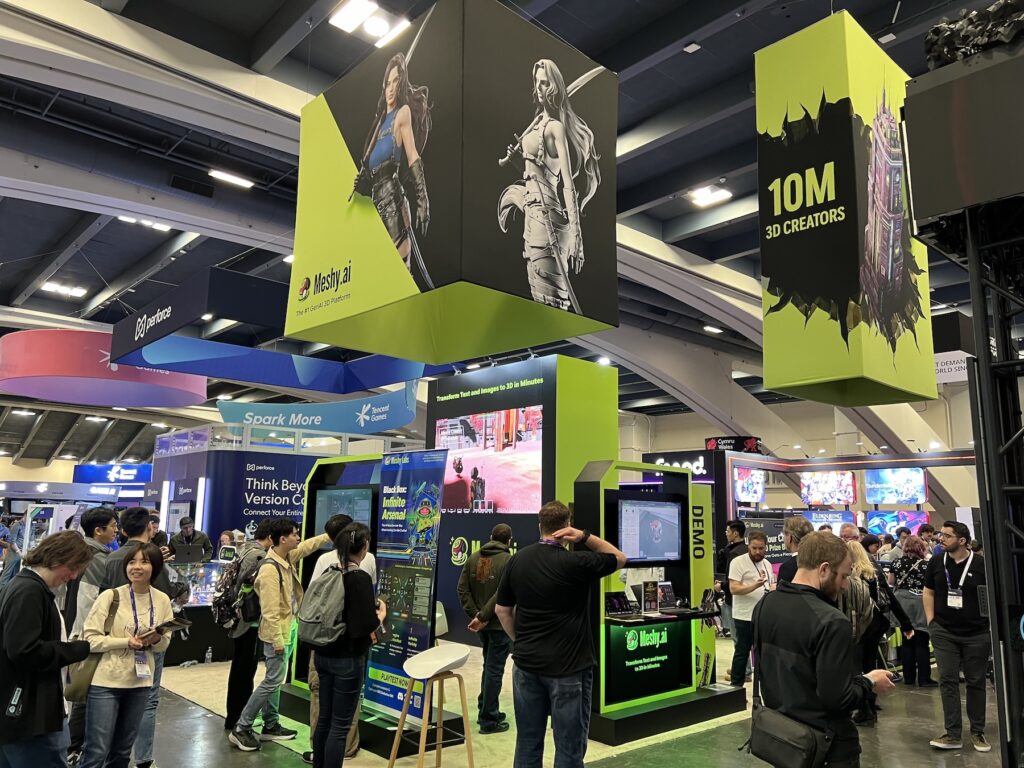
That afternoon, I headed to the expo floor to meet with a representative from Meshy, an AI-powered asset generation company that has moved into creating game experiences. I had been emailing back and forth with the company’s PR person to schedule my visit, so I assumed that someone would be ready to talk to me. This was not the case. The booth was a little chaotic, with players and passers-by occupying the different demo kiosks or entering the company’s raffle to win a PS5. I flagged down one of the workers and gave her the name of the person I’d been talking to; she didn’t know who he was.
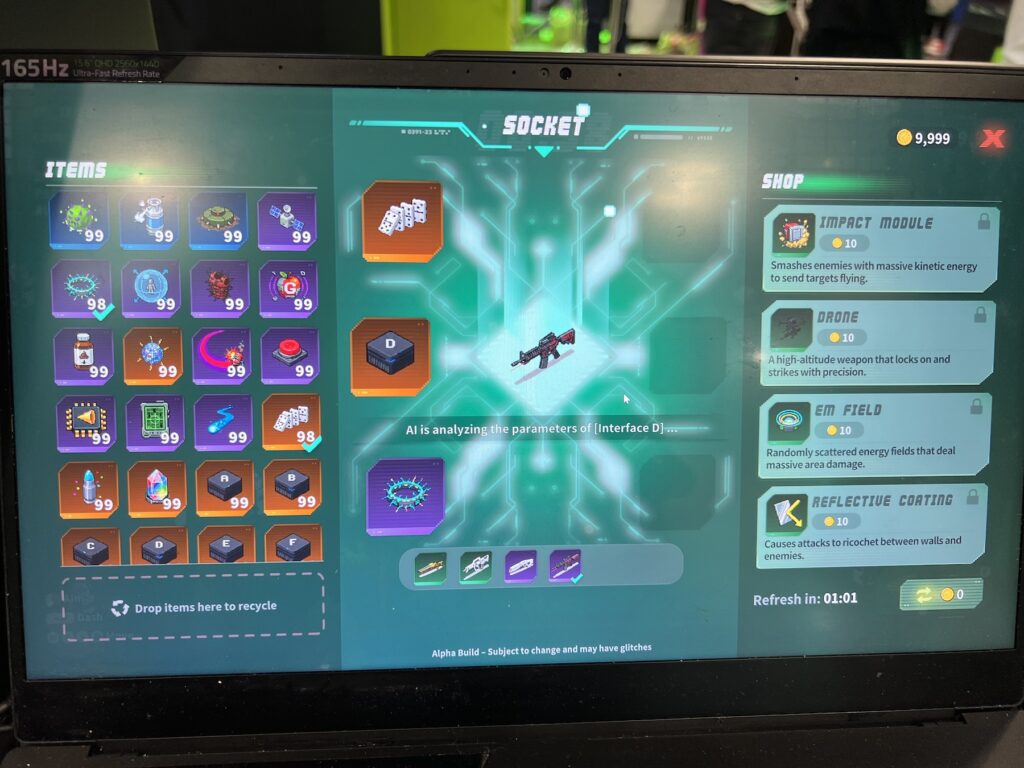
She passed me along to another company representative, who gave me the rundown on the company’s 3D model generation technology and got me set up at the booth for the company’s game Black Box: Infinite Arsenal. The game is a basic Vampire Survivors-like with AI-generated weapons, and it was sort of fun. But it was so derivative that I wondered what would stop someone from just playing Vampire Survivors instead.
I put that question to the (different) company representative who was watching me play. He said that the difference with Black Box was that each playthrough would be completely unique, due to the unpredictability built into the weapon generation system. A few minutes later, I put in a combination of prompts that made the AI spit out a completely useless gun, and died.
I put the controller down. The player waiting behind me immediately stepped up, curious to try out this new technology for themselves. I wonder how long their play-through was; I didn’t stick around to find out.