
Three things emerged from a supes hearing this week on homelessness and supportive housing, called by Sup. Chyanne Chen:
First: Proposition C, the 2018 increase in taxes on the biggest businesses in town, promoted by progressives including former Sup. Dean Preston and opposed by the Chronicle and much of the conservative political establishment, has been a phenomenal success.
In fact, it’s been such a success that Mayor Daniel Lurie is using a $68 million surplus, Prop. C money that exceeds budget expectations, to replace General Fund support for the Department of Homelessness and Supportive Housing.
“Prop. C has been wildly successful,” Jennifer Friedenbach, director of the Coalition on Homelessness, told the Budget and Appropriations Committee. She said the money that came from taxing the rich has created 5,620 units of affordable housing, and has moved 8,420 people who were living on the streets into stable housing, including 2,800 children.
Lurie is now opposing another tax on the rich, Prop. D, which would bring in enough money to solve much of the budget crisis. If it passes, I look forward to hearing next year that it’s wild success has made the mayor’s job a lot easier.
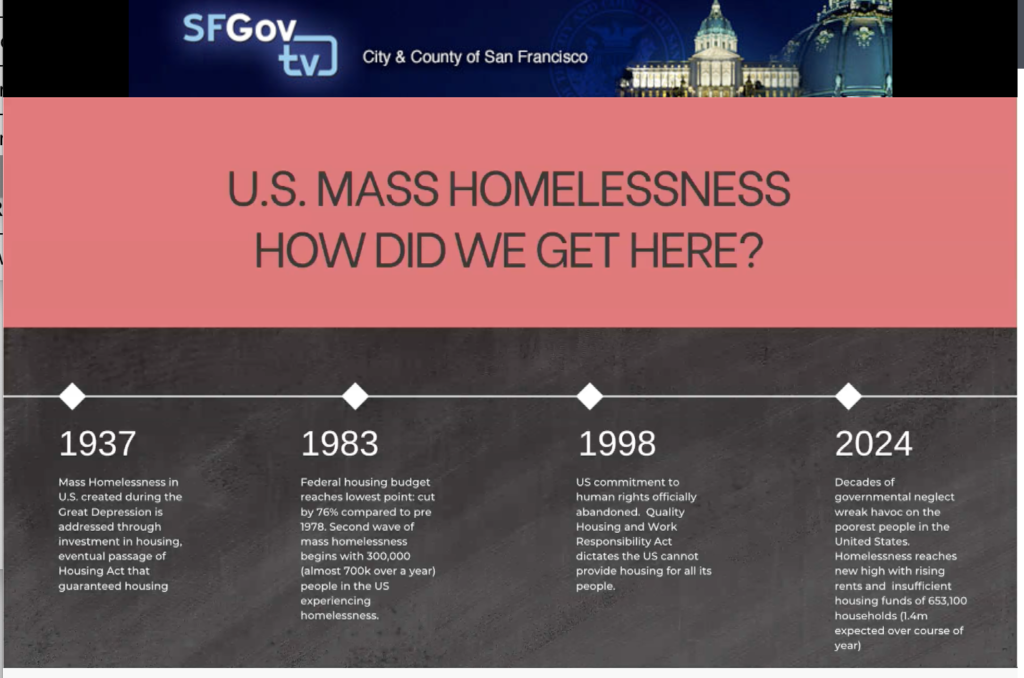
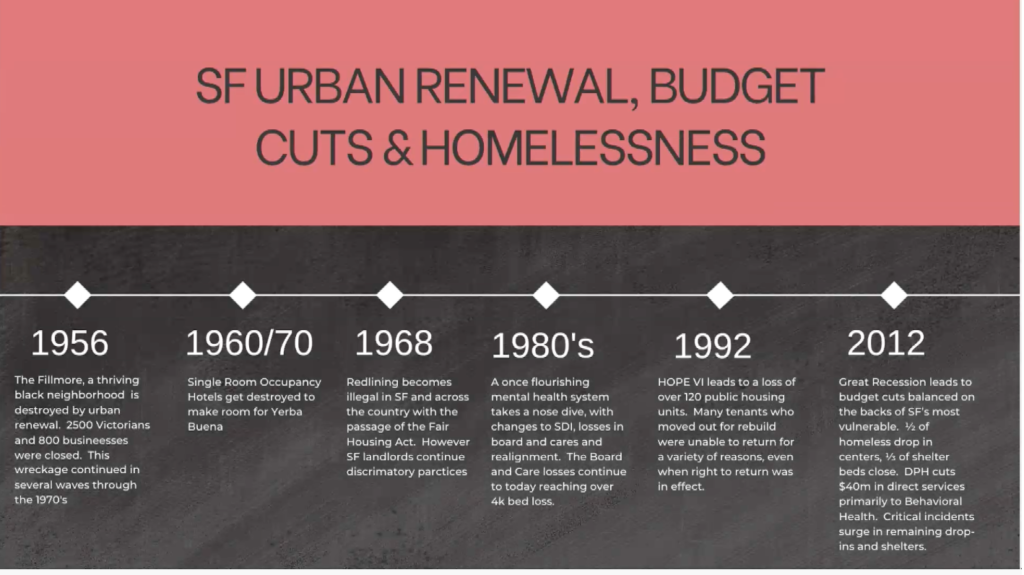
Friedenbach gave a short, but critical history of why homelessness has become such an issue in the US:
Second: Housing First, a policy that Sup. Matt Dorsey is trying to undermine, is widely recognized as a critical approach to ending homelessness.
“Housing First is the most effective approach to ending homelessness,” Colleen Rivecca, director of policy planning at the Tenderloin Neighborhood Development Center, noted. “It is an evidence-based practice that is supported at the federal, state, and local level.”
Under Housing First programs, tenants can’t be evicted for failing to meet treatment goals—that is, they can’t be thrown back on the streets if they are still struggling with substance use.
Third: The city isn’t putting enough money into funding permanent supportive housing, despite all the money coming in from Prop. C.
PSH isn’t just about putting people in rooms; it requires a trained, dedicated staff to work with every resident to address the trauma, physical and mental health issues, and substance disorders that are the result of this nation refusing to fund affordable housing.
That costs more every year, in part, Rivecca said, because the population PSH is serving is getting older, and the trauma is getting more serious. Plus: The cost of living keeps exploding in San Francisco, thanks to the latest tech boom (which the mayor happily embraces). When more rich people move into a city, the price of housing (and almost everything else) goes up, and the nonprofit workers who don’t have AI salaries need better pay to afford even marginal housing.
This is a fact that generations of mayors who supported tech booms have failed to acknowledge.
The failure to fund services in PSH creates a doom loop: Tenants and neighbors complain that the facilities aren’t well run, Dorsey demands no drugs, and public faith in the programs drops. This is a classic right-wing strategy: Refuse to fund public services, then complain that the programs are failing, and cut their funding entirely.
Prop. C will bring in $63 million more than expected this calendar year, and some $90 million more during this budget cycle. And yet, the budget for HSH is going down by more than $50 million. Sophia Kittler, the mayor’s budget director, told the supes that money that once came from the General Fund to support programs to end homelessness is now being replaced by unexpected money from Prop. C.
Sup. Shamann Walton was a bit incredulous. If the city has all this extra money, he said, why are they any cuts to HSH?
Kittler said there are no service cuts, since the Prop. C money backfills the cuts from the General Fund.
“But you could be doing so much more,” Walton said, to applause from a room full of affordable housing advocates.
Sup. Connie Chan was also disturbed. “If we know there is a forecasted revenue increase, why are we cutting services?”
Kittler said that the mayor’s approach this budget cycle will be to reduce funding for new PSH. “The emphasis has been on capacity building,” Kittler said. Now, Lurie wants to move toward stabilizing existing programs, to “not double down on capacity but improve the infrastructure,” she said.
Walton kept making the point that the city can do both.
Instead, the mayor wants to reduce the amount of new housing, while homelessness continues to increase. As Friedenbach noted, every time the city finds housing for one homeless person, three more become homeless—largely because rents keep going up.
Largely because Lurie keeps promoting this city as the AI capital of the world.
Nobody ever asked the residents to vote on whether that’s the city we want to live in.