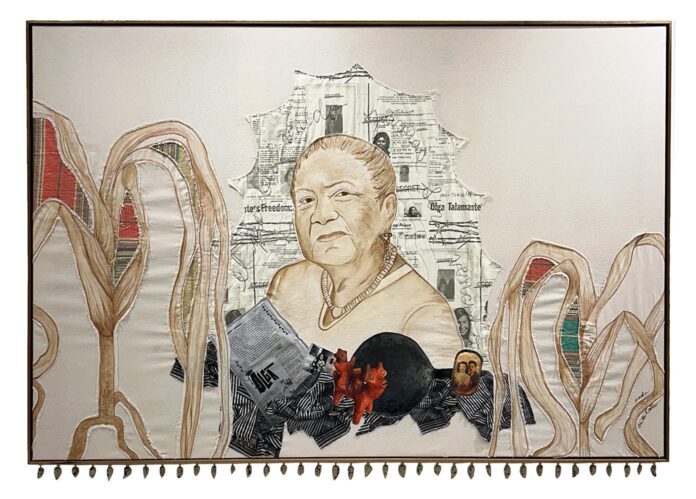
Paola de la Calle is a Colombian American multidisciplinary artist examining family and identity. Through sculpture, printmaking, and textile collage, de la Calle uses a variety of media as a means of investigating how everyday objects reimagined as artifacts and familial narratives can be recontextualized as sites of historical inquiry. For the artist, memory is also a medium and the materials she chooses have more to do with narrative significance than anything else.
“My interest is primarily in how history is told and preserved. I see myself and my practice as being a blend of archeology and translation. I am interested in metaphorically digging up the past and reinterpreting it, adding lesser known or ordinary stories to the canon,” de la Calle told 48hills.
In the act of taking things apart and putting them back together again, de la Calle seeks reparations and rebirth. She says her practice functions as a way to mend and connect by bringing fragments together, repairing what has been broken, and creating new links between people, memories, and histories.
Growing up between homes in Medellin, Colombia and Cambridge, Massachusetts, de la Calle says the geography of those places is part of the reason she was drawn to the Bay Area. Feeling most at home in the mountains and by the ocean, she is grateful to live where she doesn’t have to choose just one.
As a self-taught artist, de la Calle participated in a high school technical arts program, learning the principles of graphic design while attending Cambridge Rindge and Latin School in Massachusetts. In college, she was a sociology major with an art minor at Skidmore College in Saratoga Springs, New York. During this time, she attended a semester abroad in Madrid, Spain where she focused on completing studio art credits.
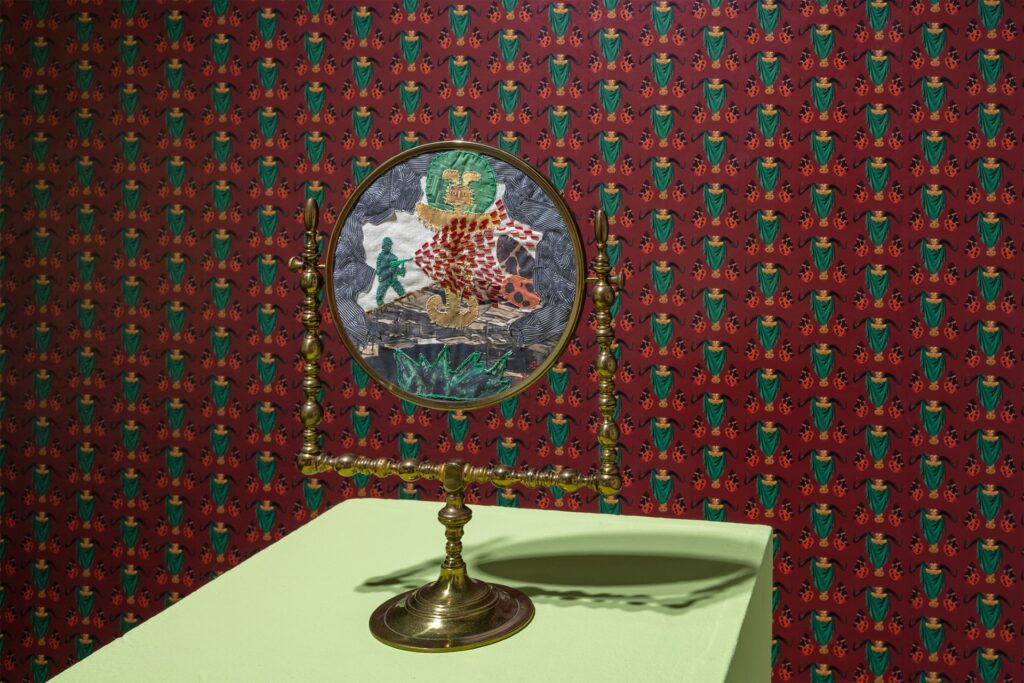
“In Madrid, I took my first ceramics class, which took place in the basement studio of an artist named Maria Jose, who we lovingly called Majo. When I returned to Skidmore in the Fall of my senior year, I signed up for a printmaking course and began to draw connections between what I was learning in my sociology classes and printmaking as a medium for disseminating information,” de la Calle said.
Prior to moving to the Bay Area, de la Calle taught art full-time at a middle school in Memphis, Tennessee for three years, while struggling to make her way as an artist. It was during a school break that she first visited San Francisco.
“On this trip, I stumbled across a wheatpasted screenprint at the 24th Street BART by the artist Piojos. I strolled into Galeria de la Raza for the Women are Perfect! exhibition and saw the works of artists I admired like Dignidad Rebelde and Jess Sabogal. It was then that I realized my people are here. This was my introduction to the history of art as a tool for social justice in the Bay Area,” de la Calle said.

Six months later, without having secured a job, she made San Francisco home. Just a few weeks in, she volunteered to work on a mural at Hasta Muerte Coffee in Oakland where she met Piojos. A year later, she exhibited her work for the first time in San Francisco at Galeria de la Raza.
“It felt serendipitous, like a full circle moment, and it’s been that way since. I’ve been fortunate to meet and become friends with and collaborate with artists I’ve admired for ages, including getting to assist Jess Sabogal on a monumental mural in the Mission, and most recently, painting a portrait of Latina artists Ester Hernandez and Olga Talamante for a project funded by the ReGen Artist Fund.
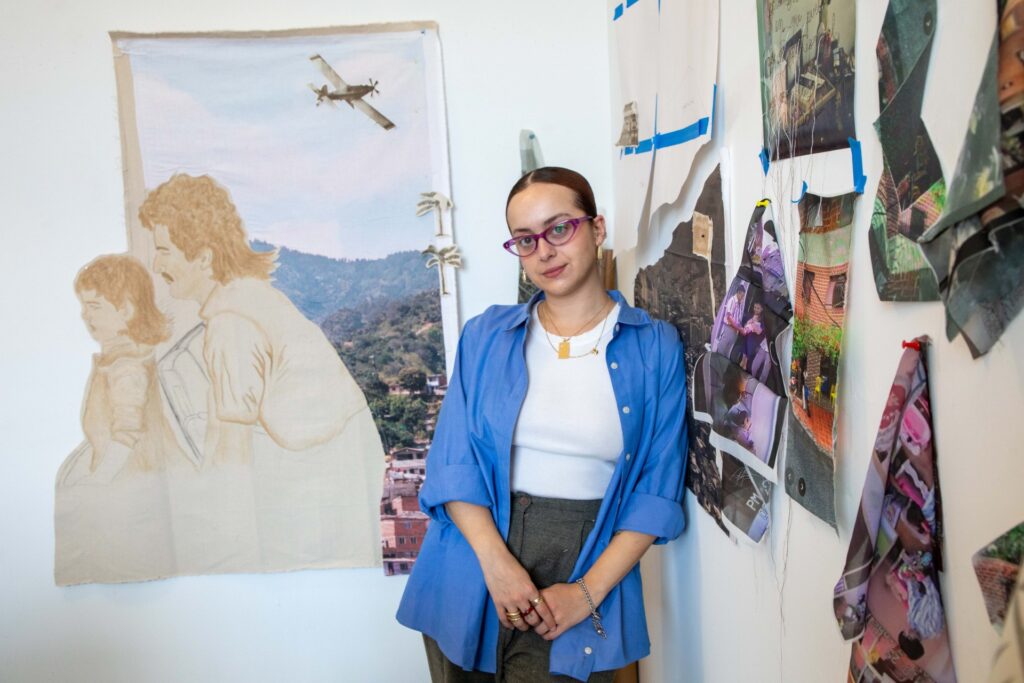
In 2019, de la Calle took a New Genres summer course at San Francisco Art Institute, which she credits with planting the seeds that cultivated into her current methods and materials.
“The assignment was to make an altar to something that didn’t exist anymore. I made a collage about my childhood which I then projected onto a blank screen,” she said.
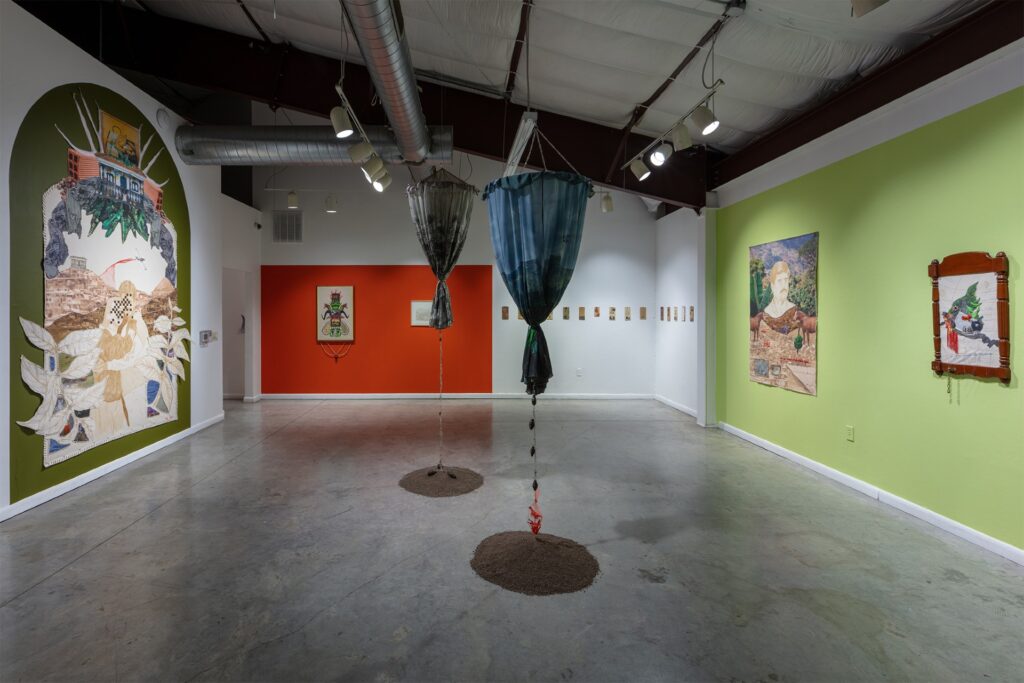
With numerous artist residencies under her belt that nurture her exhibition work, de la Calle has grown as an artist. In 2022, she was included in the exhibit, Pedagogy of Hope, at Yerba Buena Center for the Arts, presented by Galería de la Raza for the Caravan for the Children Campaign. Her debut solo exhibition at SOMArts in 2023 was pivotal, which she refers to as a quinceañera party for her art. Developing work for the show while attending a residency in Brooklyn was a challenge structurally, but the ample studio space allowed her to push the scale of her work, transforming her into a multidisciplinary artist who engages with installation, ceramics, and sound.
Settling into a new studio in the Mission, her first since holding a space at CTRL+SHFT Collective in Oakland, de la Calle works on every surface possible, alternating between floor to walls to tabletops, depending on the phase of the creation cycle she is in. To find her, follow your senses: the wafting aroma of coffee set to the beat of her sewing machine, music, and podcasts will lead you there. Sunlit mornings in the studio are favored though she is known to work late hours too.
“Over the years, I’ve gotten better at knowing when to stop working on an artwork and give it (and myself) space to breathe. Not every day can be a production day. Some days require leaving the studio and taking in new experiences, exhibitions, conversations, and geographies to aid in the process of making,” she said.
While learning the history of printmaking and its transformative power as a tool for social and political reform, de la Calle was influenced by the work of Jose Guadalupe Posada and Ester Hernandez, and posters of the Organization of Solidarity with the People of Asia, Africa, and Latin America (OSPAAAL) which she came across on a trip to Havana, Cuba. Eminently concerned with justice and systems of power, de la Calle references artists whose work aligns with her own.
“I’m been inspired by artists like Doris Salcedo for her approach to working with victims of violence, the power in the subtleties within her work, and her approach to material. Do Ho Suh for the scale of his work. Billie Zangewa for the intricacy and intimacy of her collages on silk, Tschabala Self, for the color and movement in her work. I admire filmmakers Pedro Almodovar for how he composes every shot and his use of the color red; Iñárritufor his approach to surrealism; and Eva Victor for the movie Sorry, Baby,” de la Calle said.
Family has also been integral to her creative development. Growing up, de la Calle spent a lot of time in other people’s homes, as her parents cleaned houses for a living, an activity that she and her sisters would sometimes participate in.
“I was typically tasked with the job of dusting which allowed me a close look at objects. Things carry so much significance. Looking back, I think those early experiences in domestic spaces inspired my interest in the found objects that make their way into my work,” she said.
Her aunts contributed significantly to her learning the language of craft, as she watched them sew holiday costumes and sculpt figurines. She says she still approaches work through the lens of her inner child, exploring the multitude of questions she had growing up in a “mixed status” family. The power of an image and its interpretation is important to de la Calle as she is curious about how something can appear to be one thing at first glance, then become something else entirely.
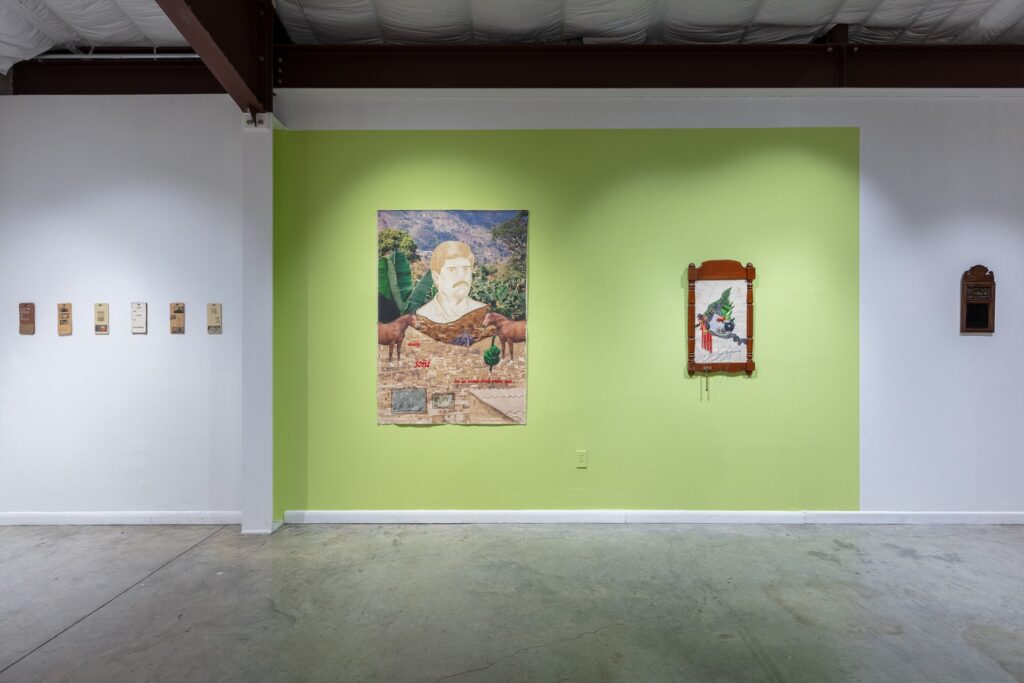
“An impartial advertisement of a banana in a headdress becomes a point of departure to explore systems of exploitation; an old calling card preserved in my grandfather’s wallet becomes a map that traces collective histories across time and space; and coffee painted onto canvas becomes an elixir revealing the faces of loved ones separated by borders. At the core of all of my work, I address themes of displacement, home, and memory,” she said.
Regarding source material, de la Calle says she is interested in mining archives not just their contents, but for their silences, omissions, and gaps in myriad complexities.
“I draw on imagery from National Geographic for its role in shaping pervasive narratives on the Global South, archives from the War on Drugs for its role in destabilizing nations across Latin America, and the Chiquita Banana archives as both an example of neocolonial exploitation and a point of connection to my family’s history,” she said.
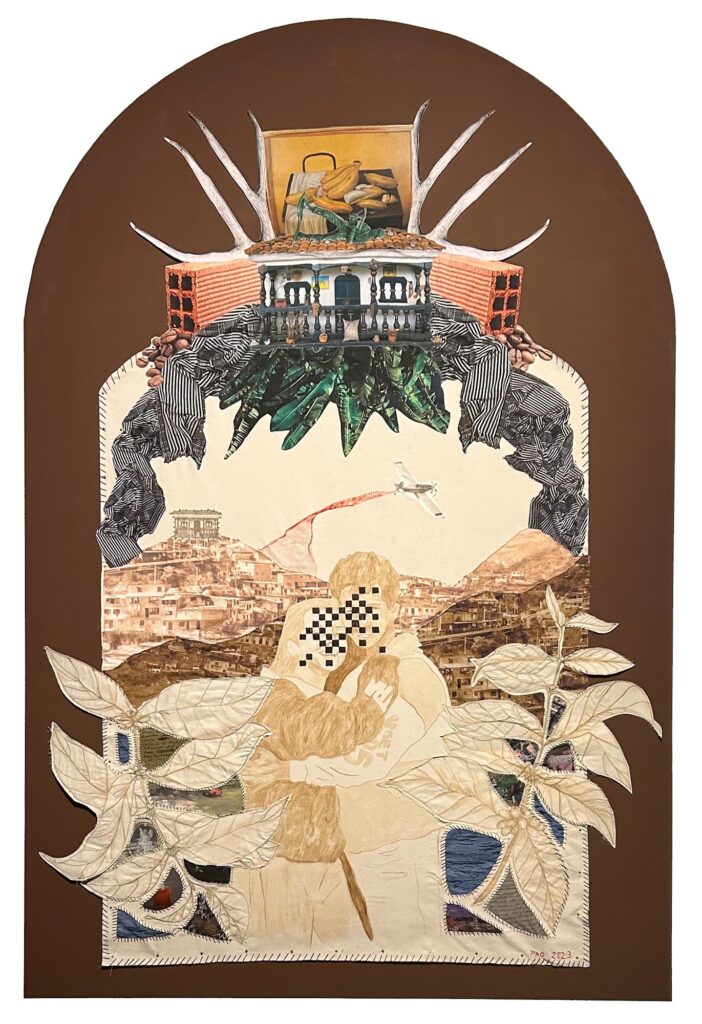
Her piece, Tío Jaime (Portrait of a Banana Farmer), is based on her uncle who was diagnosed with cancer due to frequent exposure to pesticides. In The Embrace, a portrait of her parents, young and in love, sits beneath an image of a crop-spraying plane.
“The image of the plane is screen printed onto canvas using ink made with iron, an element that accelerates the fabric’s decay—operating as a material intervention and symbolic dismantling of a system that continues to enact personal and ecological harm throughout the region,” de la Calle said.
De la Calle was just awarded the Ann Chamberlain Artist Residency at SFSU, and recently wrapped up several local shows wrapping up, including showing work at Root Division’s booth at the San Francisco Art Fair 2026 in April. Her piece ‘Entre Azul y Azul’ will be installed at the Textile Arts Center in Brooklyn, New York later this year, and she will be included in the group exhibition, the delicate waist of America, at the Art Museum of The National Hispanic Cultural Center in Alburquerque, New Mexico from March 2027 through February 2028.
She is also one of 21 creatives selected to participate in The Culture Keepers, a Bay Area project aimed at documenting how artists find a sense of belonging while inspiring and shaping local communities and the world.
Writing is also a key part of her expressive verve. She loves handwritten letters and postcards and has kept a journal since she was seven. She says the physicality is important and a practice that keeps her grounded.
Presently, Paola de la Calle’s studio is filled to the brim with works in progress. Having recently received a generous seed grant, she is beginning a series of large-scale textile pieces that address borders, memory, and archives through the lens of cartography.
“The artworks are photo-based and take the form of imagined maps depicting alternate futures, delineating and obscuring borders, and plotting histories that have been erased and evaded,” she said. “Though my work tends to look at the past, I’m enjoying the process of imagining possible futures.”
For more information, visit her website paoladelacalle.com and on Instagram.