
The Board of Supes will consider Tuesday/7 an application to legalize the conversion of a four-unit building into a single-family mansion—a move that would have dramatic, lasting impacts on the city’s rental housing stock.
As we reported:
In 2010, according to city documents, a developer and speculator named Peter Iskander, who has a record of evicting seniors under the Ellis Act, bought a four-unit building at 524 Vallejo and, perhaps by threatening evictions, bought out all the tenants.
City records show the purchase price was around $500,000, not surprising for that time and a property filled with rent-controlled tenants.
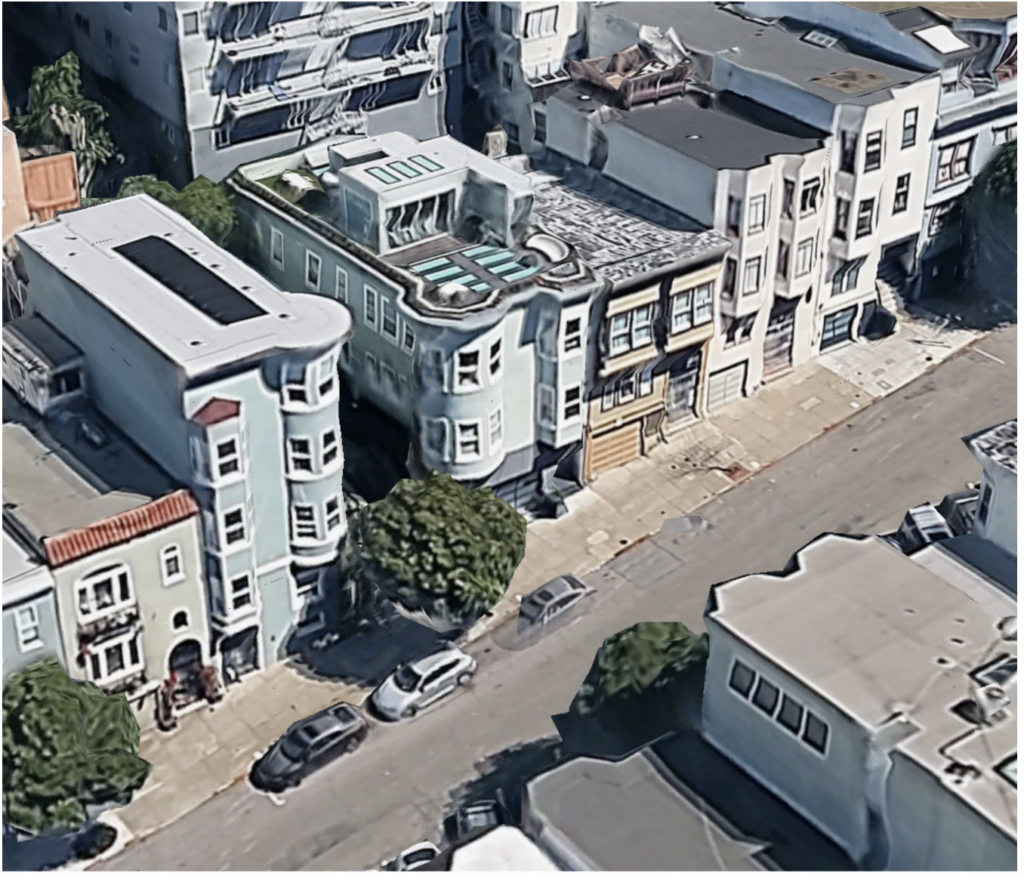
Then at some point in the next few years, the building was converted to a single-family home, which a wealthy family bought for $4.75 million in 2021. A story in the Chron suggests that the family just wants to live in their “dream house,” and those awful bureaucrats at City Hall want to ruin their lives.
In fact, either the owners or some group of supporters has posted a detailed web history of the property, which purports to show that it was once a two-unit building.
The owners want the city to retroactively approve the conversion if they agreed to add one in-law unit.
The Planning Department didn’t buy that, and demanded that the property be restored to what it was: A four-unit rental. The Planning Commission, on a 3-3 vote, refused to override the department’s ruling.
Now the owners want the supes to overturn the commission decision.

There’s a lot more at stake here than one rich family and one luxury mansion in North Beach. If the supes side with the owners, the message to speculators will be clear: It’s fine to buy a four-unit building, evict the tenants, and make a fortune converting it to a mansion, which will sell for a premium in this AI boom.
In fact, according to the San Francisco Anti-Displacement Coalition, similar four-unit rentals in North Beach sold for about $2.8 million in 2021—meaning the premium for the illegal conversion amounts to an additional $2 million.
The coalition notes, in a letter to the supes:
If the Board overrides the findings of Planning staff and the Planning Commission, it would be creating a significant new loophole to our existing laws that protect rent-controlled units, the tenants who live in them now and those who will need that housing in the future.
As the City’s real estate market for luxury homes heats up, there is simply no way for tenants to compete against an industry of developers and realtors that profit off of their displacement, cannibalize rental units, and repurpose them as single family homes to be sold for millions.
SFGate already announced, gleefully, that a converted seven-unit building is now on the market for $35 million.
The owners say the Vallejo Street building was constructed with two apartments in 1907. By 1984, two more units were added—without permits, the owners say. But that doesn’t matter: Those were rent-controlled units, and under city law, they can’t be removed without a conditional-use permit from the Planning Department, which routinely denies those permits.
From a statement by former tenant L. Molast:
From 2010 to 2013, all plans that Developer shared with the community and the building residents showed the proposed redevelopment of the building would contain four separate units. During that time Developer offered each building resident the option of buying her or his unit after redevelopment. Developer offered me my unit (524 Vallejo) for purchase at $550,000. No units were offered for rent after the completion of the redevelopment.
More:
Planner Vicent Page told the Planning Commission that “at some point between 2016 and 2022 all four units were merged without authorization and the subject property has been functioning as a single-family dwelling ever since, even though the assessor recorder’s data for the property reflects that it is legally a four-unit building.”
From the ADC letter:
At the time the appellants bought the subject property—in April 2021 for $4.8 million—every public record described the lawful and permitted use of this building as a four-unit apartment building. This continues to be its lawful and permitted use. There has never been a time when this property was approved to be in its present condition, as a single family home. As they now concede, appellants were aware, prior to purchasing the property, that the building was permitted only as a four-unit apartment building.
That would have been hard to miss: The Assessor’s Office files today still list it as a four-unit apartment building. In fact, the owners, on their website, note:
Katelin Holloway and Ben Ramirez purchase the property on April 12, 2021 for $4,858,490 (MLS #508471). The MLS listing, while classified as “Residential Income / Quadruplex” due to the 2013 paper designation, markets the home as “presently arranged as an expansive single-family home.” All four listed “units” show 0 bedrooms, 0 bathrooms, 0 square footage, and $0 rent. The physical condition at purchase is identical to the 2016 as-built certification.
If nobody noticed, and nobody complained, they might have gotten away with it, but technically, they were buying a four-unit building.
According to the ADC:
Despite this knowledge and the explicit cautionary notices that the City requires to be provided to all buyers, the appellants proceeded with the purchase. They now claim they should be allowed to disregard those cautionary notices and be afforded the privilege to continue to ignore the laws that protect rental housing from demolitions and conversions.
More:
According to data from the Assessor’s office, there are more than twenty-three thousand two-to-four-unit apartment buildings in the City. Depending on their locations, access to views, or other conditions, many of these buildings (and the tenants in them) will be put at greater risk of conversions into luxury housing if this board overturns the Planning Commission’s decision and sides with the owners.
Sup. Danny Sauter, who represents the district and is, from all accounts, supporting the owners, can present this as a one-off, a rare example of a family making a mistake; the penalty, restoring the place to four units, might force them to sell, probably at a loss, and move out.
But the fate of this one wealthy couple, who likely can easily afford another house in the city, isn’t the question the supes are facing. It’s about a precedent that could encourage more speculators to destroy more rental housing at a time when the city’s tenants are under immense pressure.
That hearing starts at 3pm.
The Land Use and Transportation Committee will consider Monday/9 an update to the city’s Climate Action Plan. The plan, adopted in 2021, gets updated every five years.
From the legislative digest:
New climate action goals would include, for example, transitioning all energy uses Citywide to 100% renewable and/or greenhouse gas-free sources by 2040, reducing building emissions by 20% from 2020 levels by 2030, and achieving a 25% reduction in per-capita vehicle miles traveled by 2030. Future climate action goals would include, for example, exploring and identifying best practices for carbon removal that could allow the City to remove atmospheric carbon dioxide equivalent to San Francisco’s residual greenhouse gas emissions.
But there’s a huge element missing here: Big Tech.
As the city moves to cut Muni lines, Waymo and Uber are gearing up to increase vehicle miles traveled. There is no mention, zero, in the plan about the carbon impacts of the AI boom that the Lurie Administration is encouraging. The city doesn’t even know how much carbon the data centers for local companies (most of them situated outside of the city) are emitting.
Also: No implementation strategies. None. No funding; in fact, the Department of the Environment is getting its budget gutted.
And yet, Sup. Rafael Mandelman is presenting this plan for board approval. That hearing starts at 1:30 pm.