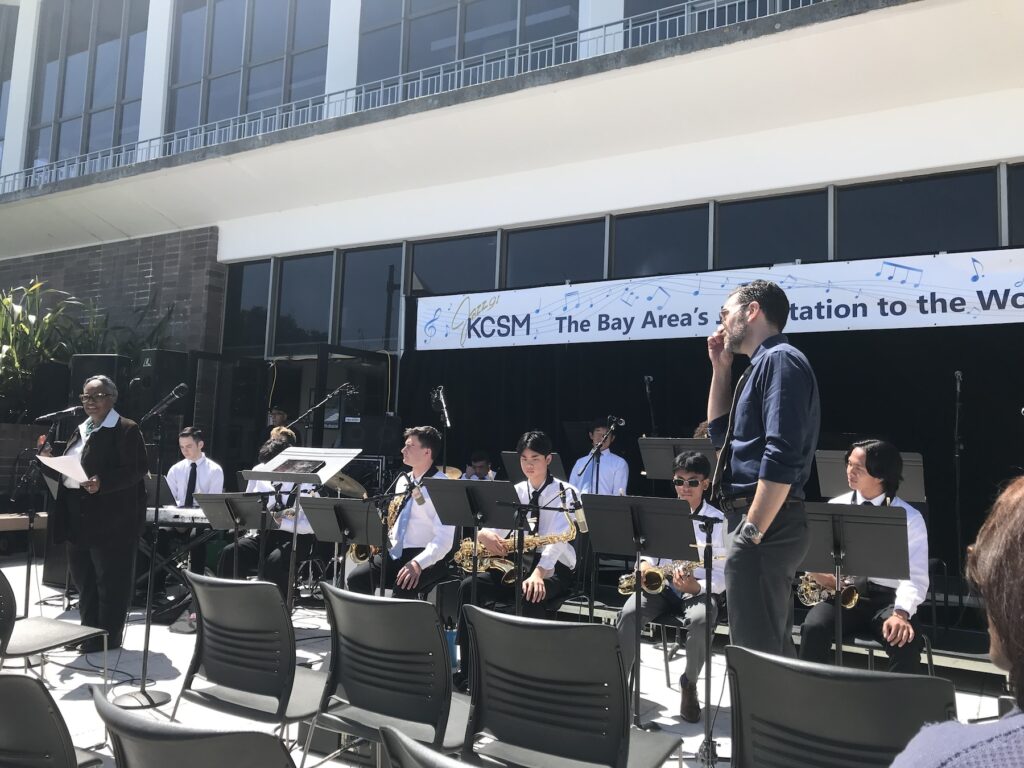
Miranda Wilson, MC of radio station KCSM’s “Passing the Torch” celebration on last Thursday at the College of San Mateo, has a voice made for radio, as crisp and clear as the sunny San Mateo day surrounding us. “The legacy of jazz is in very safe hands with the folks behind me,” Wilson says.
The folks behind her are teenage boys in ties, a few more nervous than others. The first of four acts, the St. Ignatius Jazz Band, directed by Mr. Galen Green, kick-off the third annual Celebrate Jazz Appreciation Month with KCSM to honor jazz’s influence on generations of musicians.
Green, who has performed with the Temptations, The Four Tops, and Tito Puente, Jr., directs his six horns and full rhythm section into “Mr. Saturday Night,” snapping his gum and his fingers to the beat, followed by “Green Eyes,” then “After You’re Gone,” a favorite of Charlie Parker. Green sets up “After You’re Gone” by sharing that one of his favorite performances of Parker was in Carnegie Hall. “He does things in performances he would never do in studio. He would stretch it out a bit.”
The brilliant improvisation of Charlie Parker speaks to the importance of listening to jazz live and in-person. “People know passion when they hear it, and jazz is passion,” Dr. Robert Franklin, KCSM-FM Station Manager at College of San Mateo, explained by phone the previous day. “Hard for most people to even explain it. You can’t fake passion – you either love it or you don’t.” When asked if the spontaneous passion of live jazz somehow makes the art AI-proof, Franklin responded, “AI can’t duplicate soul and authenticity.”
The SI Jazz Band hits its stride with “The Pink Panther Theme” by Henry Mancini, any remaining nerves swept away by Mancini’s cool strings and smart sax. The band and the crowd connect through the contagious beat, the music pulling us into the present to provide a thrilling if momentary respite from reality. (Even journalists understand the power of a good beat—legendary reporter Pete Hamill stole drummer Gene Kruper’s internal mantra of “Lyonnaise potatoes and some pork chops, lyonnaise potatoes and some pork chops” to lend rhythm to his typewritten prose.)
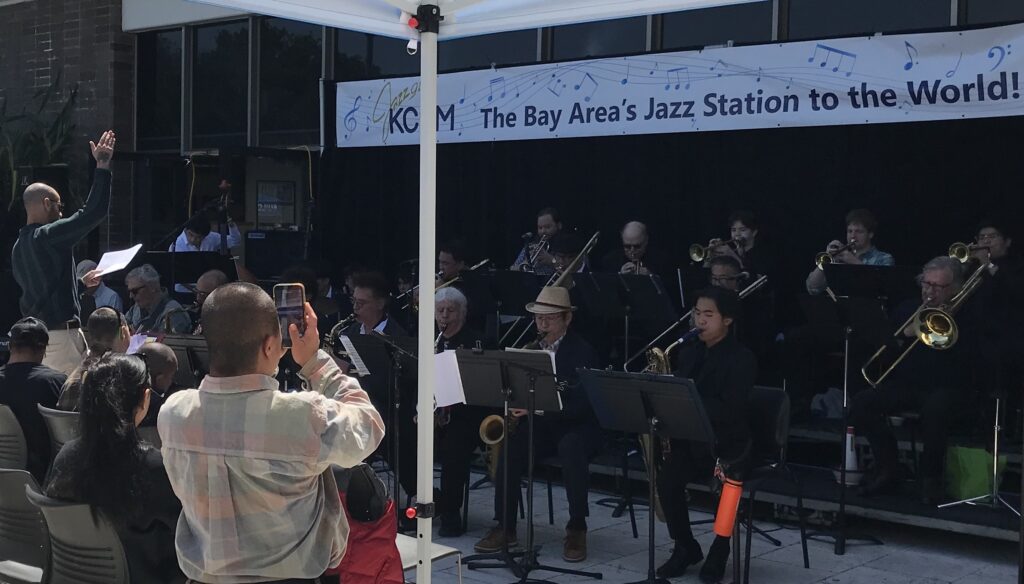
The band, sadly, has to get back for afternoon classes. But Miranda Wilson keeps the crowd entertained during the set change (“If only our politicians knew how to work in concert with each other like those kids.”) We graduate from high school to college with the next act, The College of San Mateo Big Band under the direction of Michael Mitchell, who moves behind the crowd for a sound check. “Beautiful to hear the St. Ignatius Band,” Mitchell says. “We invite younger musicians out there to practice with our band to cut their teeth.”
How his own band has “cut their teeth” is clear from the opening notes—more layers, tighter, the band plays with each other and not just at their director. Mitchell “keeps it moving” from “Grace” by Quincy Jones to “Satin Doll” by Duke Ellington to a toe-tapping crescendo of “Blues in the Closet” by Oscar Pederford. A Goldilocks musical zone: No note is too long or too short, every note just right, and the players make a competition out of cooperation like only great jazz players can.
Wilson again carries the energy through the set change with her joy and wit. “They turned this patio into a night club! You come out here at night and all you’d find are coyotes running around.”

Less than two cords into the third act, and it’s a shame the high schoolers didn’t stick around for a real education. Accompanied by a flutist and stand-up bass, Larry Vuckovich and Kai Lyons show no performance jitters, Larry moving behind his piano with accustomed ease and guitarist Kai Lyons strapping on his instrument like he’s sliding on a shirt. “I come from Montenegro, the only student of Vince Guaraldi,” Vuckovich says by way of introduction.
They begin with “Whispering” by Dizzy Gillespie, one of several icons who Larry played with (“Dizzy told the draft board during WWII that if you give me a gun, I might shoot the wrong person,” Vuckovich shares with a laugh.) Their scatting is the peak of improvisation; when they go back and forth, the language sounds unprogrammable. (And even if you could program it, why on earth would you?)
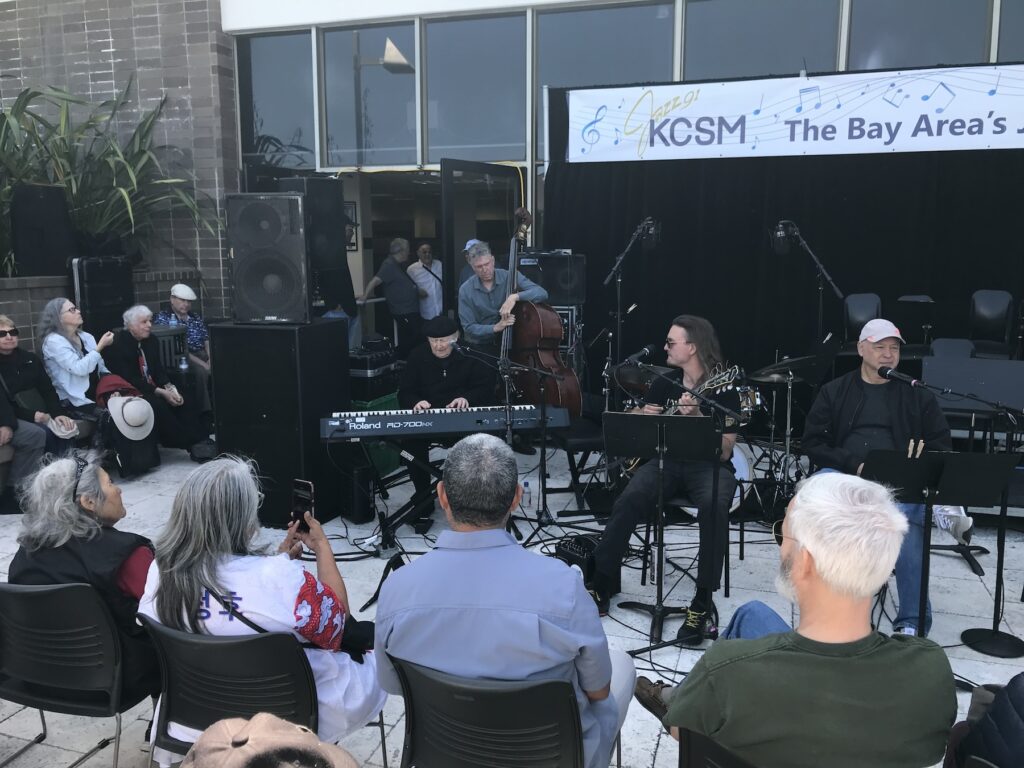
They walk so easily into a samba by Guaraldi that the line between their lives and their performance seems invisible, their expertise allowing them to watch each other as much as their own instruments. (They are, in fact, each other’s instruments.) KCSM Director of Radio Operations Chris Cortez joins them on drums, and they keep it moving into a chacha of “Perhaps, Perhaps, Perhaps” that gets the bass player plucking strings and shaking like the bass plays him.
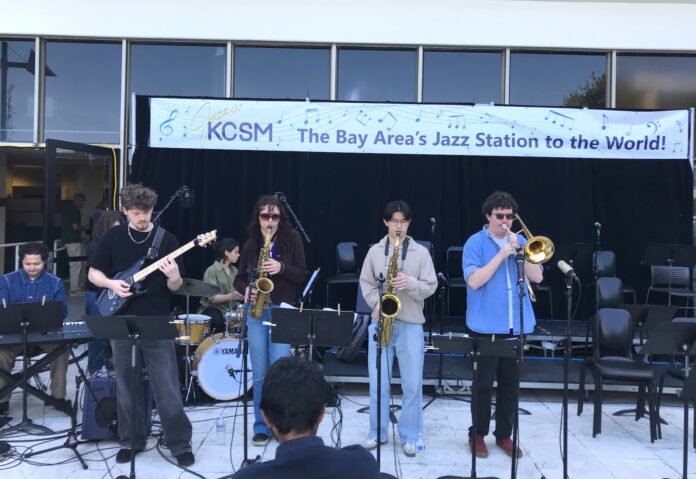
It’s clear that many in the crowd, which thins before the final act, came to see Larry. But several old lions stick around for the finale, as the torch is passed to the young lions of the San Francisco Conservatory of Music‘s Roots Jazz and American Music (RJAM) combo, featuring Tania Cosma (drums), Graham Houpt (trombone), Kira Agrell (alto saxophone), Trent Horio (Tenor sax) , Alexis Tsamoudakis (bass), and Abner Robles (piano).
Under the direction of drummer and SFCM professor Akira Tana who watches from the crowd, the six pieces play tight and connected. They display virtuosity, in particular, in their solos, understanding that what makes or breaks most solos is a smooth set-up before and an easy transition after. And their lively improvisations are a good reminder of the value of adaptation, not just in jazz but in life, considering none of us really know what’s coming next. (Even AI.)
They move easily from “Scotch and Water” by Cannonball Adderley to “Inside Straight,” the charisma of saxophonist Kira Agrellcreatingan orbit for the rest to spin around. No stories about hanging out with Dizzy, just the music. And, by the sound of it, the torch they carry burns as clear and bright as a San Mateo spring day.
(For those who missed the event, mark June 6’s “Jazz on the Hill” on your calendar.)