Even as political events in the here-and-now grow ever more… um, theatrical (re: last weekend’s unconvincing dramatics at the White House Correspondents Dinner), and media monopolies increasingly seem bent on warping or shutting out real news, documentary filmmakers continue to seek verifiable, often inconvenient truths. This week provides a particularly rich local array of such works—and before the month’s end there will be another truckload in the form of SF DocFest, which opens May 28.
Two arrivals at the Roxie on Fri/1—yes, May Day—provide stirring portraits of stubborn activism against capitalist behemoths. Argentinian director Lucretia Martel, who paid a visit to the Bay Area just a couple weeks ago, will see the opening there of latest feature Our Land aka Nuestra Tierra (more info here). It’s an expansive overview of a knotty, long-running true crime story: In 2009 indigenous leader Javier Chocobar was killed while confronting representatives of corporate interests determined to mine his land’s minerals, with or without his cooperation.
It took years for the homicide case to come to trial, at which point the defense doubled down on arguments that might seem outrageous to outsiders—they claimed the 68-year-old Chocobar couldn’t have any rights to that land, because his Chushchagasta peoples “disappeared” two centuries prior. But then that is typical of their treatment by colonialists over an even longer span, an attitude of almost cartoonish white privilege condescension and dismissal that duly gets played out all over again in the courtroom. “Justice,” it seems, is still rigged by the wealthy against marginalized communities. You’d think the Chushchagasta themselves are on trial, they get subjected to such hostile questioning—while conversely we never see the well-connected accused questioned at all.
This would comprise a powerful-enough indictment if handled in completely straightforward terms. But making her first full-length documentary, Martel approaches things from many angles, incorporating aspects of historical overview, film essay, landscape appreciation, and more. Our Land is a beautifully crafted, complex entity that rewards on a lot of levels. Starting on Fri/8, the Roxie will also begin showing a new 4K restoration of the director’s sophomore feature, The Headless Woman (more info here), an unsettling 2008 fiction whose narrative again happens to involve socioeconomic imbalances and death in a rural area.
Another struggle over who gets to profit from local resources is depicted in famed documentarian Barbara Kopple’s 1990 American Dream (more info here), which is likewise being re-released in a 4K restoration at the Roxie. Repeating the success of her 1976 Harlan County, USA (which itself re-opens Fri/8), it won the Oscar in its category. But unlike that film, which offered an ultimately upbeat, inspiring portrait of coal miners striking for better pay and conditions in Kentucky, this unofficial followup illustrates how disempowering the Reagan Era was for labor unions. In mid-’80s Austin, Minnesota, Hormel Foods’ meatpacking plant is the biggest employer. The work is demanding, sometimes dangerous (injury rates are high), but at least it pays well enough to comfortably support area families. It does, that is, until Hormel decides to significantly cut wages and benefits—just to “stay competitive” with lower-paying rivals, though it’s already making an annual profit of $30 million.
Workers are outraged, of course. But what makes Dream a particularly heartrending downer—though a thoroughly engrossing one—is that the union’s position is no longer strong enough to protect their interests. Indeed, there wind up being painful fissures amongst union factions, which place lifelong neighbors, friends, even siblings on bitterly opposed sides. Meanwhile, corporate management sits on its hands, confident in prevailing…with even worse reductions in renumeration on its to-do list. The ironically named American Dream provides potent evidence that the current climate of fear over AI replacing human labor is nothing new—owners have been callously trimming employee ranks to fatten their bottom line since the start of the Industrial Revolution about 200 years ago.
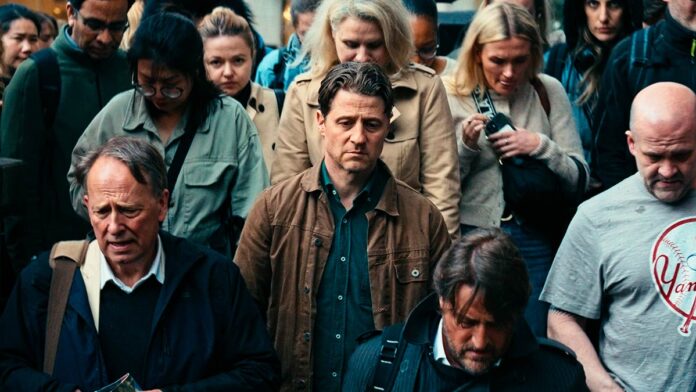
Two new documentaries are also playing single shows at the Roxie this Sun/3, both with their directors present for post-screening Q&A’s. Actor turned economic commentator Ben McKenzie—perhaps best known for the small-screen series The O.C., Southland, and Gotham, though I’ll always treasure his turn in the 2005 indie jewel Junebug—wades into the world of cryptocurrency with Everyone Is Lying To You For Money (more info here). What he discovers is, of course, pretty well distilled by that title. Unspooling earlier in the afternoon is Gail Freedman’s No One Cares About Crazy People (more info here), based on Ron Powers’ nonfiction tome about the ways in which the US is and isn’t coping with the needs of those afflicted by severe mental illness. This overview is narrated by Bob Odenkirk and scored by Wilco’s Jeff Tweedy; Senator Susan Eggman will join the director and other panelists in a live discussion.
Last but not least, there’s a whole four-day smorgasbord of nonfiction cinema from around the world starting this Thurs/30 at the 10th annual edition of DocLands, taking place at the Smith Rafael Film Center in San Rafael. Its expansive lineup of features, shorts and panels encompasses scrutiny of myriad environmental issues (Fog Eaters, Arctic Alchemy, Hellcat, The Art of Adventure, Hard Twist), plus inquiries into solar geoengineering (Plan C for Civilization), justice for indigenous peoples (Aanikoobijigan), and the activist individual (Jane Elliott Against the World, Tough Old Broads). Portraits of an artist range from multi-hyphenate Luis Valdez (American Pachuco) to poet Mary Oliver (Saved by the Beauty of the World), photographers (Creating a Photojournalist, Birds of War), musicians (Little Feat, Beatles-related Rolling Film, Rocking History) and a scholar of rock (The Last Critic).

The animal kingdom is explored in films about cows (A Dairy Story), horses (Iron Winter), polar bears (Trade Secret) and Mongolian eagle hunting (Black Eyes). The sporting life gets represented in looks at soccer in Greenland (No Place For Football) and Jamaica (Reggae Girlz), plus South African surfing (Into the Light). Observer ponders sight, and Joybubbles its lack; male contraception is the subject of Give It a Shot. Then there’s the intriguing Nuns vs. the Vatican, and self-explanatory Zelensky. Filmmakers will be present at many screenings, a full program schedule is here.
Other new releases this week:
Hokum
Each successive film so far from Irish writer-director Damian McCarthy has broadened his audience, and each I’ve liked a bit less than the one before—but that only means he’s gone from exceptional (Caveat) to very good (Oddity) to plain old good with his latest. His work remains well above average as screen horror goes, atmospheric and twisty without need for gore (or even much violence) to induce chills. Here, an American genre novelist (Adam Scott) journeys to a country inn on the Emerald Isle to spread his parents’ ashes—they’d once had happy times there. He’s a brusque, unpleasant personality who dismisses tales of the hotel’s “haunted” honeymoon suite, purportedly involving a resident witch. Then, of course, circumstances find him trapped in it.
Edging towards greater commercial conventionality, McCarthy includes more jump scares this time around…which is a tad disappointing, though he does them well enough. But there are also playful reprises of ideas he’s already utilized, which come off less as self-cannibalizing than as in-jokes for the knowledgable. I found Hokum’s framing device (which visualizes a passage from our hero’s latest pulp fiction) gratuitous, and general emotional involvement lean. But there is still no doubt this director knows just how to give you a fine case of the creeps. It opens nationwide on Fri/1.
One Spoon of Chocolate
A less accomplished spin on genre tropes is this third feature by RZA of the Wu-Tang Clan. It’s his most ambitious directorial effort to date, but falls considerably short of its goals, unhelped by the recent memory of Sinners—a movie that approached similar serious themes within an exploitation-cinema context, albeit much more artfully. Returning to his native Ohio small town after three military Iraq tours and a prison stint (he’d put a neighbor’s violently abusive husband into a coma), Shameik Moore’s protagonist Unique soon discovers it’s been taken over by a gang of racist whites. They terrorize the African-American populace with zero interference from local authorities, who in fact are fully supportive of the goon squad. Needless to say, a couple deaths and training montages later, Unique will whup major honky ass.
With Tarantino on board as an executive producer, Chocolate at first promises to be semi-tongue-in-cheek retro action trash, mixing elements of 1970s blaxploitation, vintage Southern melodramas, and 1980s grindhouse sleaze—the Nazi-punk villains are right out of Class of 1984, Savage Streets, or a Death Wish sequel. But the vigilante-flick cartoonishness of RZA’s script needs zestier execution than he provides as director. While slick enough, this movie is too slowly paced, its setpieces too lacking in punch or stylish distinction, for a screenplay so simplistic—and in the end it’s oddly over-earnest, as if it were making a Major Statement rather than recycling hoary potboiler cliches. As for the casting of Paris Jackson as Unique’s love interest… let’s just say, acting doesn’t seem to be her forte. The film opens Thurs/4 at theaters nationwide.
Love Hurts: ‘Erupcja,’ ‘Paying For It’
Two modest new seriocomedies explore the awkward intricacies of modern romance. Prolific US indie writer-director Pete Ohs’ Erupcja finds Bethany (pop star Charli XCX) and Rob (Will Madden) as a couple who’ve been living together in London for a year. On what’s intended to be a romantic weekend getaway to Warsaw, she looks up childhood friend Nel (Lena Gora)—with whom her chemistry is so combustive, volcanoes erupt somewhere around the globe each time they reunite.
Finding himself abandoned, when he’d expected to “pop the question,” Rob must come to terms with his relationship’s apparent, unexpected end. Just 71 minutes long, Ohs’ latest is quirky and interesting but never feels substantial. That’s perhaps an accurate representation of characters who themselves remain immature and indecisive. But it makes this breezy divertissement, which opens at the Roxie on Fri/1 (the director in person on Sun/3), feel almost weightless.
More impressive is the Paying for It, adapted from Chester Brown’s graphic memoir by Sook-Yin Lee—whose real-life breakup with him was largely its original subject. This Chester (played by Dan Beirne) is, natch, a nebbishy underground comics creator living with longtime girlfriend Sonny (Emily Le), a VJ on MusicMax (a fictionalized version of Canadian MTV equivalent MusicPlus, which Lee worked for). They’re comfortable together. But emotionally, things have flatlined, and sexually, they’re six feet under.
Sonny announces she wants to pursue other involvements, which Chester passively agrees to. But for her that new freedom turns into a parade of boyfriend disasters, while for him it opens a surprising door to satisfaction—he realizes his needs are fully met by paying professionals for regular, polite sex. This is one of those offbeat, low-key relationship dramedies that don’t aim for any big payoff, yet ingratiate with its smartly insightful script, character delineation and performances. Paying for It bypassed the Bay Area in recent limited theatrical release, but is available as of Fri/1 from arthouse streaming platform Film Movement.