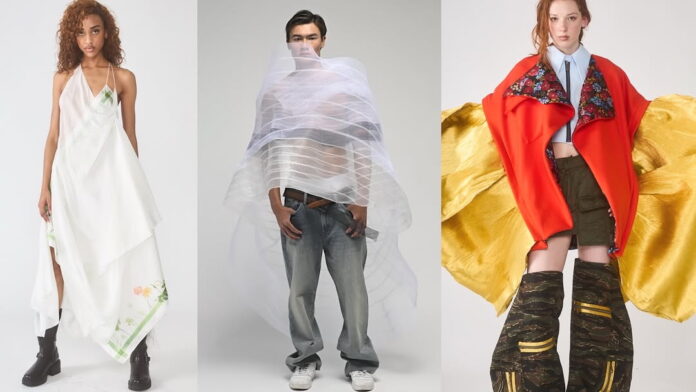
Forget the gaudy Met Gala: Across two days in early May, the Academy of Art University’s School of Fashion presents a stylish snapshot of emerging local design, spanning runway presentations and a public-facing show in Union Square.
On May 7, “US NOW” unfolds in twin runway presentations at 2:30pm and 7pm (the latter streaming globally), followed the next day by the “Bloom Fashion Show,” a Halston-inspired presentation developed in partnership with the With Love Halston Foundation.
The initial shows center on 19 graduating designers presenting thesis collections developed over the past year. Rather than working toward a single aesthetic, the runway moves through a range of distinct voices—some direct and declarative, others more introspective—each grounded in a specific set of influences.
“Our students form opinions, create concepts, and showcase them through fashion and clothing,” says Academy of Art University’s Executive Director Neil Gilks. “It’s open to their interpretation.”
Gilks brings a background that bridges design and industry leadership, with experience that includes work with the Council of Fashion Designers of America (CFDA) and ongoing engagement with the professional fashion world. That perspective shapes how he positions the program—not only as a space for experimentation, but also as one that connects directly to industry pathways.
In San Francisco, that connection often takes a different form than in traditional fashion capitals. Rather than feeding into a centralized system, students move through a network of opportunities that includes internships, studio work, and placements with major companies.
Through partnerships and proximity, some students gain hands-on experience with companies like Gap Inc. and Levi Strauss while still in school, building practical skills alongside their conceptual work and, in some cases, continuing into roles after graduation.
The balance between independence and access informs the structure of the shows, creating space for individual approaches to develop while remaining legible beyond the academic setting.

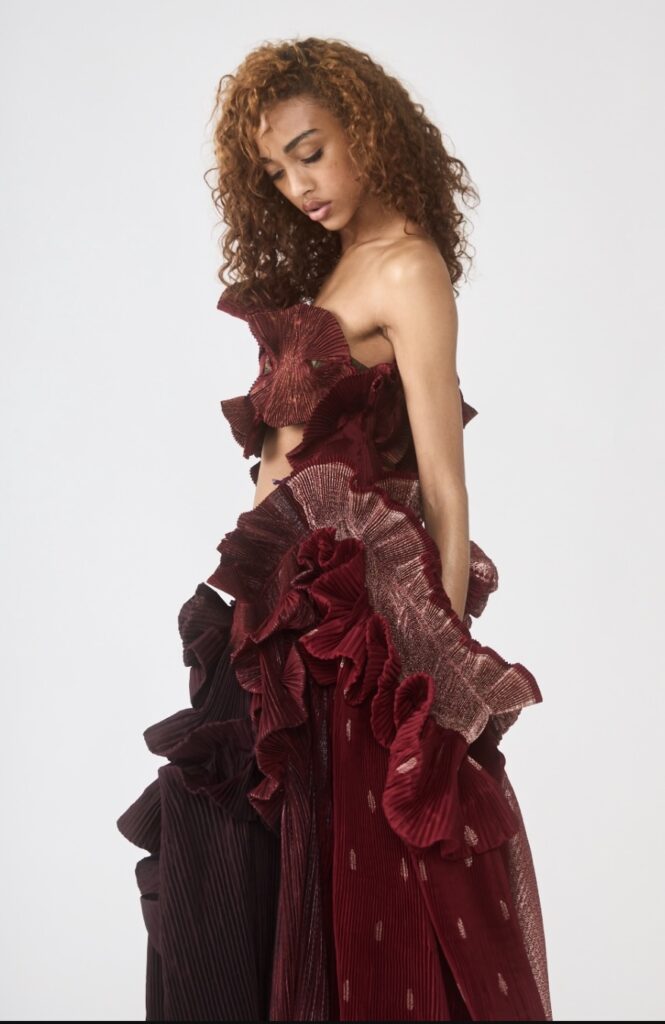
You can see it all come through in the garments. Structured, sharply tailored pieces give way to more fluid silhouettes, with materials ranging from rigid to responsive. The show doesn’t resolve those differences; it lets them coexist.
“We have students who are big and passionate about making political statements, but we also have people who just want to create things of beauty,” Gilks says.
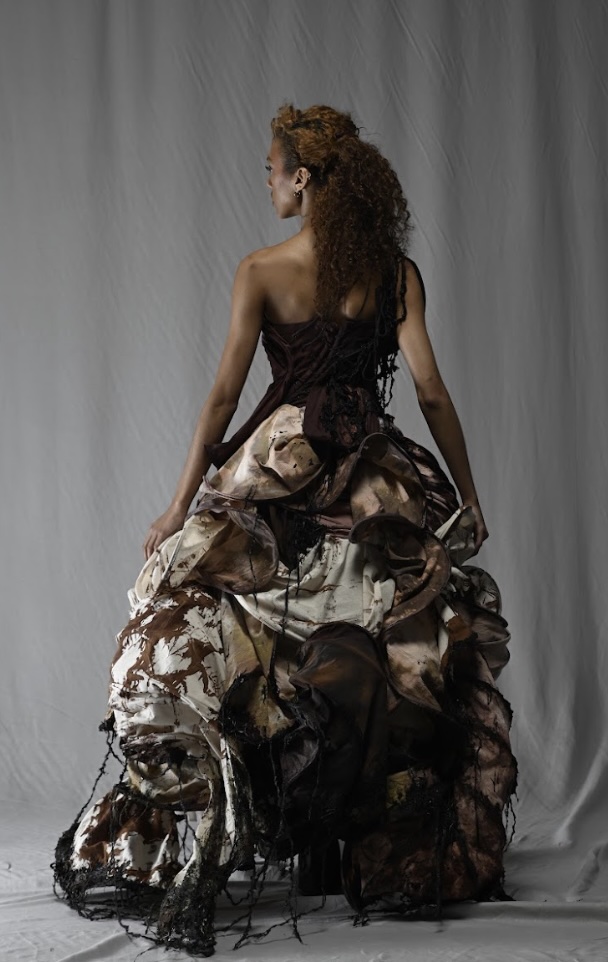
Those perspectives come into focus through the designers. In Substrata, collaborators Ella Romano, Justin Federico, and Katelyn Knapp construct uneven, layered forms that feel eroded rather than assembled, as if shaped over time rather than designed in a single moment.
Katherine Van Kraut extends that approach, using wood and bark to create rigid silhouettes that sit somewhere between clothing and objet d’art.
Elsewhere, movement takes priority. Eva Kam creates pieces that hug the body and shift as the wearer moves. Fiza Riyas builds rich, ceremonial layers inspired by the Theyyam tradition of South India. Patric Yikun Wang leans into theatricality, using costume to explore transformation and queer identity through dramatic changes in scale and presence.
Michal Rezoni begins with discarded garments, reconstructing them in ways that preserve their history rather than erase it. “It’s as if the history the garments carry through wear and tear is still embedded in them, but she’s totally reframed everything,” Gilks says.
Brittany Patterson, a US Air Force veteran, also draws from personal history, but moves in the opposite direction, loosening the visual language of uniform and introducing color and softness where there was once structure.
“I hope people will leave the shows with a few question marks,” Gilks says. “It’s about provoking thoughts and emotion.”
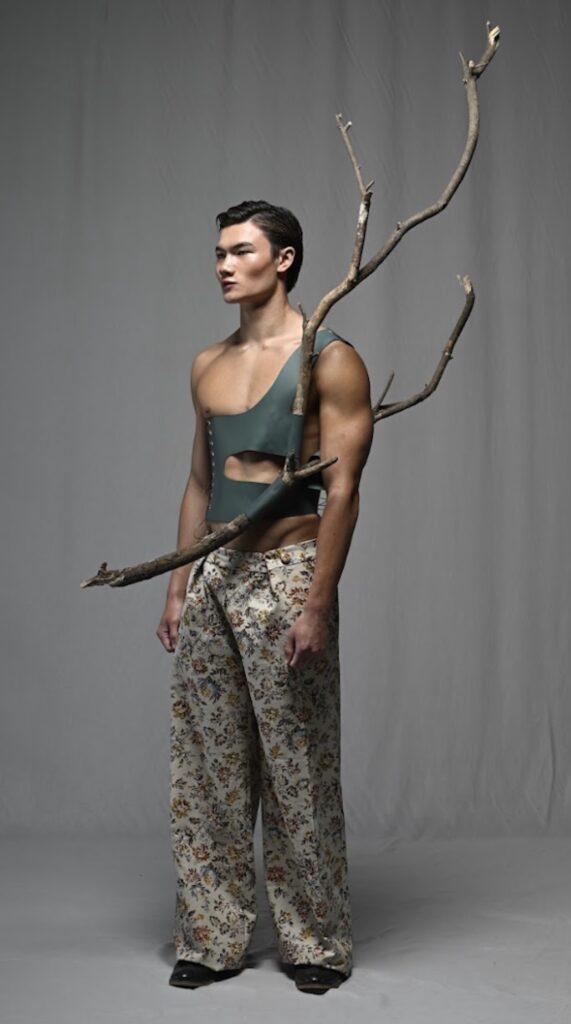
Materials matter, too. Several designers constructing textiles from the ground up, knitting, weaving, or engineering fabric before garment building begins.
If “US NOW” is expansive, “Bloom Fashion Show” narrows the focus, drawing from Halston’s principles of ease, movement, and the relationship between garment and wearer, and reworking them through a contemporary lens.
“The last thing we wanted to do was make this feel like it’s a period piece at all,” Gilks says. “It’s the attitude that makes it now.”
Presented as part of floral showcase Union Square in Bloom, the show places the work in a public setting, where it flows with the city rather than apart from it. A panel of judges will select a standout designer, but the more lasting shift is in how the work is encountered as something embedded in a shared, everyday environment.
For Gilks, that relationship between fashion and daily life is closely tied to San Francisco itself, a city he argues is often mischaracterized in conversations about style. “I read on socials, ‘San Francisco’s got no style,’” he says. “And I’m like, ‘Are you walking around with your eyes closed?’”
Historically, San Francisco’s fashion landscape has developed outside the traditional industry model. Without the centralized infrastructure of cities like New York or Los Angeles, it operates as a network of independent designers, art schools, and cross-disciplinary practices—less unified, but often more flexible.
The independence has long shaped the city’s creative output, from its countercultural past to its current mix of designers working across fashion, art, and technology.
“I think there’s such a cross-section of people and fashion in this city, which I find really wonderful,” says Gilks.“The greatest thing I find about San Francisco is that there’s a lot less judgment,” he says. Everyone is much happier to let people identify, dress, and do as they wish.
“There’s a pulse to this place that’s reflected in the shows.”
US NOW Thu/7, 2:30pm and 7pm, Academy of Art University, SF. More info here.
BLOOM FASHION SHOW Fri/8, 1pm, Union Square, SF. More info here.