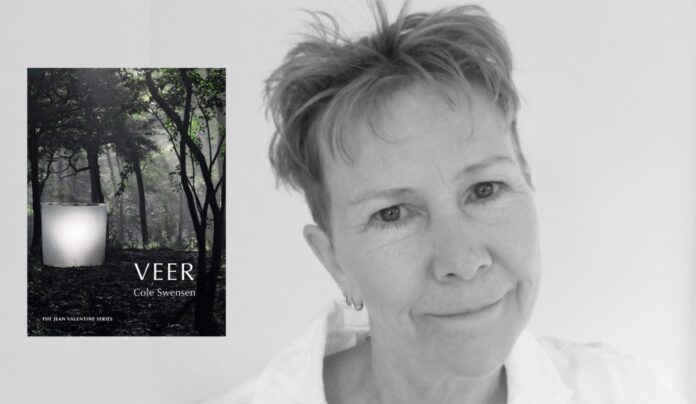
Poet, editor, and translator Cole Swensen’s latest book Veer (Alice James Books) is organized into three parts: Tic, Tac, and Tao. The poems roam adventurously through nature, a hike undertaken by someone who dares dive into streams, delve into the minds of crows, scamper up tree trunks, or edge daringly close to the sun. The poems are and are not about relationships—Swensen leaves room for the reader to choose which scenario to perceive. Throughout, they demonstrate her crisp sense of humor and sparse, evocative writing style.
Born and raised near San Francisco, a longtime professor at Brown before her recent retirement, and a 2006 Guggenheim Fellow, Swensen has long been a fixture of the poetry scene. In anticipation of her Mon/18 conversation with fellow poet Norma Cole at City Lights—and because she was traveling by train in Germany and phone connections were iffy—she graciously answered some questions over email.
48HILLS How did your childhood reading habits and early exposure to art shaped your writing habits?
COLE SWENSEN I’m not sure that I can draw any specific connections, but I was an avid reader as a child, and my mother was a painter, so I grew up in a house in which the arts were a normal part of everyday life. I never questioned whether being a poet was practical or reasonable; I just wrote poems and greatly enjoyed it, so kept on doing it. I began writing when I was about 11, and it was always poetry, though I don’t know why, as most of what I read were novels.
48HILLS You studied at Santa Cruz. Beyond your instructors’ insights, what do you think you took from that environment as a poet?
COLE SWENSEN I was at Santa Cruz for my PhD, so I was deeply engaged in critical writing. While I’d done a lot during my undergraduate and master’s degrees, the PhD required a deeper commitment to both critical writing and critical theory, which I greatly enjoyed. I did worry when I started the program that it might nudge the poetry out of my life, that I just wouldn’t have time for it. But that didn’t happen. Instead, my studies, particularly the critical theory, added a dimension of reflection to the poetry, allowed it to become denser and based less strictly on image, and more on the action of language itself.
Another, and wholly unexpected, aspect of my experience of Santa Cruz was the drive up and down the coast—I lived in San Francisco and drove down to Santa Cruz a couple of times a week, always along Highway 1, and spending so much time right up against the vastness of the ocean and the surrounding landscape made a deep impression on me, which I still feel—and I miss it.
48HILLS If your previous collections are thought of as ancestors that can be traced to Veer, is there one you believe establishes the lineage most clearly?

COLE SWENSEN And And And, the book that came right before Veer, was quite different from what I had been doing before, and Veer continues in that vein. In And And And, I started writing in much more coherent paragraphs, dropping the fragment, ellipsis, and other forms of linguistic disruption that I’d used for years, and introducing an element of the absurd and the illogical, which are other, though very different ways, of approaching the limits of language, which has always been one of my principal interests.
That said, coherent paragraphs also appeared in earlier books, particularly in Art in Time, which is a collection of hybrid poem-essays about landscape artists who refuse or complicate linear perspective. The shift toward the coherent paragraph stems, I think, from an increasing interest in saying things. I’m a firm believer that poetry does not say, but does. Yet nonetheless, there’s an element of conversing with the world, with some of its concrete, specific things, that I really enjoy and that has become more prominent in my work, and that requires a more fluid, direct language.
48HILLS I flagged several of the poems to ask you comment on, but then forced myself to select four. Without forcing an agenda on the direction you take, please share any comments that come first to mind. First up, “More Story Problems.”
COLE SWENSEN “More Story Problems” is a poem based in friendship. The writer Lisa Robertson and I were looking through Coleridge’s notebooks, and in one, he writes out a story problem for a child—I think it was his grandson—and we found ourselves laughing about the form (the genre, really), and I found myself wanted to take his terms, the apples and pears, and play with them. It’s also a sort of revenge on the form, which as a child, I particularly detested.
48HILLS “More Sunlight”?
COLE SWENSEN There are a number of poems to sunlight in the book, and each of them is just an excuse to spend time wallowing in the fact of it—what could be more marvelous than sunlight! And yet, what is there to say about it beyond “hooray!”? Which is where the absurd comes in. Through it, language can offer us a chance to spend time with something, in this case, sunlight, without having the burden of “saying something.”
48HILLS “Paper Boats”?
COLE SWENSEN This is another poem based in friendship; the poet and novelist Biswamit Dwibedy one day described this ceremony to me, and at first, I really did misunderstand it, and I enjoyed that misunderstanding. (The misunderstanding involved the Indian celebration known as Bali Jatra.) I’m also particularly interested in poems that find themselves wrong or that change their minds at some point—a poem that says, no, not quite that, but maybe this… And I also simply love the image of the lighted boats heading out on the water.
48HILLS And “Birds on Statues”?
COLE SWENSEN This is also a poem based on an actual event—the two statues are right beside an outdoor café in a local park, and often there is a bird perched on each of their heads, and they look so delightfully absurd. Writing about them allowed me to sink into them a bit, to participate a little in their absurdity.
COLE SWENSEN WITH NORMA COLE May 18, 7pm. City Lights Bookstore, SF. More info here.