The night Cabaret Voltaire played its first show back together in the fall of 2025, the clocks seemed to turn against them.
It was October 26 in Sheffield, England, and the pioneering electronic group had just finished a sold-out hometown gig at FORGE Warehouse. The moment they walked offstage, Britain fell out of daylight saving time. For these night owls, the wee small hours of the morning suddenly grew longer.
Later that night, at a friend’s house, two inebriated women stood in the kitchen trying to reconcile the time on their iPhones, watches, and oven clock, none of which agreed.
“They kept asking, ‘But what time is it, really?’” founding Cabs member Stephen Mallinder tells 48 Hills.
The title of Cabaret Voltaire’s new live album, But What Time Is It Really?, emerges from that moment of confusion and gets at the heart of what the band’s final shows represent: not nostalgia, not a victory lap, but a reckoning with age, memory, loss, and the passage of time.
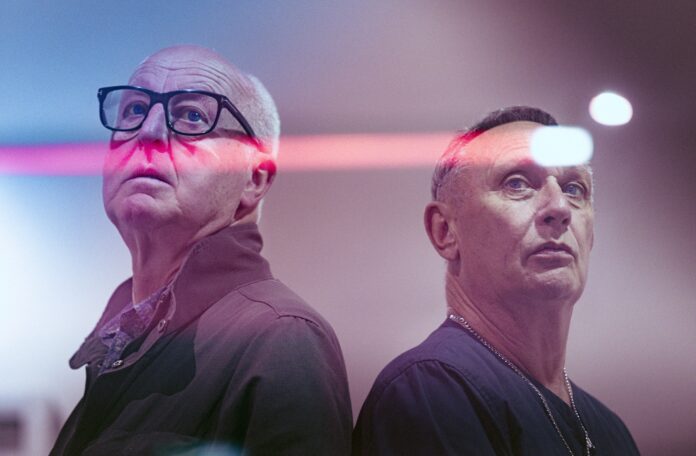
That sense of time catching up with them comes to San Francisco when Cabaret Voltaire plays The Regency Ballroom on May 15, celebrating the group’s 50 years of recording.
For Mallinder, the city is not just another stop on the tour. It has been tied to Cabaret Voltaire since the band’s earliest US visits in 1980, and Mallinder is clearly eager to return.
“My first perception of America was San Francisco,” he says. “I have massive memories of San Francisco and such great times there. And your first impressions of a place are always the ones that stick.”

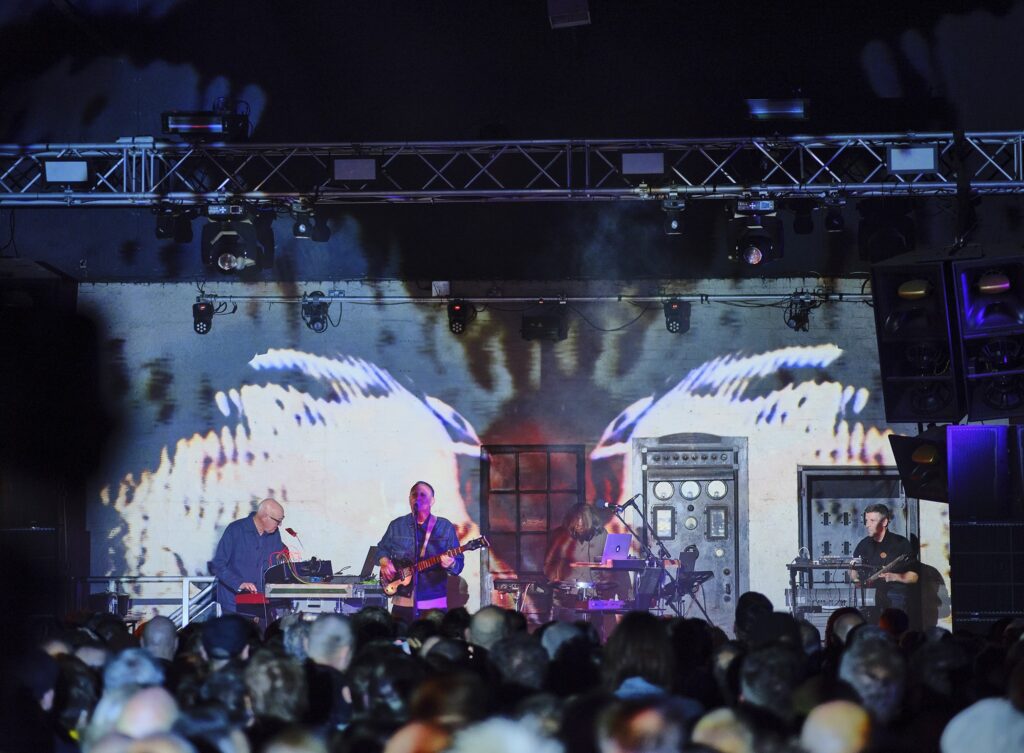
But Mallinder is equally adamant that audiences’ first impressions of these songs may not survive what they hear on this tour. He says the tracks only retain the original samples—TV dialogue, radio fragments, and found voices. Everything else has been rebuilt from scratch.
Mallinder spent months working with music engineer and synth specialist Ben “Benge” Edwards to reconstruct material spanning from 1977 to the early ’90s because the original multi-tracks no longer exist. And he says the reworked songs consistently catch audiences off guard.
“People go, ‘They sound exactly like they did,’” says Mallinder. “But they don’t because we’ve remade them for now.”
That insistence on the present tense is at the heart of why he decided to do this at all. “It was about the relevance of the work: the themes, technology, approaches, and sounds,” he says. “They’re probably as relevant—in many respects more relevant—today.”
He’s not wrong. A band that spent decades making music about surveillance, media manipulation, systems of control, and the paranoid texture of modern life looks more prophetic than ever in 2026.
“Our reasons for being paranoid were only partly paranoid,” Mallinder says with a laugh.
But beneath the dark humor was a serious desire to make people question the world around them and the forces shaping their lives. Titles like “Crackdown,” “Spies in the Wires,” and “Sex Money Freaks” now read less like period pieces than dispatches from the present.
“With deepfake and AI, with social media and the ability to live in this odd simulated world where we question reality, those things we built around are still massively relevant today,” says Mallinder.
There is also, beneath all of this, a more private reason for these shows. Richard H. Kirk, the third original member of Cabaret Voltaire and the person who kept the name alive during the band’s long hiatus, died in 2021.
“I was really devastated and brokenhearted,” Mallinder says. “He was like a brother to me.”
The two had known each other since they were 14 years old, growing up together in Sheffield long before the band existed. The decision not to record new Cabaret Voltaire material is bound up in that grief.
“I didn’t want to do new material out of respect for Richard,” says Mallinder. “We did all this work together, so sadly, we couldn’t play it together. But I don’t want to use Cabaret Voltaire as a model for my own music. That doesn’t seem right to me.”
Preparing for the live shows meant sitting alone with decades of recordings and reverse-engineering how everything had originally been made.
Mallinder says the process forced him to revisit years of studio memories, equipment, and recording methods. It was, he says quietly, incredibly emotional.
“I take Richard with me in spirit with these shows because he’s still very much part of it for me,” he says. “He’s in those tracks. I hope I’m honoring his name with this. That’s the intention.”
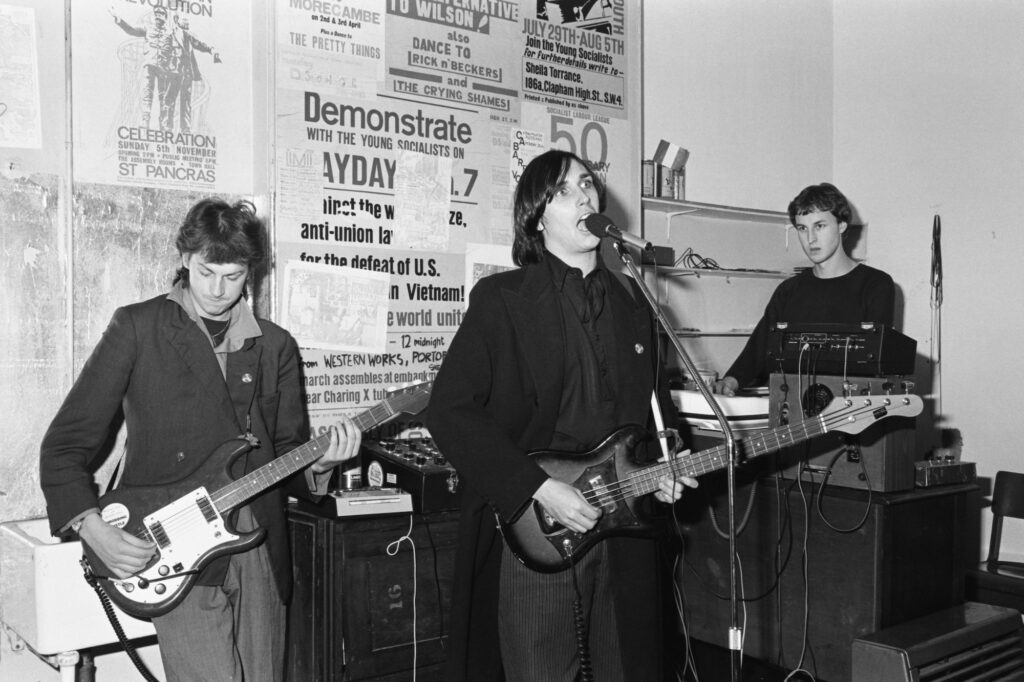
Chris Watson, an original member who left the band in 1981 and went on to a career in field recordings, will not be making the San Francisco date (or any of the US engagements) due to family and health reasons. His contributions are still woven through the set, though, with Tara Busch of I Speak Machine stepping into Watson’s role for the US dates alongside Mallinder, Benge, and Eric Random.
“He’s kind of with us in spirit, but he’s also with us in sound because we’re using his sounds,” says Mallinder.
The one new piece in the set, “Tinsley Viaduct,” a musique concrète work Watson has been developing for roughly a decade, was included partly to give him a real presence in shows that otherwise draw heavily on material recorded after he left.
Mallinder talks about the Sheffield electronic scene that Cabaret Voltaire emerged from as if it were a perfect storm of conditions that could never happen again: a city without a rock tradition, a strong soul and club culture, and a group of bands pushing one another forward.
“One band spawns another,” he says, describing the ecosystem that included themselves, ABC, Clock DVA, The Human League, and Heaven 17.
He credits the drum machine as the key technological pivot point. “The drum machine gave our music a rhythmic foundation which transformed much of what we’d done,” says Mallinder. “From an audience point of view, it gave them something to find relatable.”
Punk also played a role, even if Cabaret Voltaire never saw themselves as a punk band. “Punk was what opened a lot of those doors,” Mallinder says. “Punk allowed people like us to sneak through.”
The ‘80s were both the band’s most commercially successful period and their most politically antagonistic. Thatcher’s Britain, Reagan’s America, and the flood of money through financial centers gave Cabaret Voltaire something to push against, even as the era helped fund their studio work and Doublevision video label.
Mallinder says the band tried to use whatever money and opportunities came from the ‘80s boom years productively, putting them back into studios, labels, and creative work.
He is philosophical about the fact that Cabaret Voltaire never had a crossover hit.
“We never had a ‘Don’t You Want Me’ that was a millstone around our neck,” says Mallinder. “Our success has been gradual and continual.”
Still, for all of Cabaret Voltaire’s global influence, some of the band’s earliest and most formative American memories remain tied to San Francisco.
When the Cabs first came to the US in 1980, they did not start in New York or Los Angeles. They came straight to San Francisco, staying in North Beach for weeks as guests of V. Vale of RE/Search Publications, the legendary zine publisher who would become one of the key chroniclers of industrial and avant-garde culture.
They played Bay Area shows at San Francisco’s 10th Street Hall and the Keystone venues, sharing bills with underground acts like The Sleepers. Their blend of tape loops, dub basslines, industrial noise, found-sound collage, and dance music fed directly into the Bay Area underground, influencing industrial clubs, synth-pop nights, and the broader experimental scene that RE/Search helped map and amplify.
Across albums like The Crackdown and Micro-Phonies, Cabaret Voltaire evolved from abrasive experimentalists into one of the defining acts of electronic post-punk. Tracks like “Nag Nag Nag” and “Sensoria” became underground club staples, with “Sensoria” giving them their closest thing to a crossover hit, thanks in part to its surreal, industrial, and disorienting video directed by the legendary Peter Care.
Their relationship with the city was not without darker edges. After a June 1981 San Francisco performance, the band issued a postcard declaring that “The mission has been terminated”—a stark reflection of the exhaustion and tension building within the group.
When this final run of shows is over, Mallinder says part of him will wish he could keep going. But he is clear-eyed about why he won’t.
“I want to do as many shows as I can with Chris,” he says. “And if not, I don’t want to do too much without him there.”
But the final Sheffield show, he suspects, will be emotional, because there will be no going back.
What lingers is the sense that these shows are doing something more than marking an ending. They are acts of reconstruction: of sounds, memory, grief, and a relationship between music and the present moment that Cabaret Voltaire, almost uniquely, never had to manufacture.
The clocks may not agree on what time it is. But the music, rebuilt note by note from nothing, is unmistakably now.
CABARET VOLTAIRE Fri/15, 8pm, Regency Ballroom, SF. Tickets and more info here.