Mayor Daniel Lurie and four supervisors are moving to cut dramatically the city’s requirements that luxury housing developers include affordable units in their projects, although the evidence that the plan would encourage more private development is close to nonexistent.
The proposal comes before the Planning Commission Thursday/18.
The legislation aims to encourage more private development by lowering “obstacles” to construction, including city fees. The state has already cut local government out of the regulatory process for much new luxury housing; approval of the project at the Mission St. Safeway will be “ministerial,” meaning no Planning Commission hearing or vote.
But Lurie and Sups. Matt Dorsey, Myrna Melgar, Stephen Sherrill and Danny Sauter are going a step further, cutting all affordable housing fees for projects of fewer than 25 units and reducing the overall mandate to just five percent.
The problem: According to the Controller’s Office, even with zero affordable housing mandates, no market-rate construction is feasible right now. The cost of materials and labor and the interest rates on capital make it impossible to build at any level.
As Quintin Mecke, director of the Council of Community Housing Organizations, points out in a letter to the commission:
The ordinance rests on the Controller’s finding that the maximum feasible on-site rate is currently zero. But read the rest of that analysis: the Controller modeled the prototypes withno inclusionary requirement at all, and nearly every one remained infeasible.
If projects do not pencil even at zero inclusionary, then inclusionary is not what is stalling production — interest rates, capital costs, and rents are. Cutting the on-site requirement from 15% to 5% therefore guarantees a loss of affordable homes and revenue in exchange for a highly uncertain gain in production, because it cuts the one variable the City’s own study says is not the obstacle. The premise that lower inclusionary will unlock stalled projects in a declining market is contradicted by the feasibility study offered to justify it.
More:
Inclusionary is a planning tool, not a fee. It is the only mechanism the City has to convert all of the recent streamlining, upzoning, and density bonuses into affordability now, for the residents who live here today, rather than a promise of filtering and trickle-down over decades that displaced families will never see.
The City already constrains private return in the public interest as a matter of course — we cap parking, we require family-sized units, we set design and open-space standards — and no one calls those requirements confiscatory, because private development carries public obligations. Inclusionary belongs in precisely that category. Singling it out for permanent reduction while leaving the other public-interest requirements intact is not a feasibility judgment. It is a decision about whom new housing is permitted to serve.
So: the city gives up affordable housing fees, and likely gets no new market-rate housing anyway—and when economic conditions change, and developers start building more luxury units, the $50 million a year for affordable housing that once came from these fees will be gone.

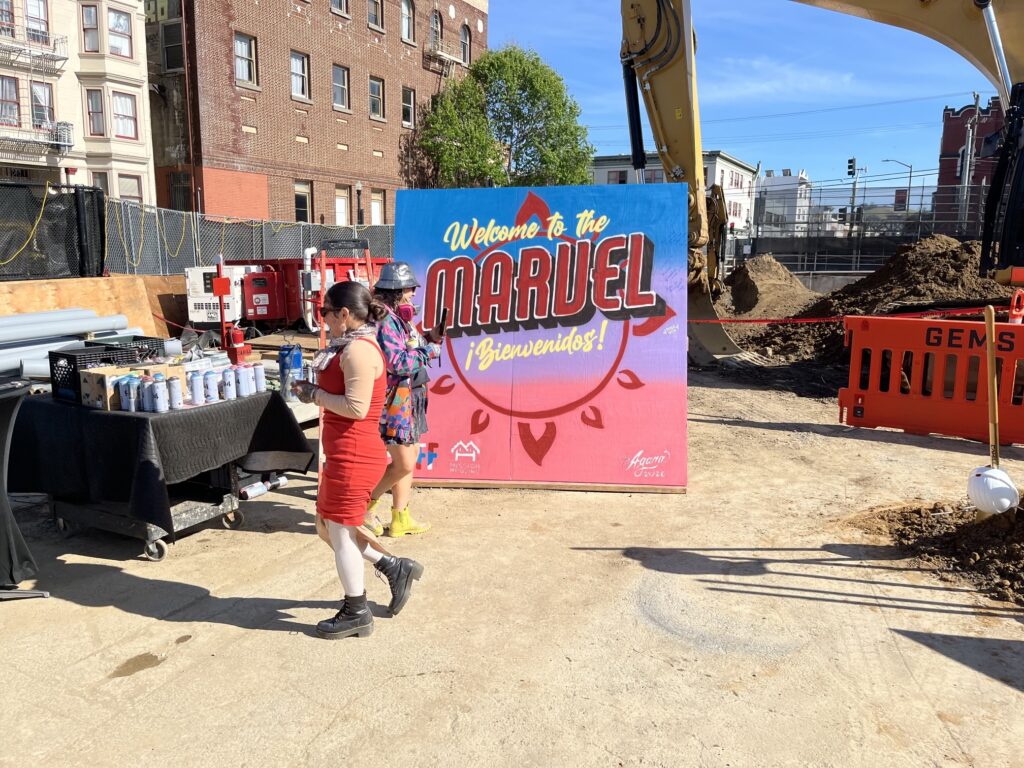
BTW: The Marvel in the Mission, the huge affordable housing complex at 16th and Mission, was funded by inclusionary housing fees.