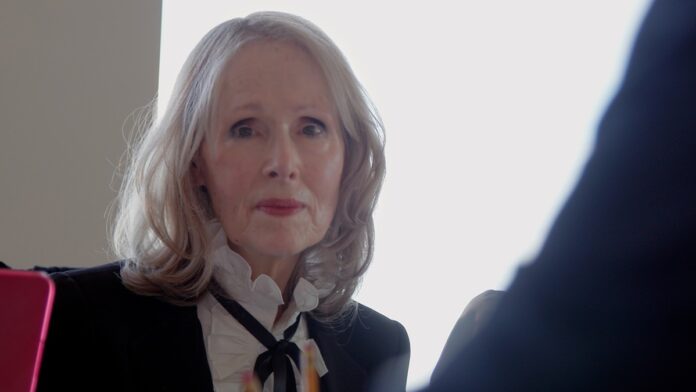
In the mid-1990s two Manhattan celebrities crossed paths outside the fabled Bergdorf Goodman department store. He said something like “You’re that advice lady.” She said “You’re Donald Trump.” (It later turned out they’d previously been photographed having some brief exchange in an event reception line… but people like these are always being introduced to each other.) According to E. Jean Carroll, the relentlessly self-promoting real estate tycoon corralled her into helping him “buy a present for a girl,” and she went along with it, because she was a journalist and thought this would turn into a funny, usable anecdote. She attempted to steer him towards the handbag department. He insisted on “lingerie.”
I’ll spare you the grisly details—though they are duly related in the new documentary Ask E. Jean. But when, incredulous but still amused, she agreed to try on something he’d picked out for his supposed friend, he followed her uninvited into a dressing room. According to Carroll, he yanked down her panty hose (which thwarted initial attempts to kick her way out of the situation) and abruptly if briefly fulfilled any legal definition of “rape” before she managed to struggle free. “I was so shocked I was laughing,” she says decades later, relating how she almost immediately called a friend to relate what had happened. The horrified friend said that what she was describing was sexual assault, and should be reported to police.
Why didn’t she do that at the time? Why instead did she wait to tell the story publicly many years later, when Harvey Weinstein revelations triggered the whole #MeToo movement and made her feel she had to? Well, those questions are a big part of Ivy Meeropol’s film, as well as key to who E. Jean Carroll herself was and is. A confessed “eccentric personality,” she inherited much of her self-confidence and “fearlessness” from a midwestern-politician mother apparently as brassy as they come.
Carroll left a first marriage in 1982 Montana when she began selling articles to national magazines, acquiring a taste for life in the Big Apple. Her sense of humor, curiosity, and adventure earned the title of “female Hunter S. Thompson” (she also wrote a book about him). She joined Saturday Night Live’s writing staff for a season, then hosted a cable talk show. Gregarious, sometimes outrageous, she was a fully empowered feminist role model who turned naturally to writing an advice column for Elle. It encouraged women to “stop cowering,” take that leap, and not worry what anyone (esp. men) thinks.
In retrospect, she cringes at print or TV appearances back then where she flatly told victims to “Suck it up and just get on with it.” She even criticized high-profile sexual harassment accusers Anita Hill and Paula Jones for lacking “personal courage” to “deal with it on the spot”—i.e. tell their handsy bosses to fuck off. It was a stance she’d regret once she had all-too-personal reasons to understand traumatized readers’ plights. After the incident with Trump, she too thought “nobody would believe me,” worried she couldn’t afford a lawyer, and feared she’d lose her career. (In fact when she finally did come forward, Elle declined to renew her contract after 27 years—though they claimed, unconvincingly, that it had nothing to do with the assault publicity.)
In other words, she was in exactly the same position Hill, Jones, and countless other women had been in, afraid their own lives would only be further damaged by seeking justice. Of course those fears are legitimate: Once she belatedly went public about Trump, she was on the receiving end of endless public abuse from him (he initially denied even knowing who she was), his lawyers, his fanbase, conservative pundits, et al. “She’s not my type,” Trump shrugged in his inimitably repugnant way—never mind that tall, stylish, model-looking Carroll was precisely the type he’d long preferred to be seen with—while Fox News types smirked she was “too old” for him anyway. (Two years his senior, she was a youthful, athletic 50-ish around the time of the original incident.) Her accusation brought death threats that were only exacerbated by the subsequent trials.
Trump’s loud, insulting denials gave Carroll fresh impetus: “He called me a liar, and I couldn’t let it stand.” She sued him in 2019 for defamation and battery. Faced with apparently strong evidence, a judge and jury took remarkably little time before deciding in her favor, awarding $5 million in damages. Trump immediately opened his yap to deny everything all over again—resulting in a second defamation trial, this time awarding her $83 million.
Needless to say, not one cent has been paid yet, with Roy Cohn’s erstwhile protege dragging out every possible legal dodge and delay. Most recently it’s been reported that Trump ordered the DOJ to “investigate” Carroll in the hopes of somehow overturning those judgments. There’s little question this administration is capable of practicing a very free imagination when it comes to finding excuses to attack its perceived enemies.

Ask E. Jean—which was also the title of her advice column and TV talk show—isn’t really about That Guy, though. Instead, it’s about an accomplished, colorful and intelligent woman who’s seized every opportunity she got—starting with Miss Cheerleader USA of 1964—en route to thinking “of myself as an invincible old lady.”
She found out through over-publicized adversity that she had vulnerabilities, after all. A painful revelation here is that as much as she tried to compartmentalize-away the rape, it completely ended what had previously been a healthy sex life. “I never had sex with anyone again,” she admits. Nonetheless, this competently crafted portrait finds her still energized in her 80s by a refusal to be victimized, let alone simply because her bully is now the biggest of Big Cheeses. If she was ever intimidated by her predicament, life is clearly too short to remain so now.
Ask E. Jean is playing around the Bay Area at venues including SF’s Roxie (Fri/26-Sat/27), Marin’s Smith Rafael Film Center (Fri/26), Sebastopol’s Rialto Cinemas (Sun/28) and Berkeley’s Elmwood (Mon/29), most with director Meeropol present for post-screening Q&A’s. A full national list of dates and locations is here.
Other new movies arriving this weekend:
Maddie’s Secret
Opening commercially just a day after its Frameline screening at the Castro with John Early in person, that comedian’s debut feature as writer-director-star is an ambitious seriocomedy that doesn’t completely work, but is always interesting. He plays the titular drag role of a Los Angeles foodie who’s fully supported at home by a bearish husband (Eric Rahill) who loves her, and loves the recipes she invents.
At work, however, she’s little more than a much-abused gofer for the vicious on-camera chef (Claudia O’Doherty) and obnoxious producer (Conner O’Malley) of an online cooking show. She does have a lesbian coworker (Kate Berlant) on her side, albeit with maybe a little too much stalker-ish fervor. Once Maddie goes unexpectedly “viral” with a casually posted entree of her own creation, the resulting immediate fame, pressure, and jealousy prove too much for her—awakening some old demons rooted in her treatment by a horribly belittling mother (Kristen Johnston of 3rd Rock from the Sun).
At first we keep expecting Maddie’s “secret” to be gender-identity-related. But in fact we’re meant to take her at face value… which is distracting, as having a lead character clearly played by a man in drag maintains a note of soft-pedaled camp that doesn’t always mix well with the eventual darker themes here. Those include eating disorders, body shaming, nervous breakdowns, child abuse, suicide—matters it’s hard to make funny, and this movie is too coated in snark to pull off its more serious tonal shifts. Nonetheless, it’s always watchable, with an admirable level of narrative ambition, and vivid performances from a cast of mostly comedic talents. Maddie’s Secret opens Fri/26 at SF’s Opera Plaza Cinemas, plus the Alamo Drafthouses in SF and Mountain View.
Peter Asher: Everywhere Man
A contemporary of E. Jean Carroll’s—who likewise seems to have met everybody and done everything—is Asher, the Englishman who’s been a pop star, a manager of pop stars, and one of the most influential record producers in pop history. He started out as one half of the shamelessly Everlys-esque Peter & Gordon (with teenage schoolmate Gordon Waller). He and his siblings, all redheads, were child actors; sis Jane Asher, who continued in that profession to the present day, was an early girlfriend of Paul McCartney just as the Beatles took off. That association led to P&G being given some McCartney songs, which were hits, and to an extent sharing in the wave of Beatlemania.
The late Waller (though he’s seen in a fair amount of latterday interview footage here) was a volatile type who eventually walked out on their somewhat drippy duo. Once again, Asher’s connections proved gold, as he found himself hired as chief of A&R for the newly launched Apple Records. Though that multimedia enterprise soon crashed amidst management woes and the Beatles’ own messy breakup, it enabled him to sign James Taylor, with whom he then absconded to Los Angeles in search of a more stable label. As manager-producer, he turned JT into one of the biggest stars of the 1970s—a trick soon turned as well for Linda Ronstadt. Those two acts shared many of the same backing musicians both in the studio and on the road; Asher turned them into de facto stars as well by simply listing them as album personnel, a credit hitherto largely denied anonymous “session players.”
Other luminaries and fellow travelers heard from here include Steve Martin, Lyle Lovett, Twiggy, Pattie Boyd, Marianne Faithfull, Danny Kortchmar, Eric Idle, Carole King, Waddy Wachtel, and Natalie Merchant. There’s also footage from a career-overview show of songs and anecdotes, shot at our own Bimbo’s 365 Club. Expanding out from the signature Me Decade “Southern California rock” sound he helped invent, Asher eventually produced records for Cher, Diana Ross, Neil Diamond, Morrissey, Elton John, Bonnie Raitt, Billy Joel, Randy Newman and others—though we don’t get any dirt on those later collaborations.
While there is fleeting acknowledgement that the Me Decade had its casualties, including the subject’s first marriage (as Ronstadt bluntly notes, “Cocaine’s a lot of fun… but it ruined everything”), Daniel Geller and Dayna Goldfine’s Everywhere Man is more honorarium than tell-all. It’s an engaging look at the rather awe-inspiring career of a man who survived dealing with a lot of titanic egos by seemingly never developing one himself. The film opens June 26 at Bay Area theaters, with the locally-based directors appearing for post-screening Q&A sessions at SF’s Opera Plaza Cinemas (Fri/26 5 pm), the Orinda Theater (Sat/27, 1pm), Marin’s Smith Rafael (Sat/27, 7pm), Berkeley’s Elmwood (Sun/28, 3pm) and Rialto Cinemas Sebastopol (Tues/30, 7pm).
Rose of Nevada
The Swinging London of Asher’s initial heyday might as well exist in another dimension entirely from the cold grey southeastern England in this latest from Cornish writer-director Mark Jenkin. As in his intriguing prior features Bait and Enys Men, coastal Cornwall here is a timeless place of social isolation and economic hardship—if there were better days here once, they appear to be long past. Thirty years earlier, the titular fishing boat disappeared. Now it has mysteriously reappeared, seemingly no worse for wear yet offering zero clue as to what befell its still-missing crew. Likewise, a crusty old skipper (Francis Magee) materializes out of nowhere to pilot it out to the open sea once more.
Two young local men are not in a position to decline work even in this bizarre circumstance: Nick (George MacKay) is desperate to provide for his wife and child, while Liam (Callum Turner) is a transient ne’er-do-well for whom anything is better than sleeping on the docks. But while fish are duly caught, something else is lost: Three decades, to be exact. Our protagonists find they’ve stepped (or rather drifted) into a time warp, where their onshore reality has been replaced by that of 1993, when the ship originally vanished. That’s not a bad thing for Liam, a 21st-century fuckup eager for a fresh start. But it’s a catastrophe for Nick.
This Twilight Zone-ish premise unfolds over a full two hours in Jenkin’s deliberately retro telling, which (as shot in “academy ratio” on 16mm) looks like a lost independent production of the 1970s. But despite all rather fussy visual detailing and narrative portent, the director hasn’t provided much suspense or atmosphere, making this a draggier cipher than his prior ones. He remains a distinctive talent, and there’s a wistful gravity to the fadeout—but it needn’t have taken so long for us to get there, with characters and narrative still feeling more underdeveloped than enigmatic. Rose of Nevada opens Fri/26 at SF’s Roxie Theater.