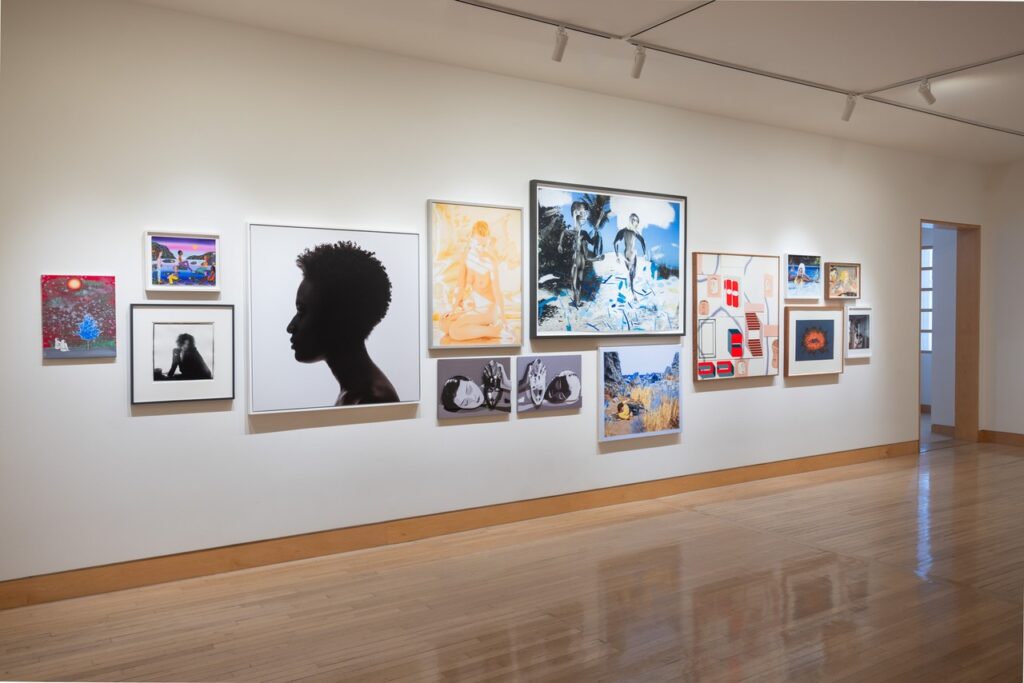
In “Slice of the Pie: Fourteen Bay Area Galleries & What Makes Them Different” at the Fraenkel Gallery through August 15, Libby Black’s mixed media work, Ruth Asawa Through Line, sits near David Huffman’s painting Castles Made of Sand. Adana Tillman’s textile Creatives Collaboration hangs by Marie Watt’s sculpture Telegraph (Kin), made up of Native American tin jingles. And Glenn Hardy Jr.’s painting Barbershop is placed on the wall above Julio Cesar Morales’ video Boy in Suitcase.
In what some people describe as a miniature art fair, more than 40 artists are represented at the gallery on Geary Street in downtown San Francisco.
Founded in 1979 by Jeffrey Fraenkel, the venue is a heavy hitter in the world of photography, representing artists including Nan Goldin, Richard Misrach, and Hiroshi Sugimoto, and working with the estates of Diane Arbus and Peter Hujar.
Christian Whitworth, the gallery’s director, says that after recent blows to the San Francisco art world—such as Vanderbilt University taking over the California College of the Arts campus, meaning the closure of the last art school in San Francisco, and several galleries including Altman Siegel and Gallery 16 shuttering— Fraenkel looked to make this year one of collaboration.
Crown Point Press, which Kathan Brown founded in 1962, is the oldest gallery in “Slice of the Pie.” Crown Point has showed artists like Richard Diebenkorn and John Cage as well as hosting workshops by artists from Asia and Europe. Director Valerie Wade was asked to participate, and she had a conversation with Jeffrey Fraenkel, who she has known for a couple decades, about how best to represent the gallery and its long history.
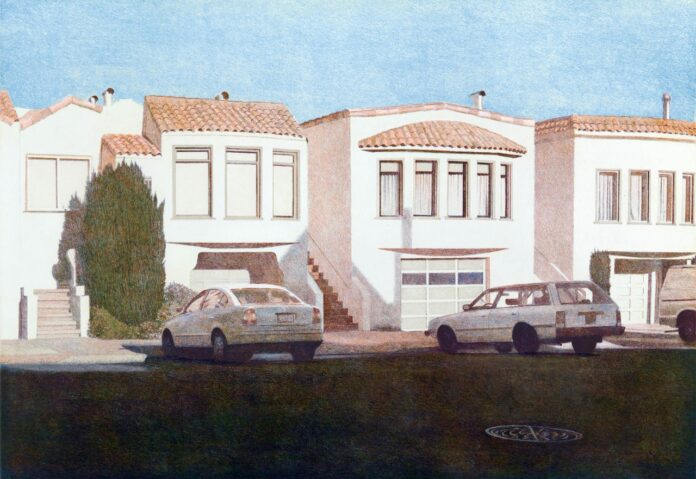
They decided on works by painters Robert Bechtle and Wayne Thiebaud’s and an etching by Rupy C. Tut, to give a taste of artists who were foundational to Brown and her peers, along with work by Tut, a contemporary artist living in Oakland.
Wade appreciates how the exhibition puts the art of the Bay Area on display.
“There’s no one stamp that marks what the art world is like here, but it is incredibly diverse and it’s all welcome and celebrated, which is what we love about San Francisco,” she says. “I think the exhibition highlights that fact, and I think it’s the only way it could be seen is to bring a show together like this.”
When he was looking to open his gallery in 2023 (making it the newest in the grouping), Jonathan Carver Moore of the eponymous Market Street gallery found the spirit of hospitality Wade mentioned.
“A lot of people were very receptive to me asking them questions and wanted to serve as my mentor,” he says. “I think asking this plethora of galleries to come together and do one big group show in the Bay shows our level of wanting to be connected to one another and to see each other succeed.”
For “Slice of the Pie,” Moore selected Hardy’s painting, Tillman’s textile, and a photo by Pieter Hugo that he took in the Tenderloin, where Moore’s gallery is located.
This kind of range of materials and subjects allows visitors a cross-section of the talent and vibrancy of artists represented by Bay Area galleries, Whitworth says. The Fraenkel staff wanted the works to be intermixed, so those from a particular gallery are not all grouped together. To demonstrate this, he points to three works next to each other on a wall.
“We can start to make these associations,” he says. “For example, in this case, in the kind of reoccurring motif of the birds within the Jim Campbell (Edition 25 [Birds]), the Ranu Mukherjee (osmotic guardians), and Claire Rojas (The Divide).”
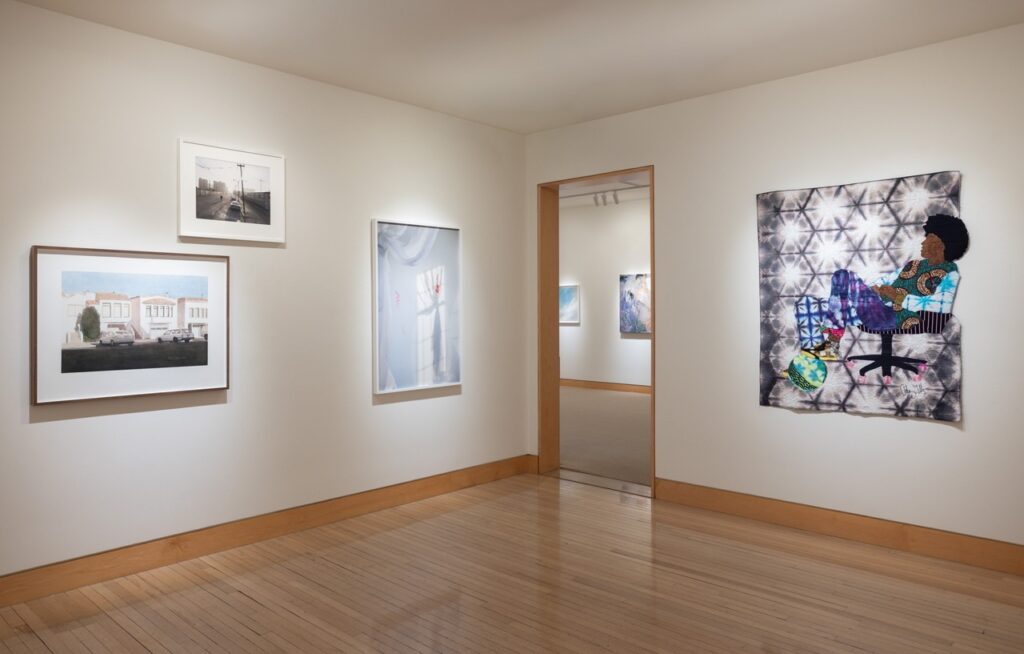
Whitworth points to a couple of works together in the next room which both depict San Francisco neighborhoods, with a photo by Janet Delaney from her South of Market series (Saturday afternoon, Howard between 3rd and 4th Streets) and Bechtle’s Three Houses on Pennsylvania Avenue in Potrero Hill.
Along with the major galleries here, and institutions like the San Francisco Museum of Modern Art, the Asian Art Museum, and the Fine Arts Museums, Whitworth says what makes the Bay Area art scene unique is the nonprofits, including Headlands Center for the Art and Southern Exposure (where artist Morales recently stepped into the role of director).
“There is kind of a wealth of institutions here who are working across many media, but also I think what really separates San Francisco is a kind of underdog status and that’s what makes us special,” he says. “We operate on a very global level and are putting on exhibitions and signing artists who have that kind of major appeal, but there’s something about the local community which makes it a little more personable and accessible.”
SLICE OF THE PIE: FOURTEEN BAY AREA GALLERIES & WHAT MAKES THEM DIFFERENT runs through August 15, Fraenkel Gallery, more info here.
Besides the ones mentioned in the above article, galleries include in the show are Anthony Meier, Berggruen Gallery, Casemore Gallery, Catharine Clark Gallery, EUQINOM Gallery, Gallery Wendi Norris, Hosfelt Gallery, Jenkins Johnson Gallery, Jessica Silverman, Micki Meng, and Rebecca Camacho Presents