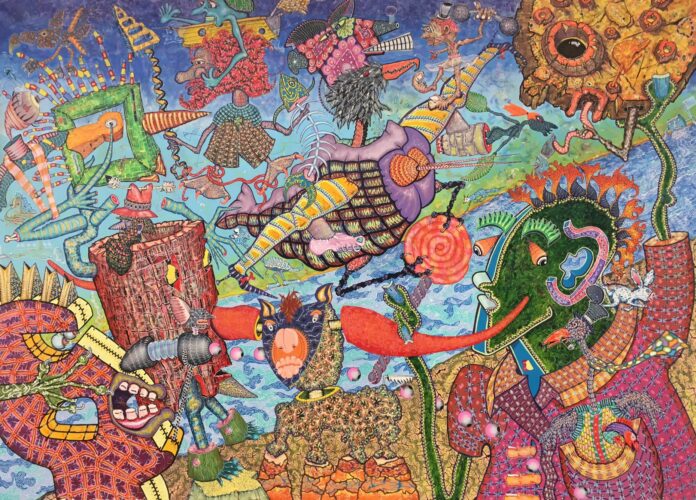
Finding your way inside a painting by M. Mark Bauer is step one. Allowing yourself time to linger inside the labyrinthian spaces inhabited by curious characters long enough to glean deeper meaning requires more commitment.
If you need an assist, look toward a painting’s title for insight. With a twist of irony, his black and white painting titled, What Are You Looking For, seems to size up its own conundrum. Bauer says it’s not about any one idea in particular but was created with “a flow of consciousness.”
Bauer offers a variety of videos on his website in which he loosely translates his paintings—though Bauer admits even he can’t explain it all. Maybe the best approach is to just take the plunge and allow yourself to get lost inside the trip.
As a visual artist working in the media of drawing, painting, and small wall sculpture, Bauer thinks of his work as unconventional yet reflective and complex. In works on canvas, Bauer uses acrylics to build detailed color syntheses and patterns. When working on paper, he either focuses on a single medium or works in combinations of graphite, acrylic paints and markers, air brush, and colored pencils, keeping an experimental mindset.
Alternating between bright colors and simple black and white, what initially appears as comical whimsy is more a device that offers entry into deeply pondered issues important to the artist.
“My painting Mr. Redwood’s History Lesson is one that exemplifies both my personal time hiking and camping in the redwoods and humans’ decimation of old growth forests,” he said.
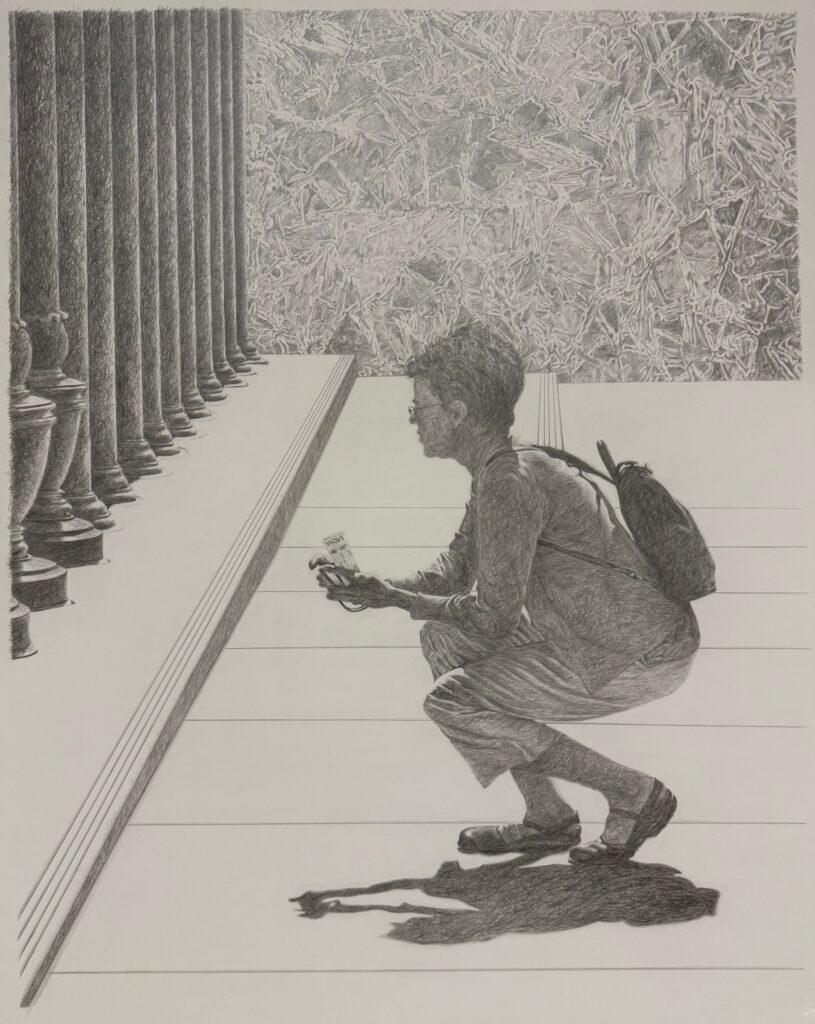
His graphite drawing LADWP (Los Angeles Department of Power and Water) depicts his wife viewing Chris Burden’s installation of two-hundred and two restored cast iron antique street lamps, Urban Light, at Los Angeles County Museum of Art.
“The background, where Wilshire Boulevard would be, is frozen ice on Mono Lake. This drawing is personal but also takes note of LA’s deceitful acquisition of Owens Valley water rights,” he said.

Another piece, Half Wrong, provides commentary on the growing divisiveness of society and the levels of absurdity reached when each person believes their view is 100% right. Bauer believes this mindset creates obstacles to solving world problems that will persist until we are able to hear other points of view openly.
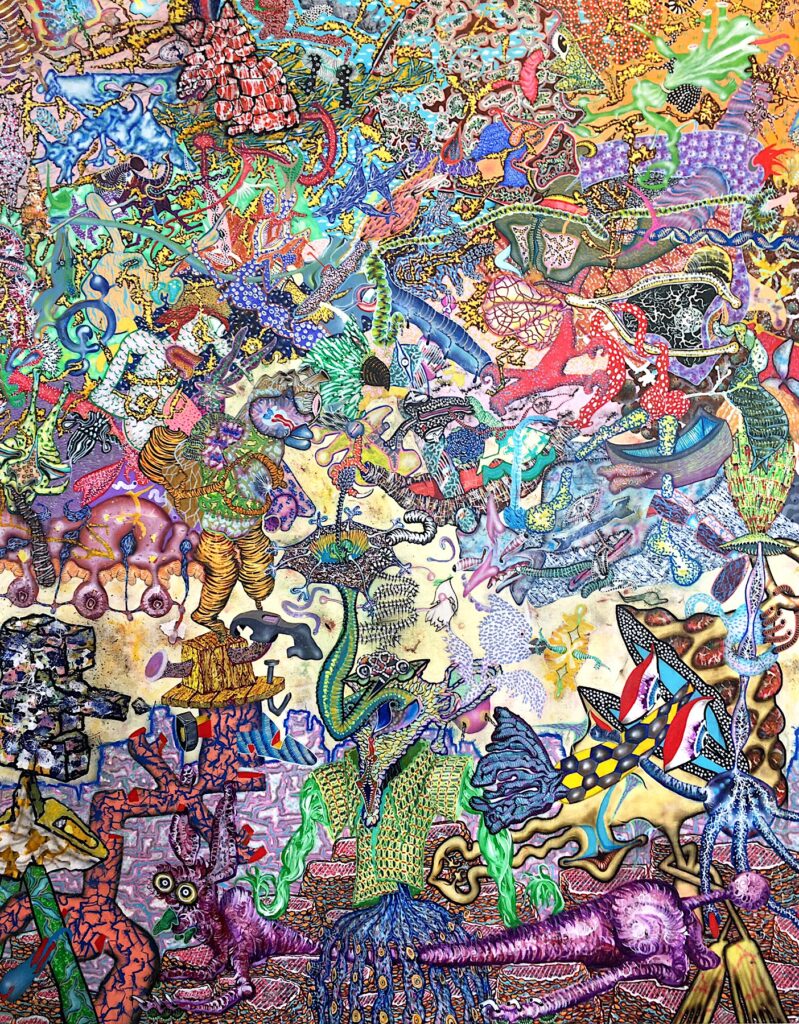
Bauer received his BA from San Diego State College in 1968 and his MFA in 1972, so he’s been at this for a while. He says the singular, most important experience and influence on his life as an artist was being accepted into the UC Davis Graduate School program.
“The faculty, which included Wayne Thiebaud, Robert Arneson, William T. Wiley, Manuel Neri, and Roy De Forest, instilled in me the possibilities of what art could be. They emphasized the importance of discovering your own individual means of expression. I am still, more than 50 years later, pursuing that elusive goal,” he said.
Bauer moved back to the San Diego area for 30+ years after grad school before returning to the Bay Area in 2010. Taking up residence in Southwest Berkeley, Bauer observed some changes. He feels that the Bay Area art scene played a much more important role in the culture in his earlier days here, a time when far more galleries existed, were well attended, and sold art well.
“I just cannot be surprised as much by the current art I view compared to my early exposure to the Davis art faculty and other artists like H.C. Westermann, Philip Guston, and Charles Garabedian. But I appreciate the value the Bay Area still places on the arts and having the opportunity to connect to others in the art community,” Bauer told 48hills.
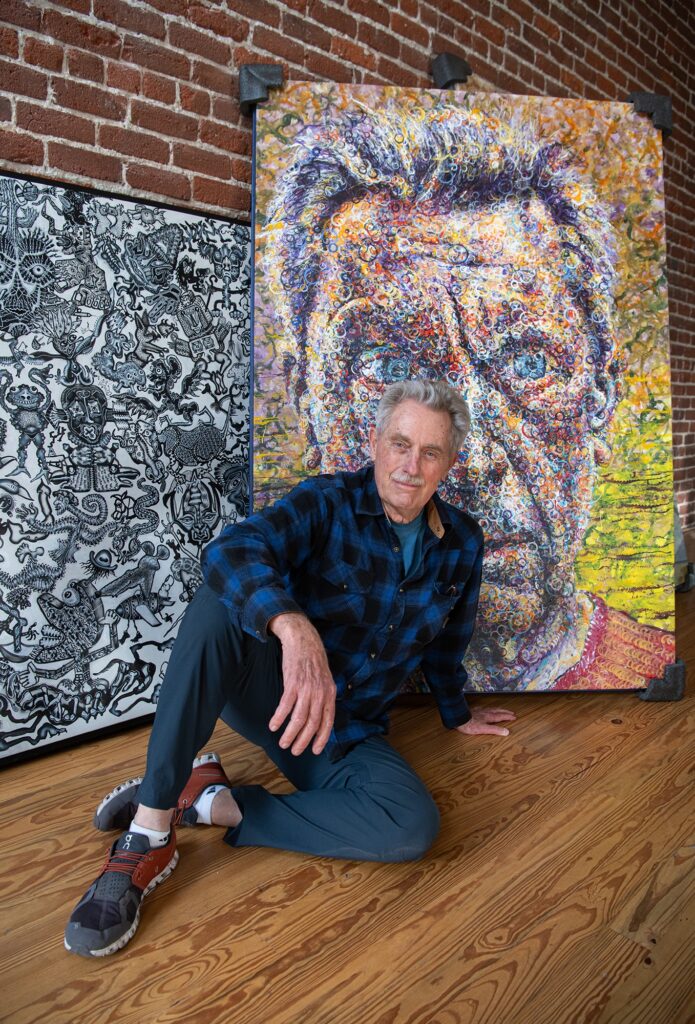
Reflecting on the heroic span of his career, Bauer reaches as far back as elementary school where he received encouraging feedback and began to excel as an artist, an experience that continued through graduate studies.
“I feel that this early positive attention instilled a lifelong desire to practice art. Even being drafted during the Vietnam War and 30 years working as a building contractor to support myself and family, I have not lost the priority to make art,” he said.
He adds that during the years that he was consumed by his business and family responsibilities, he could not have imagined being able to return full-time to making art in the manner he has for the past 20 years. Bauer has downsized his studio space for efficiency and cost and began working from two locations in Berkeley four years ago: his home studio where he paints and draws, and a workshop/storage space where he makes his own stretcher bars, finishes frames, stretches canvases and assembles small wall sculptures.
He begins a painting by pinning a white unstretched canvas to a movable studio wall, as he prefers working on a hard surface rather than against the give of a stretched piece. He says he seldom has a preconceived idea at the onset of a new work.
“Using graphite pencil, I draw and erase and redraw images until I develop a composition to the point that I feel a story has emerged and I can start painting. Most times, my art comes to me intuitively during this process,” Bauer said.
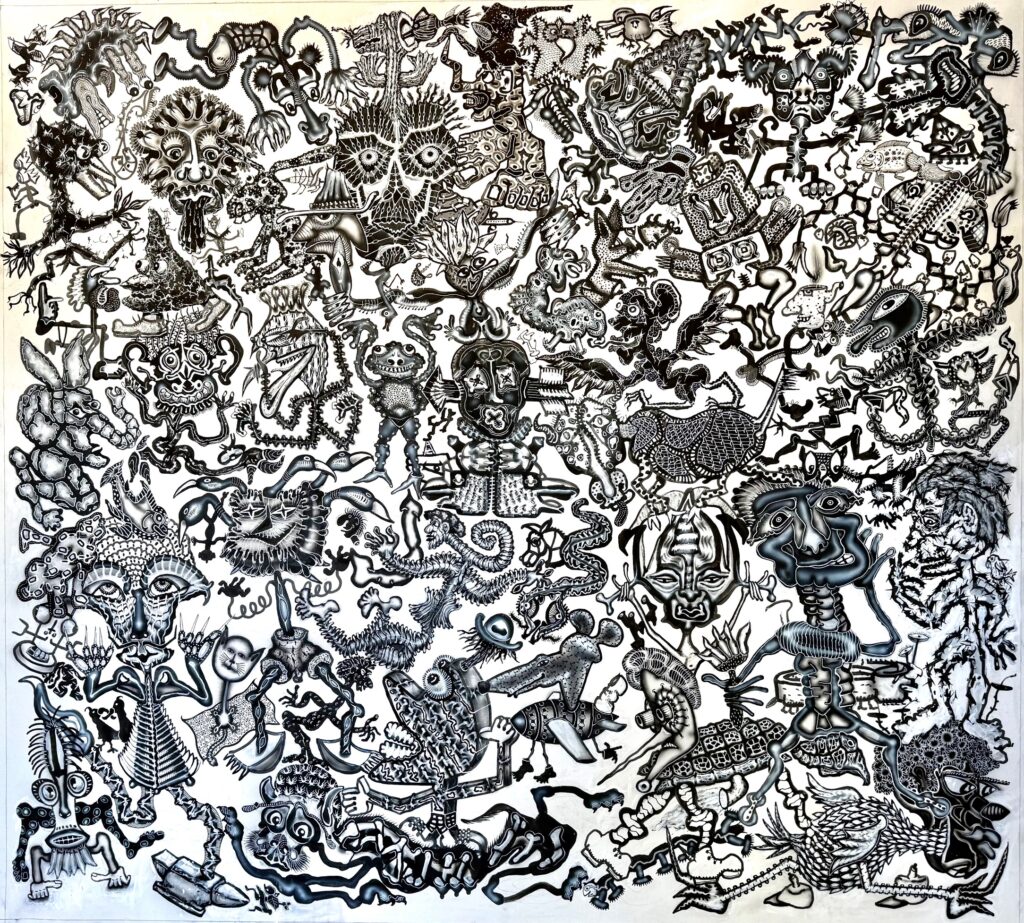
Bauer adds that essentially what has shaped his work overall is how it has provided a coping mechanism to deal with his frustrations about the lack of progress humans are making in addressing our environmental and political challenges.
“I’m influenced by multiple current issues which I prefer to address mostly indirectly through stylized figurative characters, using humor and sarcasm and complex visual compositions. The titles of my work are also important to the storytelling. My piece titled Balance of Dust is a take-off on balance of power and how governments lacking this will likely result in the world crumbling into dust,” he said.
The characters in his paintings come from different inspirations. Mythical representations of the natural world and animals—like bald eagles and water fowl mingling with stuffed teddy bears or two-headed whales—figure prominently as object/subject of human exploitation and environmental degradation.
Rabbits, which Bauer sees as representative of innocence while lending a comical tone, feature often along with grotesque, discombobulated alien-like figures who add to the sense of confusion that exists inside a complex, out-of-control world. Bauer has been working on the painting, Stub Nosed Artists on the Level, with characters depicted as artists who shoot paintbrushes instead of bullets.
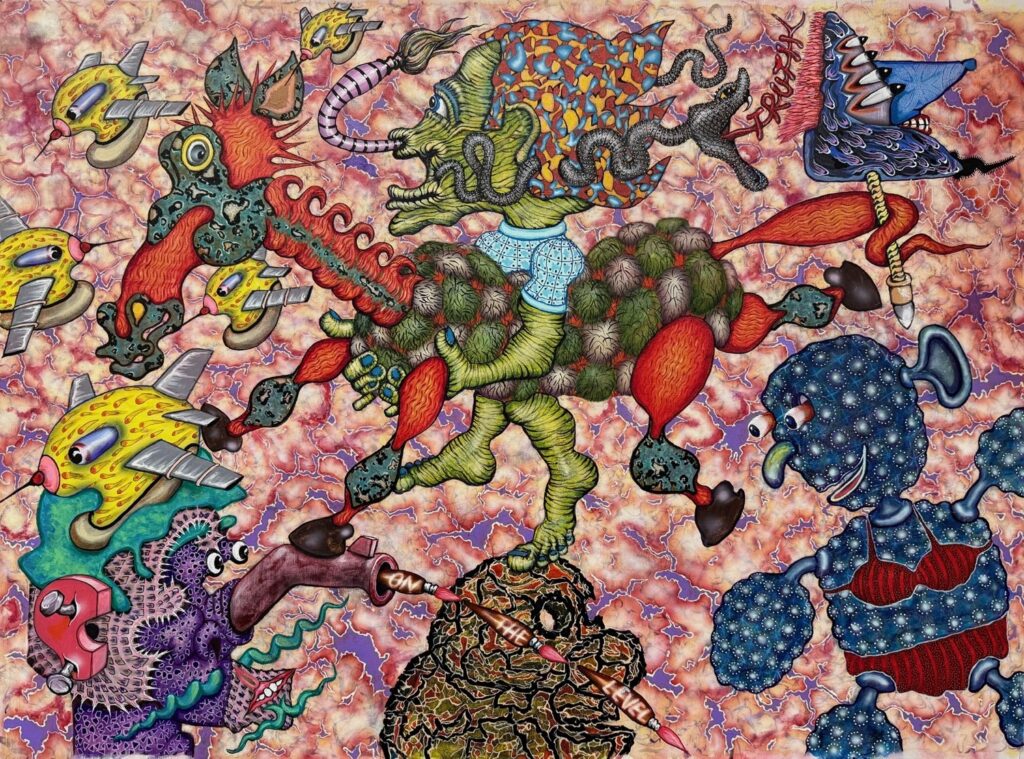
“This is an example of my way to address our gun culture with additional references to other social concerns like misinformation and drones,” he said.
Bauer’s recent exhibition, Short Stories: Fiction/Nonfiction, at b. sakata garo, a gallery in Sacramento, was held in March 2026. Solo show THE, THE was recently on exhibit at Transmission Gallery in Oakland, which also features an ongoing display of his work in its showroom. Both galleries regularly represent his work.
As M. Mark Bauer continues along in his enduring career, he aims to further broaden his means of expression through blending and overlapping stylized imagery with realistic subject matter. He’s also aware that his art is not easy to digest and that the viewer needs time to appreciate it. Though much is personal and political, he tries to leave room for individual interpretation. That’s certainly half the work—and the fun—of it.
“I hope and feel that people can engage and enjoy the abstract colorful patterns, humorous characters, playful titles, and multiple storylines making my art worth their time,” he said.
Bauer offers some words of wisdom to young artists who are just getting their feet wet, from a well-earned and respectable vantage point.
“If you feel you must be an artist, never give up. This has been my not-easy experience but I find that the use of humor in my art and my life helps keep me sane.”
For more information, visit his website mmarkbauer.com and on Instagram.