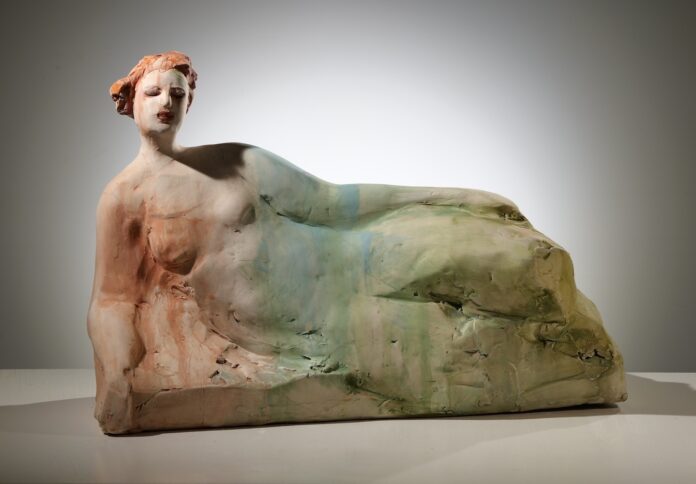
As a sculptor working primarily in clay, the Bay Area’s Michelle Gregor describes her approach on a continuum of figurative abstraction. Gregor says that the human form remains her constant point of departure, a source that feels infinite.
Born in San Francisco and raised in Lake Tahoe since the age of five, Gregor spent her childhood on the lake’s west shore and on the slopes of Alpine Meadows, where her mother worked and single-handedly raised four children.
“I’m a third-generation San Franciscan, born in the same city that my great grandfather arrived in, alone, after leaving Ireland as a 12-year-old boy to work the shipyard,” Gregor told 48hills.
Gregor received her BFA from the University of California at Santa Cruz in 1984 and returned to San Francisco, where she worked at Ruby’s Clay Studio in the Castro until she entered grad school at San Francisco State University (MFA, 1993).
“I stayed with my grandmother in the Sunset District at first. She and my grandfather had built their home on 29th Avenue and Rivera in 1939, where she described hearing the calls of peacocks and lions traveling over the sand dunes [over from the San Francisco Zoo, which was established in 1929] in those early days,” Gregor said.
During grad school, Gregor made her living as a production potter at a clay cooperative in Oakland. Working alongside a local architect on scale, designing, and sculpting residential architectural features was also formative.
“One of the best things about being an artist is the community. We speak the same language. Creative friendships bring enormous joy to my life, and witnessing the evolution of fellow artists’ creative journeys is a rare privilege,” she said.
Gregor defines her orbit as a wide set of coordinates ranging from San Francisco to San Jose and Sonoma County, with Lake Tahoe in the distance. What she loves most about San Francisco is how the city reflects so much of what she loves in its diversity, tolerance, and progressive politics. She adds that the past two years have sharpened her sense of why making art matters.

“The act of making is inseparable from the act of claiming space, and in a climate of increasing division and erasure, creative practice itself is a form of resistance,” Gregor said.
Gregor has lived in the Mission District for over 40 years, taught as a tenured professor of Art at San Jose City College in the South Bay for 20, and for the past decade has been sculpting in Petaluma alongside her partner Françoise LeClerc. Their studio is housed within an old barn built in 1915 on two acres of farmland shared with a small flock of sheep and chickens. The space is fluid, shifting to accommodate various activities.
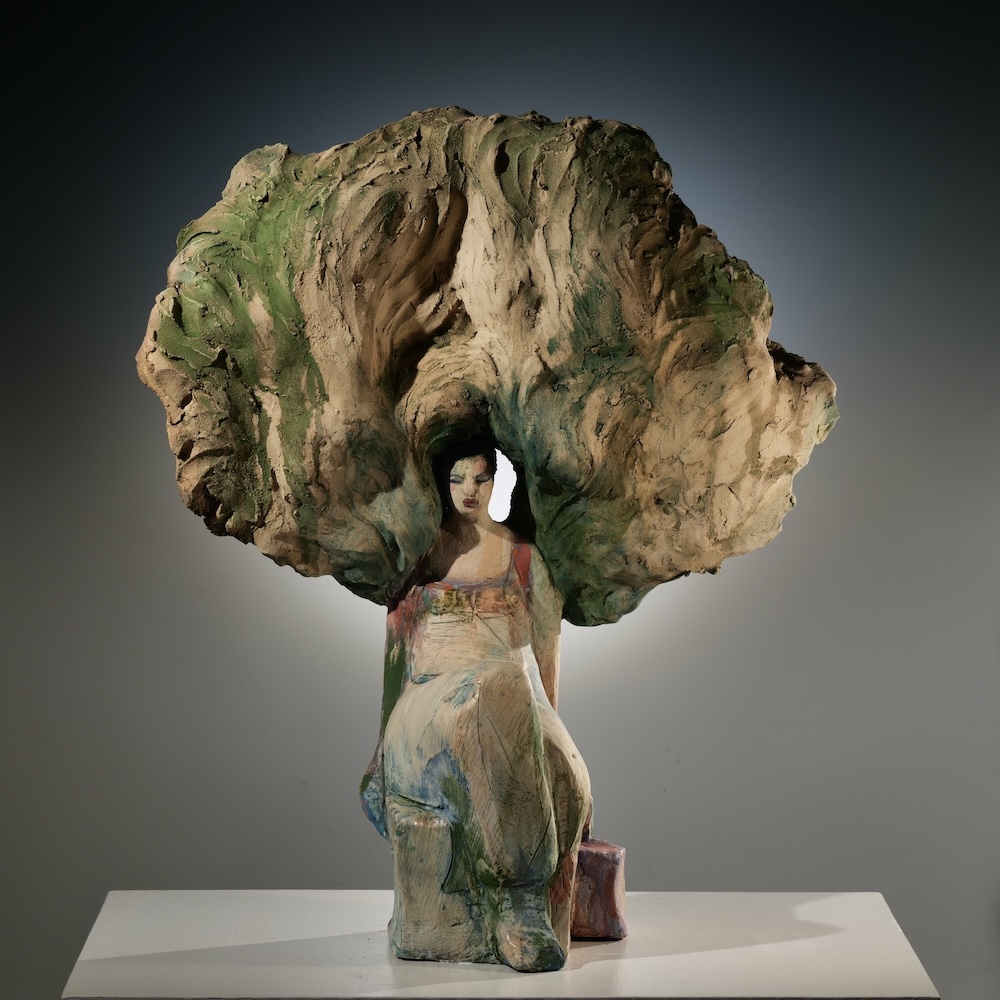
Using a block method for constructing her figures, building them solid then hollowed out, Gregor begins by determining a pose either seated, reclining, or standing. She works within a series of at least three sculptures on the bench.
“As work proceeds, it’s interesting to witness spatial conversations emerging between the figures,” she said.
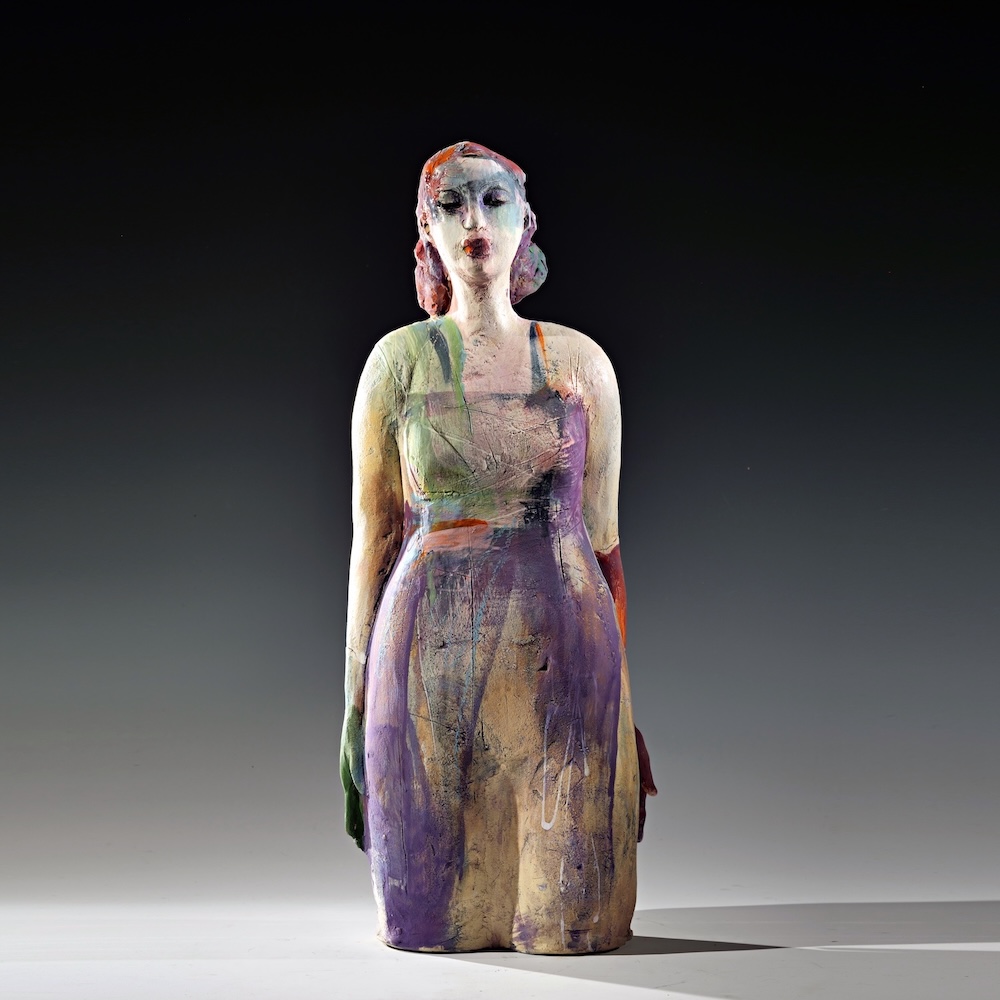
There is a rhythm and predictable flow that happens within each body of work—the physical tasks and routines of construction: hollowing of forms, surface work, drying, and numerous glazings and firings, though there is no typical day in the studio.
“With my experience of working in clay for over 50 years, the process quickly keys into a haptic modality. Decisions emerge through the practice, responding to the clay directly in its weight, tensions, and relationship to gravity, in accordance with the material’s own logic,” Gregor said.
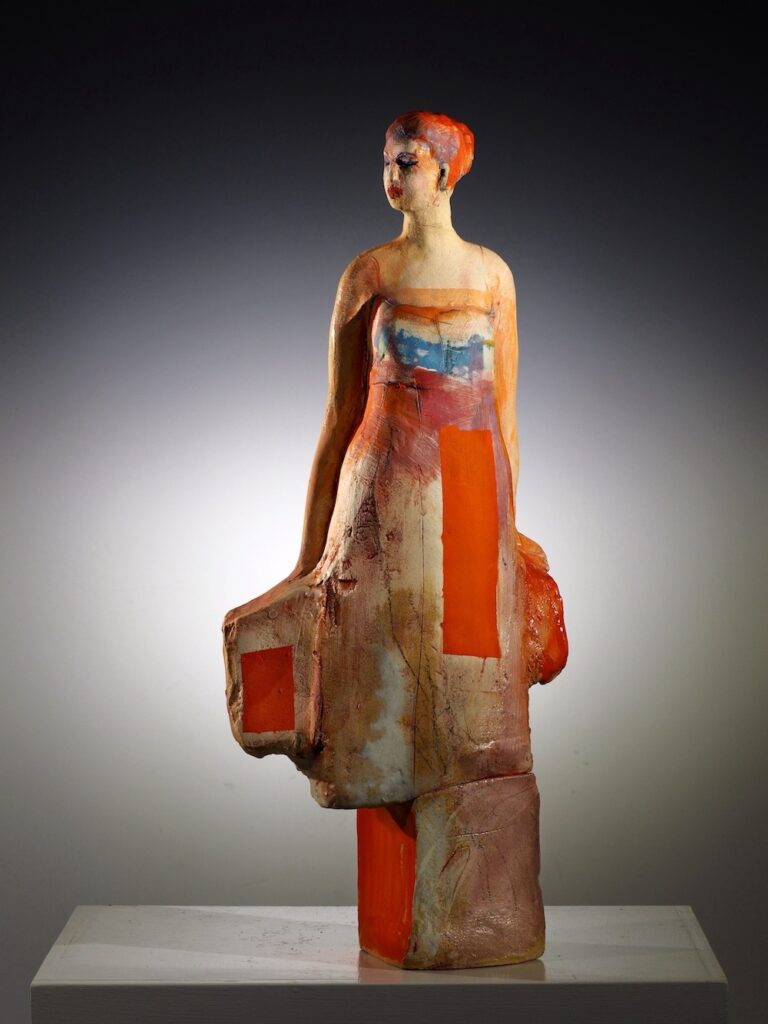
Treatment of the three-dimensional ceramic surface is inspired by abstract painting, using a wide range of materials including crayons, pencil, glazes, stains, slips, and various tools.
“Clay picks up every gesture, accepts texture effortlessly, and the marks accumulate on the surface like a map of construction, recording decisions and revisions. The angle of flow from gravity, and the way clay receives and holds color feels limitless in possibility. Color with all its many combinations takes on a wide and complex range in three-dimensional space,” Gregor said.
Each stage offers distinct possibilities for Gregor. A step that remains constant in her method is the application of porcelain slip at the greenware stage to the sculpted figure.
“Using a variety of brushes, I can achieve some subtle and gorgeous gestural marks. This slip layer encourages drawing using the scrafitto technique, in which you can carve through the slip to reveal the darker clay underneath. Perhaps best of all are the subtle value shifts that porcelain slip lends to the ceramic surface,” Gregor said.
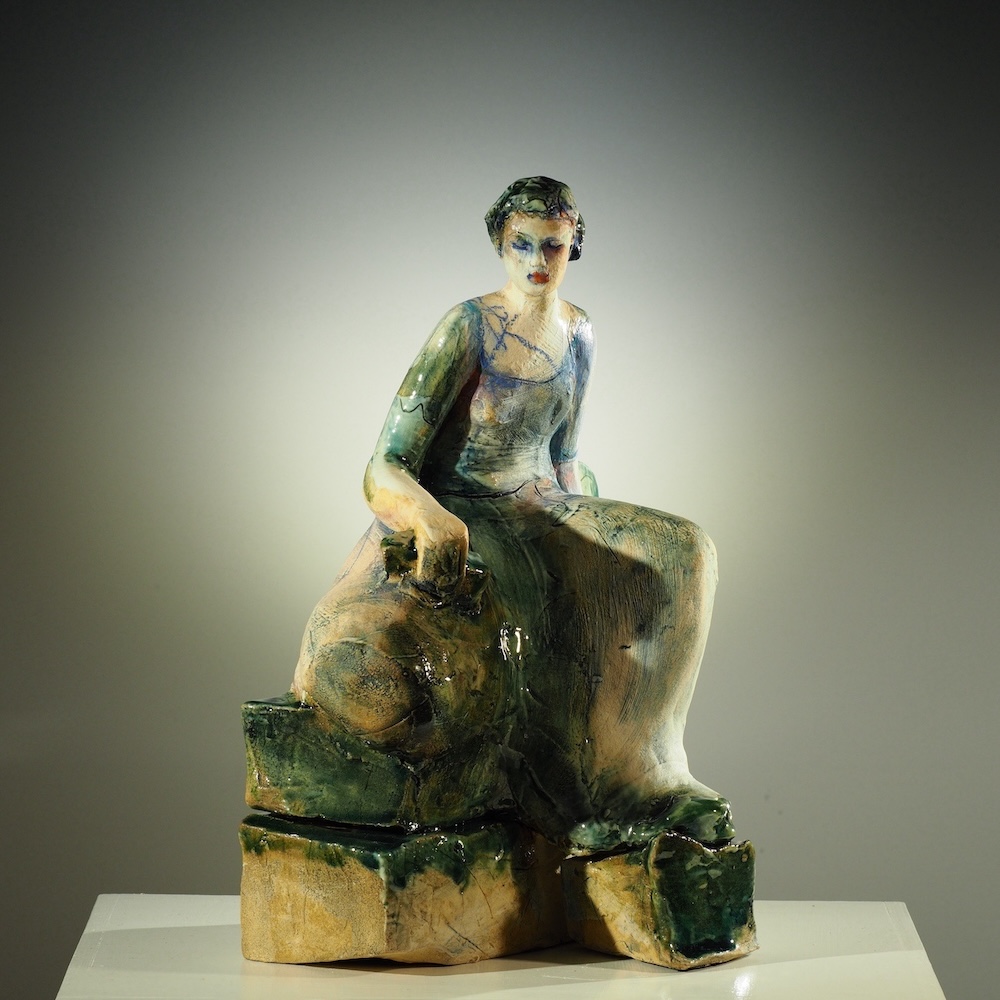
Multiple kiln firings allow her to build a surface patina that records every effort as each round sets the base for subsequent coloration and texture.
“The kiln always has the last word. I fire my sculptures, loaded together to conserve resources, to 2165 degrees Fahrenheit (cone 5). A metamorphic change occurs at this temperature, bringing a stone-like consistency and durability to the material,” she said.
Some days in the studio are spent in managerial mode; sizing and curating photos of work for exhibition, writing exhibition statements, delivering or picking up work, or recycling clay. Earlier in her career, Gregor was drawn to building larger ceramic forms and has since migrated toward mid-sized formats that move more easily through her studio.
“Though I still love working large, I’ve found a groove with smaller works, where ideas can be explored quickly. The shorter time commitment offers a freedom that feels generative. Large-scale figures carry their own complexities and the practical realities of construction, storage, and shipping are not insignificant,” Gregor said.
Gregor considers herself a serious museum aficionado, a fan of experiences that are “the bolts of lightning that inspire.” Her favorite works are the pediment sculptures of the Acropolis.
“It brought tears of joy when I encountered them in person at the British Museum, a full case of Stendhal’s syndrome,” she said.
As for other art that has moved her deeply, the luminaries of Abstract Expressionism, a 2023 encounter with Joan Mitchell’s work at SFMOMA, and a first encounter with Cy Twombly’s work at the Philadelphia Art Museum in 2010 make the list. Gregor likens an unforgettable experience of viewing the Diebenkorn sketchbooks at the Cantor Arts Center at Stanford University in 2016 to a glimpse through a window into an artist’s thinking process.
“If abstraction is poetry and figuration is prose, it’s the point between the two that compels me most. Richard Diebenkorn sits high in my artistic pantheon, an artist who inhabits that middle ground,” Gregor said.
More recently, Gregor stumbled on Flora Yukhovich‘s work while conducting sabbatical research.
“Her paintings feel both baroque and utterly contemporary to me. Discovering her work has opened new ways of thinking about color and figuration, and I find myself genuinely obsessed,” she said.
Gregor also cites her good fortune of being a student of Stephen De Staebler as a grad student at SFSU as a meaningful time. “He influenced me deeply both through his teaching pedagogy and through the kindness and decency with which he moved through the world. His sculptural work in clay remains a personal touchstone for excellence,” she said.
Beyond her position with SJCC teaching sculpture, ceramics, color theory, and design fundamentals, Gregor has taught workshops in Mexico, Bali, and the South of France, and will lead upcoming workshops at the Monte Castello Academy in Umbria, Italy.
“Making a living in the classroom has allowed my studio practice to remain free from the pressures of the market,” she said.
She is currently creating new work for several exhibitions, researching the Odalisque trope, looking closely at the work of Jennifer Packer and Mickalene Thomas alongside more historically sited examples by Matisse and Ingres.
“Several of my new works take the Odalisque as their starting point, engaging her as a contested, reclaimed, and reimagined figure,” Gregor said.
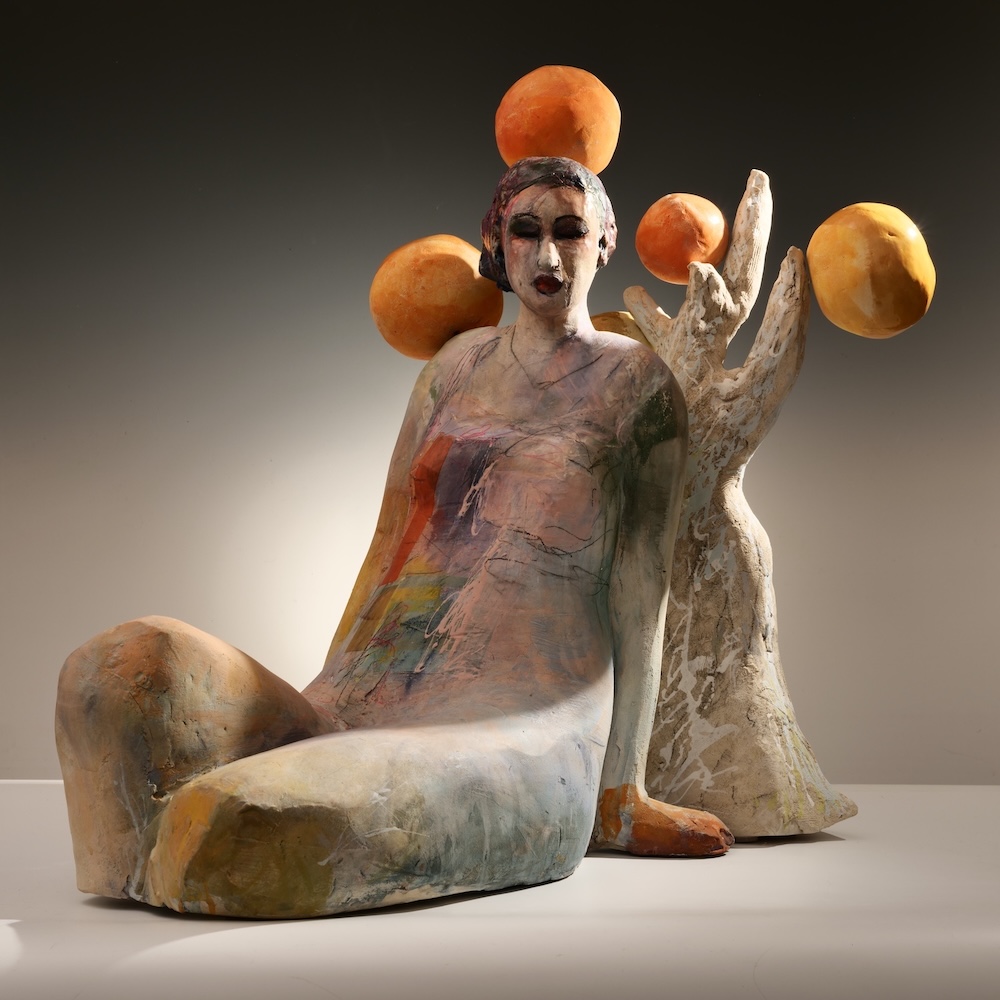
Overall, the question that Gregor is persistently trying to answer in the studio is one of surface and form integration.
“I want each piece to have its own center and vitality. How to build a surface patina on a three-dimensional form that has genuine depth, that moves with and upon the form rather than simply covering it, and that feels right. The question of ‘rightness’ has been central to my investigation from the beginning. It lives in the back of my mind through every firing and every decision about color and material,” Gregor said.
Gregor had a significant solo show in 2024, Palace of Leaves, at the Triton Museum of Art in Santa Clara. She has a solo show of new work at Sue Greenwood Fine Art in Laguna Beach, one of several gallery representatives of Gregor, running through September 21. She will be featured in, To Be Human, a group exhibition invitational at Northern Clay Center in Minneapolis, opening September 19. Sabbatical research at San Jose City College will culminate in a project exhibition in the spring of 2027. And the Natsoulas Press (of John Natsouas Gallery) has recently published a monograph of her work.
Though not expressly autobiographical, Michelle Gregor’s work inevitably reflects her identity and perspective. If someone experiences a connection to her art, she is grateful.
“I hope the viewer will take some time to explore the form and surface and that it may bring pleasure, evoke a feeling or personal memory within their own experience.”
She reflects on how a former professor, David Kuraoka, instilled a valuable work ethic that has remained with her ever since. Time in the studio is key. And to her own students, Gregor advises that maintaining a certain amount of faith in oneself as an artist is essential.
“The work will reveal itself to you within your practice. Be fearless and make big changes if the composition isn’t working,” she said. “Always, my favorite point in the creative process is looking. Simply spending time with the sculpture.”
For more information, visit her website michellegregor.com and on Instagram.