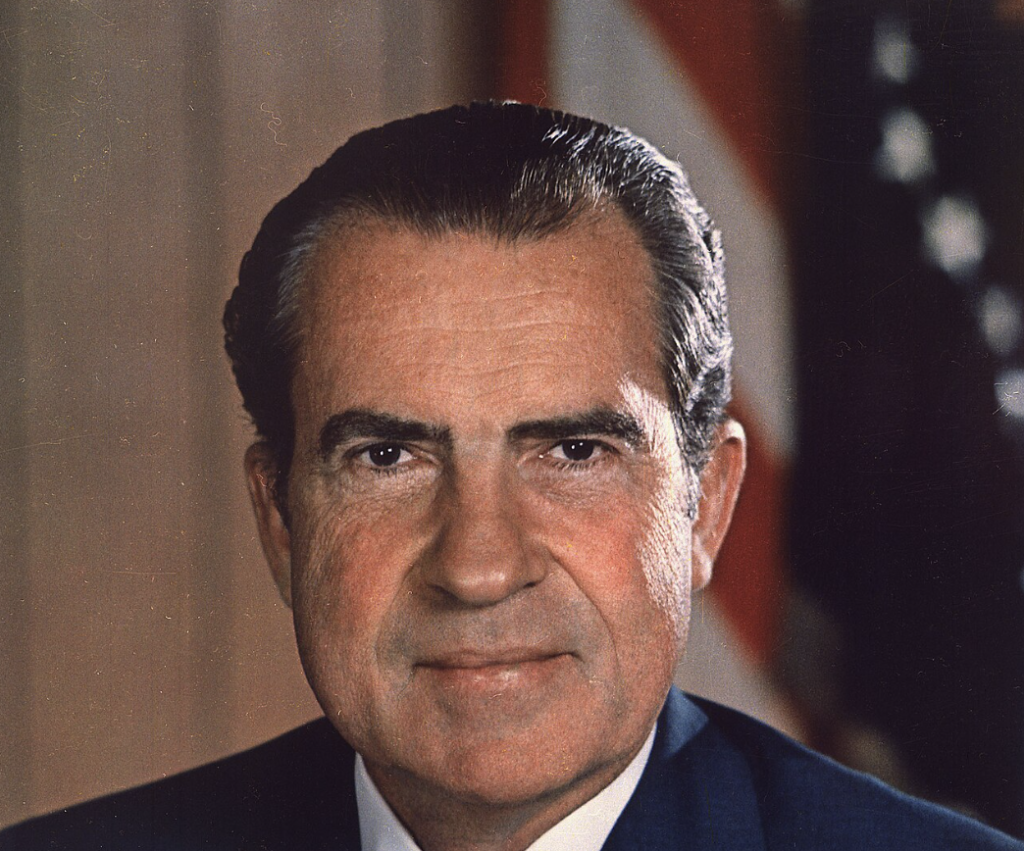
Shortly before the 1972 presidential election, the increasingly deranged billionaire Howard Hughes sent $100,000 in cash—the equivalent of almost $1 million today—to Richard Nixon. Bebe Rebozo, Nixon’s best buddy who was often linked to Mafia figures, took the suitcase full of cash from a Hughes associate in a Las Vegas hotel room.
That was just some of the significant cash money that went from some pretty sketchy folks to Nixon and his re-election campaign. Cash that paid the Watergate burglars. Cash that amounted to direct bribes.
That’s why Congress, starting in 1974, passed a series of bills limiting campaign contributions, requiring disclosure, and banning cash donations. The contribution limits were designed to make sure that one powerful person or interest group couldn’t have total sway over a campaign, and thus over the politician who got elected.
The post-Watergate laws were far from a total success. The Supreme Court, in Buckley v. Valeo, opened the door to huge amounts of what we now call “independent expenditure” groups. But the idea has remained a centerpiece of campaign laws, including in California and in San Francisco: A candidate for office can only take a limited amount of money from any individual, group, or corporation.
Among other things, the laws encourage candidate to reach out to a broad a grassroots base as possible. They also, to a certain extent, limit the bribery aspect of campaign money: If nobody can give a candidate for SF supervisor more than $500, then it’s harder for a donor to call the supe and demand a favor.
Thanks to the Supreme Court, there’s nothing we can do to stop IEs. But the law makes clear that IEs and official campaigns can’t coordinate, can’t share resources—and the donors to an IE can’t reach out during the campaign to a candidate.
In theory, that means a Big Tech lord can’t call a candidate and say: If you support my data center, I’ll put $500,000 into an IE supporting you.
This is honored often in the breach. Daniel Lurie’s mother put $1 million into an IE supporting his campaign for mayor. It strains credulity to think that he never talked to his mother during the campaign.

But the laws, weak as they are, serve a purpose. That’s why the casual disregard of the basic legal principles by the Scott Wiener for Congress campaign matters.
An IE group called Families for an Affordable San Francisco can raise unlimited money to support Wiener. Nick Josefowitz, a rich entrepreneur, put $200,000 into the Wiener IE. Andrew Chatham, an executive at Waymo, put up $50,000, according to Federal Elections Commission records.
But that group is not supposed to coordinate with the official Wiener campaign—and it’s pretty clear that they are sharing staff.
I don’t know why Nick Josefowitz or Andrew Chatham want Wiener in Congress that badly. But I know that if he wins, and either of them picks up the phone to call him, Wiener will take that call.
If this continues, the entire idea of campaign contributions limits will vanish. The post-Watergate reforms that kept million-dollar suitcases of cash out of campaign offices will be meaningless.
It’s bad enough now. The precedent the Wiener campaign is setting makes the situation way, way worse.
Just for the record: I am not a big fan of AI, but there are tools that ChatGPT provides that are helpful to reporters. I pay $20 a month for an account that lets me compare big data sets.
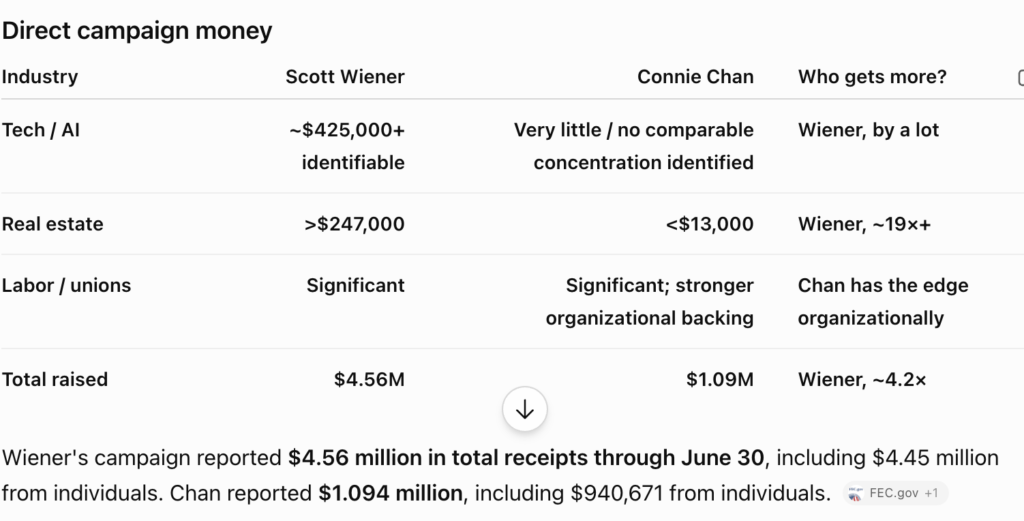
Here’s what it tells me about the FEC records on the Chan and Wiener campaigns:
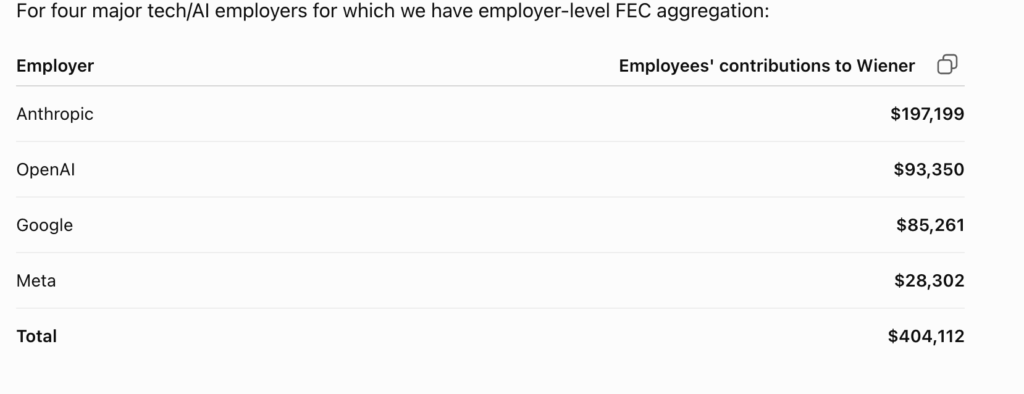
Employees of Big Tech, particularly AI, have given at least $400,000 to Wiener’s campaign. Real estate interests gave $247,000 to the primary campaign.
The charts I’ve created (with ChatGPT) show where the money is going: Wiener is the candidate of tech and real estate. Chan is the candidate of labor. (Although the Carpenters Union, which loves Wiener because he is a Yimby champion, gave $250,000 to the IE).
That tells us a lot about this campaign.
Full disclosure: My independent adult daughter works on the Connie Chan for Congress campaign.