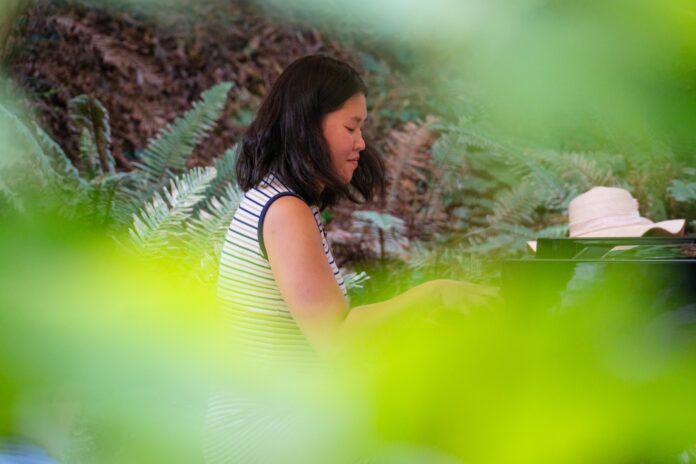
Flower Piano is an event as softly stimulating as it sounds, which is partly why it was awarded a Best of the Bay Editors’ Pick this year. Venture into its ongoing 11-day edition at San Francisco Botanical Garden (through September 20), and be greeted by musicians caressing keys throughout the green space’s winding ways. Perhaps you will come as a spectator, or sit down at an empty piano yourself, adding your sound to the auditory panorama around you.
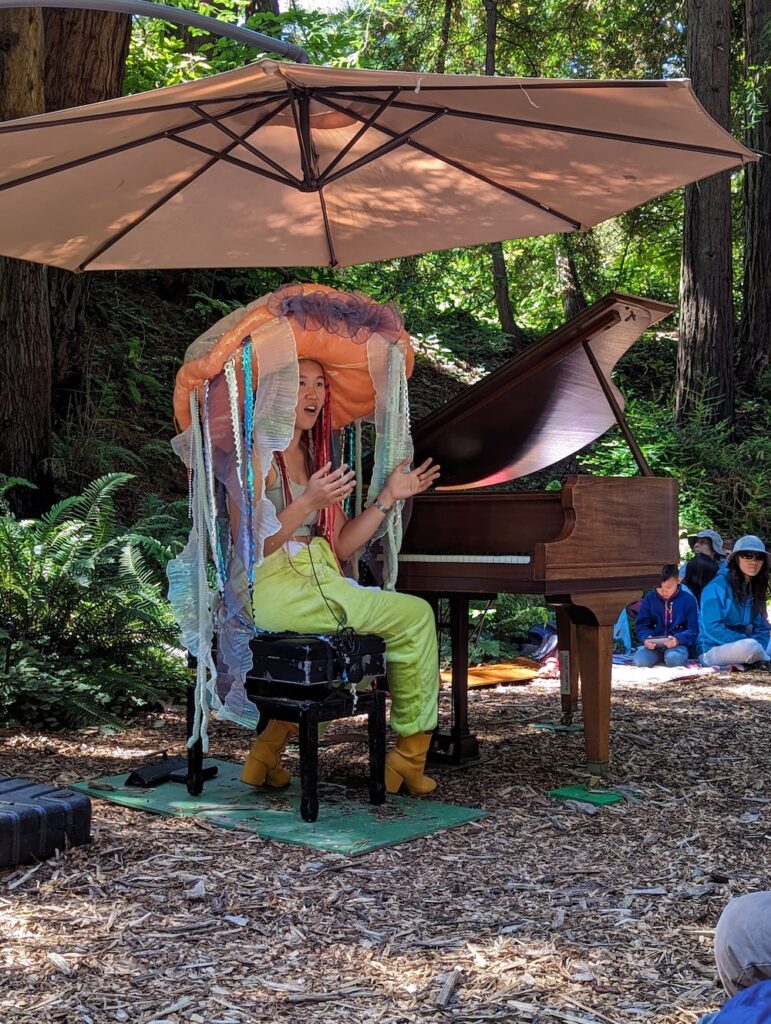
Pianist Tin Yi Chelsea Wong will certainly be there, performing Liszt, Ravel, and Crumb at 1pm this Sunday, as part of an officially scheduled Flower Piano performance you may well wish to attend in its entirety: It starts with a set from classical pianist Jaron Lanier (who is also known as the creator of virtual reality), and ends with the Kev Choice Chamber Ensemble. A sparkling show of Bay Area creatives, a reminder that art is a thread that so glitteringly weaves together our community.
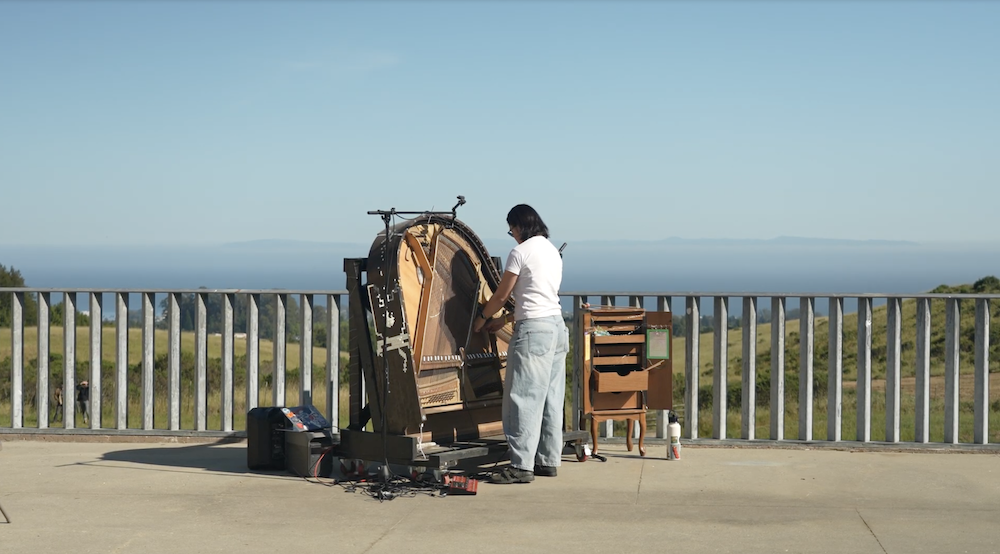
The florid outdoor performance will be an encore of of a program she’ll perform at 7:30pm, Thu/17, at the collective for which she serves as creative director, Atelier Kromatica. Kromatica’s headquarters in SoMa houses a seven-and-a-half-foot Bechstein concert grand, two harpsichords, and a “piano liberado,” converted for mobility and functionality by Wong in the style of her mentor, Flower Piano co-founder Mauro Ffortissimo.
But like many immigrants in the United States of America in 2026, Wong’s not entirely sure how long she’ll be part of the place that has so nurtured her musical practice.
She’s lived here since beginning her master’s degree at the SF Conservatory of Music. But the deferred enforced departure protection that has allowed her and other individuals from Hong Kong to gain a foothold in this country is due to expire next year.
Thus far, the Trump administration has ended similar protective status for people from 13 countries: Afghanistan, Cameroon, Ethiopia, Haiti, Honduras, Myanmar, Nepal, Nicaragua, Somalia, South Sudan, Syria, Venezuela, and Yemen.
Wong is applying for an extraordinary artist visa, which she is, and in any fair world she would be granted. In any fair world…
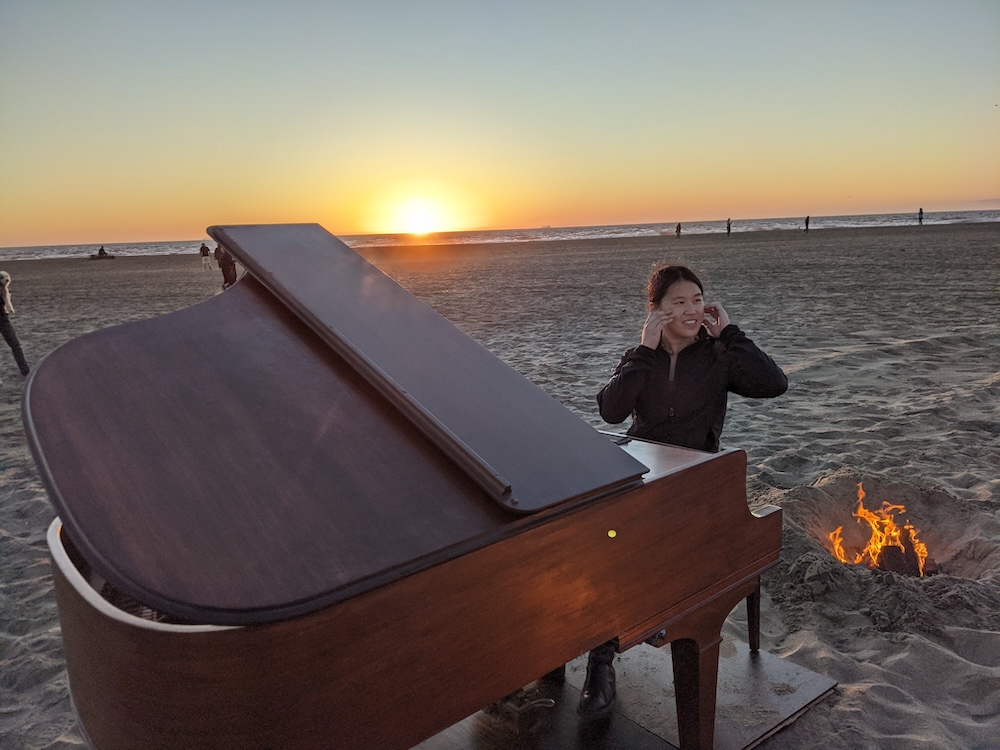
For now, she lives in the world of playing pianos outdoors. In 2020, she dealt with the pandemic by tickling the ivories under the sweeping rotunda of the Palace of Fine Arts, a daring move that wound up becoming its own musical education series beckoning the observer to “reclaim a sense of sanity.” Such centering may well take place at her annual Piano Beach Bonfires, for which she and an intrepid instrument braved the chilly dunes of Ocean Beach, the Golden Gate Park windmill turning graciously behind them, a small flame animating the chords after darkness falls.

Wong has never played outdoors in Hong Kong. It’s not clear that she ever will, as returning could put her at risk of arrest or other governmental consequence. She spoke out in support her country’s Umbrella Revolution, which saw waves of students standing up for electoral rights, and then their leaders facing serious legal repercussions in the years that followed. Already in the United States during this uprising, she felt it was her duty to express her solidarity openly, even if her online comments made it so that she could not safely return to her own country.
“Sometimes I dream about taking the risk to return to my beautiful hometown, potentially sacrificing myself for the movement,” she says. “But I’ve decided to stay where I can safeguard the memory and history of my people, and in hope of continuing to speak in honesty, in service to those who have lost their voices.”
We spoke to Wong via email to get a sense of what the Bay Area stands to lose at a time when so many of our artists and countless other community members are threatened by xenophobic policy.
48HILLS What was the path that led you to the Bay Area?
TIN YI CHELSEA WONG I came to the Bay Area to begin my master’s degree at SF Conservatory of Music, but also because my brother had been in the area for 20 years at that point. He is much older than me, and started college here when I was three years old. He took the Silicon Valley path and found much success, both financially and immigration-wise. As my niece was growing up, I wanted to be closer with her, so I started looking into connecting with teachers in the area, and struck a strong connection with my professor Paul Hersh, who pulled out a lot of passionate music making from me.
I grew up visiting my brother in San Francisco every summer, and geographically, this region shares a lot of similarities with Hong Kong—hilly streets on mountains nestled by the Pacific Ocean, boundless access to nature. So it instantly felt like home to me. There is something about living on the edge of the ocean, at the end of a continent, and I stayed because this coastline is the closest I can be to Hong Kong.
48HILLS Did you hit on the idea for the collective for which you are creative director, Atelier Kromatica, here in the Bay? What has being in the region brought to your music?
TIN YI CHELSEA WONG Atelier Kromatica is a culmination of so, so many sources of influences I’ve received from the deep history of generations of artists that came before me, that I got to absorb over the past 10 lucky years that I’ve called San Francisco home. Getting to experience Flower Piano, an interactive outdoor acoustics instrument festival like nowhere else in the world. Rubbing shoulders with so many artists involved in the making of Burning Man—which came from [San Francisco counterculture network] Cacophony Society—and the generation that was present at the Summer of Love, tracing back to the psychedelic experiments in the ’50s and ’60s, as well as the new wave of artists that puts on wildly experimental and surreal pieces in the spirit of radical generosity and resistance against the system and conformity.
Coupling this with witnessing many extremes—the poverty [stricken] and the ultra-rich living side by side, art clashing with technology in the heart of Silicon Valley as it relentlessly attempts to automate different aspects of the creative process—left me no choice but to reflect on a daily basis what it means to live as a human being. My answer was to resist through defiance and radical honesty. I started adding more dramatic elements to my performances, incorporating costumes, and began gravitating towards performing ceremonial music, or music about passion, and now music about death.
Right around when I started doing my own outdoor piano events, my world was blown open to the possibilities of the role piano plays in the contemporary art world. Slowly, my dreams started to seem more doable, and so I started acting on them more and more.
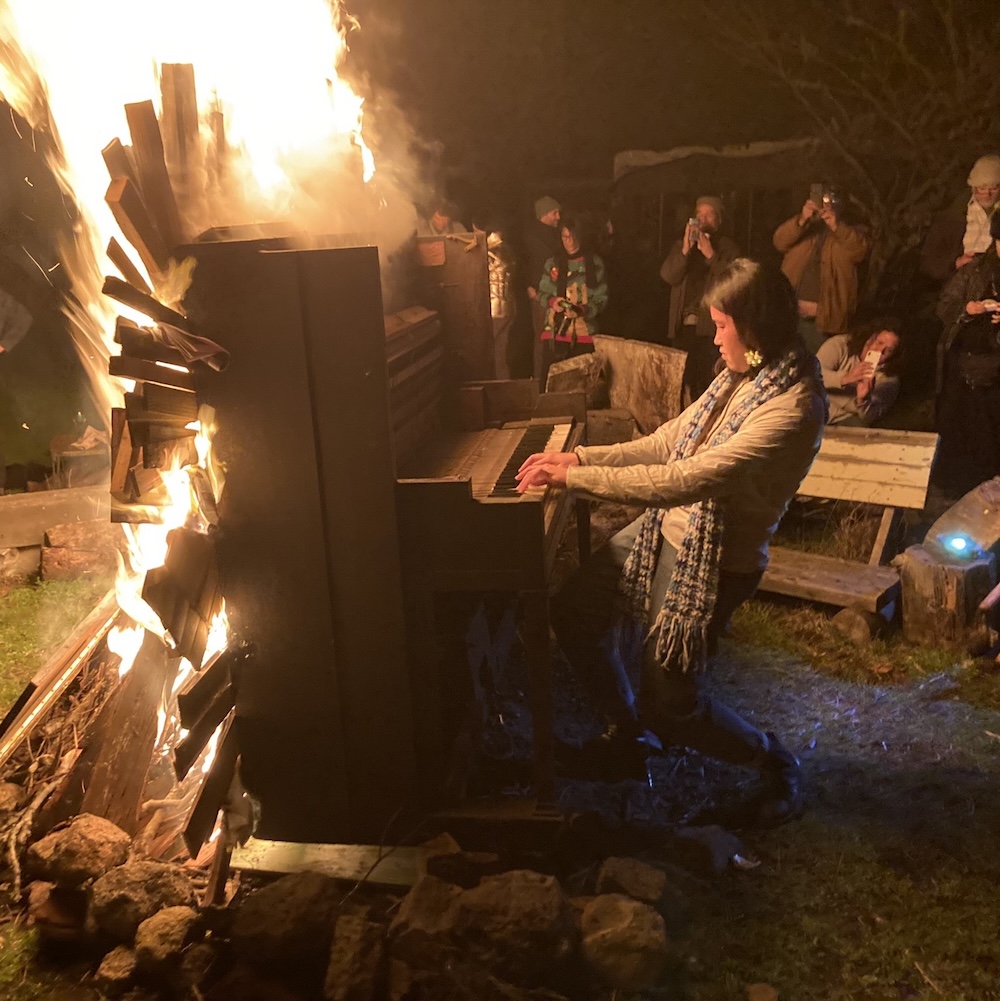
None of what I do is novel, but I was strongly called to throw myself towards a part of the movement. I cannot go without mentioning my deep history with Flower Piano, having played in it for six years, the privilege of having Mauro Ffortissimo as my mentor, and to learn of the history of Mauro and Dean [Mermell] and Electra bringing pianos outdoors, I cannot overstate their influence, showing me a path towards my own unique voice, as I started that journey myself.
The trigger for Atelier Kromatica birthing into existence, came from an art divorce with my previous partner whom I shared a makerspace with, where I was storing five or six pianos for various projects. When we were parting ways, I simply needed a place to continue working on my piano projects. When I saw the current space for AK, I thought, this should stop being another start-up office, the acoustics are too good. This will be the perfect hole in the wall to build a bridge between my two worlds, classical music and the experimental immersive art movement, to give back to the community, to offer my humble effort in helping bring classical music into modern relevance. Atelier Kromatica is a space for art mediums to clash and experiment together, according to the artists’ wishes and vision, because we all should be protecting each other’s freedom to make art.
48HILLS What is the outlook on getting your extraordinary artist visa? What, if anything, have you learned about factors that can help creatives to get one?
TIN YI CHELSEA WONG The idea of proving myself to be extraordinary to the governmen is quite demoralizing. It forces me to tie my art-making, which is something personal and subjective, to measurements of success through a capitalistic standard, in terms of commerce, fame, and influence. A traditional path of applying for this visa in the classical music realm involves connections, schmoozing, and luck, on top of superhuman skills. If I have a choice, I would rather not advertise my work and spend the energy actually working. I don’t feel like I have learned much about this process, except to not be shy about reaching out for help from collaborators and colleagues, and be practical about it, because the most fruitful reward so far in the process, is that I have reconnected or deepened my connection with many fellow artists whom I’m birthing new artistic projects with, and that’s quite exciting.
48HILLS Have you explored al fresco piano performance in other places? Have you played outside while in Hong Kong?
TIN YI CHELSEA WONG The first time I experienced outdoor piano music making was during 2016 Flower Piano. Playing piano under a tree canopy with its roots draping behind my back while a soft breeze brushes my face and birds harmonizing to my melodies, for the first time. I never thought about making it my focus of art-making until the pandemic, when all traditional indoor classical music-making was forced to be taken outdoors, and it kindled a long-lost dream of bringing a piano to the rotunda at The Palace of Fine Arts.
By then, I had already given up on returning back to Hong Kong. In fact, I haven’t left the United States since 2018, because my protection status requires extreme circumstances to apply to travel internationally. I really look forward to the day when I can travel to different countries and continents, find a piano, and go on an adventure.
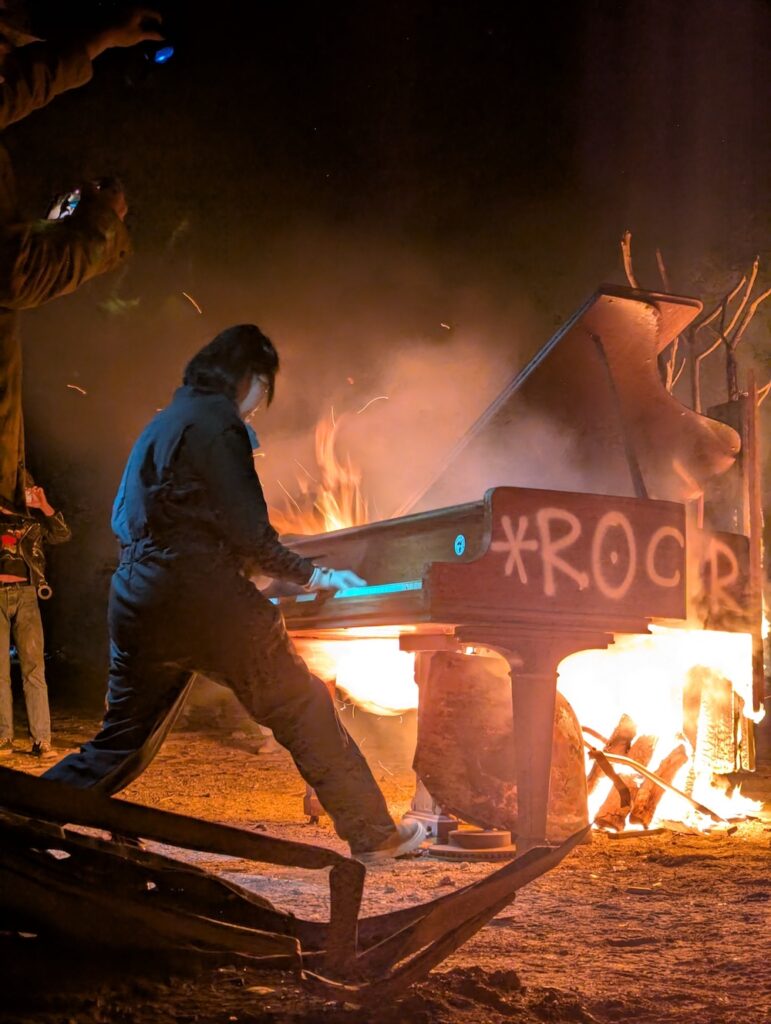
48HILLS Can you talk more about the situation of being exiled for your online views during the 2019-2020 protests in Hong Kong? What were those views, and what was the catalyst for you deciding not to return to/leaving the country?
TIN YI CHELSEA WONG During the 2019 Hong Kong protests, which we call the Umbrella Revolution, I spoke online frequently against the corruption and authoritarian approach in the Beijing government Chinese Communist Party’s response. I was living in NYC at the time, studying at NYU. Being on the other side of the world, I felt safe in exercising my freedom of speech, which most Hong Kong protestors were fighting for—lives were lost, many instances of police brutality, Communist Party leveraging the local mafia for organized violence, the younger generation being estranged from their upper-middle class parents who were promised continuous economic prosperity in exchange for a blind eye towards the passing of the National Security Law, which gave the CCP the legal ground to arrest any individuals they deem threatening, corroding the boundary between two separate political systems.
The online footprint of my critical views lengthened for years, including videos of me speaking about this during concerts, and there were many court cases of local Hong Kong citizens being arrested for their similar views online, or detained in a dark room when traveling back from overseas where they posted such views. I began to understand that there is a blacklist being kept, and I was at high risk of receiving similar treatment if I ever returned. Sometimes I dream about taking the risk to return to my beautiful hometown, potentially sacrificing myself for the movement, but I’ve decided to stay where I can safeguard the memory and history of my people, and in hope of continuing to speak in honesty, in service to those who have lost their voices.
48HILLS I just can’t help but think of the importance of art in surviving repressive regimes, and I’m floored by the push and pull you must be experiencing at the moment. What is the importance of Flower Piano in “times like these”?
TIN YI CHELSEA WONG One of the most wonderful magic of Flower Piano is that anyone can go up to any piano to play. We respect each other’s voices, and are grateful for everyone’s expression of their voices, because we recognize that everyone is at a different stage of their journey, even and especially with toddlers smashing their little fingers on the keys.
As a professional pianist, I am often at awe with how many amazing “amateur” piano players are out there. I think Dean and Mauro see that clearly from their previous works (see the documentary Twelve Pianos, about their Sunset Piano project), and have gone through a process to make this an official, sanctioned event where people can actually come together, in nature, to experiment and explore without expectations. Activating a third space for people across all social economic statuses and backgrounds and walks of life, to come out of our bubbles and cross paths, and hear each other in the language of music, hopefully can help us listen to each other with less judgement. I think to fight against a repressive regime, we need to first stop repressing each other, and ourselves.
FLOWER PIANO: TIN YI CHELSEA WONG Sun/20, 11am-6pm. San Francisco Botanical Garden. Tickets to Botanical Garden and more info here.