Acclaimed director of Ida, Cold War, and now Fatherland, Pawel Pawlikowski knows what it is like to lose one’s sense of home. At 14, amid the Cold War, his family relocated to England, where he would eventually begin his career making documentaries before branching off into narratives. He also lived for five years in Germany, and for a brief time resided in Italy. 14 years ago, he returned to Poland.
“It becomes kind of like, where is home? And it’s kind of difficult to decide,” Pawlikowski tells 48hills during a recent visit to San Francisco. “I live now on the street where I grew up, but is that home? I don’t know.”
That sense of discombobulation would have been familiar to writer Thomas Mann, one of Fatherland’s protagonists. The author of Death in Venice left Germany for Switzerland when Hitler took power in 1933. He eventually immigrated to the United States, only to return to Switzerland in the 1950s as a victim of McCarthyism. He died in Zürich in 1955 at 80.
“Most homeless people with money end up in Switzerland,” Pawlikowski observes wryly.
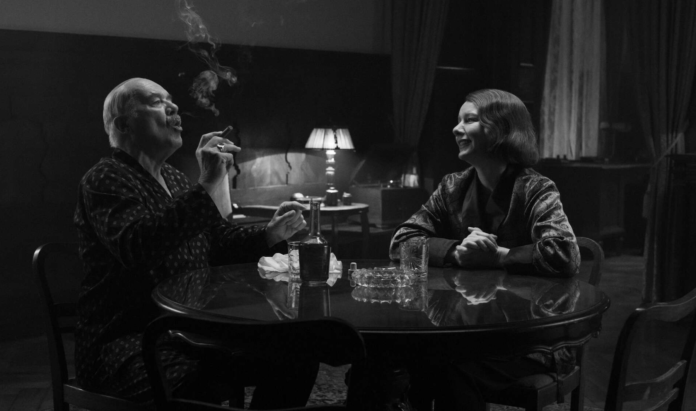
Fatherland offers but a slice of the life of Mann (Hanns Zischler) as he tours a desolate postwar Germany in 1949 with his daughter Erika (Sandra Hüller) behind the wheel of a massive Buick. The trip marks a special occasion, as the elderly writer has been awarded the Goethe Prize for his contributions to literature. The wrinkle is that at the dawn of the Cold War, Germany is already riven in two and both sides claim him. He accepts one award in Frankfurt in the west, and then travels to Weimar to receive another in the east.
Pawlikowski’s first feature since Cold War in 2018 continues an exploration of the postwar period that began with Ida—but its creation was almost accidental. He was approached with Irish writer Colm Tóibín’s 2021 novel The Magician, a fictional biography of Mann, as the possible subject of a screen adaptation. He passed on adapting the book. What appealed to him, and what he and cowriter Henk Handloegten eventually used as the springboard for their screenplay, was just a small slice of Tóibín’s work.
“It wasn’t a story, it was an interesting hook into a story,” Pawlikowski says. “The fact that Germany was this world that was divided and polarized, and that there is this this great mind, great artist who is being courted by both sides and who want his stamp of approval. He gets involved, hoping to transcend that situation and to be above it and maybe reunify Germany with the world on the basis of art and this 19th-century humanist liberal culture that he represents.
“I liked that basic situation, but there wasn’t a story. It was just a situation because the trip was complicated and long, and you know he was with his wife and the many people involved. So, then the real work of imagination started. You know, so how do we actually turn it into an interesting drama with layers?”
The narrative swaps out Mann’s wife Katia for their daughter and adds their son Klaus (August Diehl), a troubled writer in a small but substantive role. Mann and Erika travel without an entourage. The Buick is a genuine detail, but the car’s owner acted as chauffeur. Erika was a rally driver, so Pawlikowski thought it fitting that she steer her father across Germany.
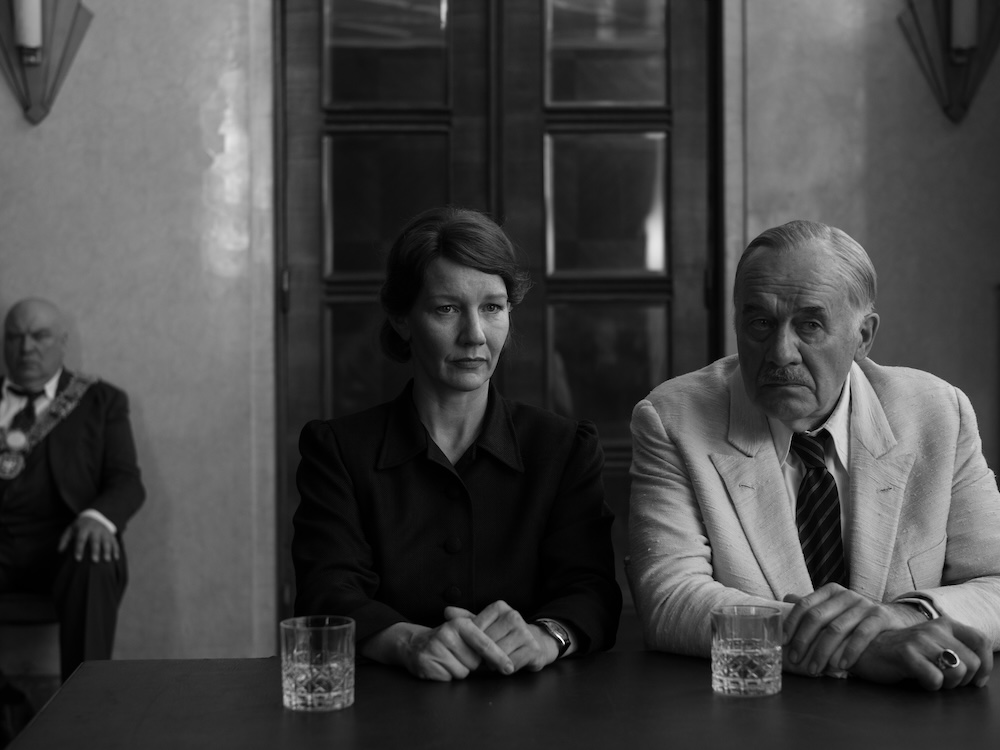
“What I did was kind of irresponsible, like changing the chronology and the characters,” Pawlikowski says. “I mean, using real people, but in wrong places, different places. Well, it’s called drama.”
In keeping with Ida and Cold War, Fatherland is shot in black and white. When he made Ida, the director chose a monochromatic palette, because he imagined the past in black and white and because he thought of the world of Ida as gray. He also finds black and white truer to the era when considering the postwar period in Europe.
“After the war, in the austerity years, there really wasn’t much color,” Pawlikowski says. “But I’m just kind of rationalizing, you know, exposed about something that just came naturally. I love black-and-white photography. I like the way it simplifies the world and answers it in some way. Also, black and white brings together a feeling of a certain kind of abstraction, you know, because the world is archived, and also has kind of documentary feel.”
Ida won the Academy Award for Best Foreign Language Film, and Cold War was nominated for three Oscars, including Best Director. Fatherland is Poland’s Best International Feature Film entry and Pawlikowski won the directing prize when the film premiered at Cannes. But with this film, the director was less concerned about awards and critical reception than he was about how it might be received by the country that reveres Mann.
“I was a bit apprehensive at the beginning, thinking what would the Germans think, because he’s a sacred beast, and Erika is well known, and Klaus Mann is kind of well known,” Pawlikowski says. “I needn’t have worried. The film landed brilliantly in Germany.
“But at the same time, when I showed the film in various festivals, exiles from Russia, Russia, come up to me, really super moved by the film,” he adds. “’We can’t go back to Russia, and if we go, it won’t be the same country.’ Or Syrian exiles. I can see that a lot of people are affected by the situation portrayed in the film.”
FATHERLAND is now playing in Bay Area theaters.