
Opponents of the massive Marina Safeway project, which just won fast-track approval from the city, have filed suit in federal court to slow the process down, saying the site is contaminated with toxic waste.
The developer admits there are toxics in the area, but nobody has tested the land below the Safeway, which will be demolished for the 840-unit luxury housing project, saying Safeway won’t allow drilling while the existing supermarket is open.
Safeway’s parent company is a partner in the development.
The complaint filed today is fascinating: It alleges, among other things, that the city changed the language of its own planning bulletins to clear the way for the project with no environmental impact report or public hearing.
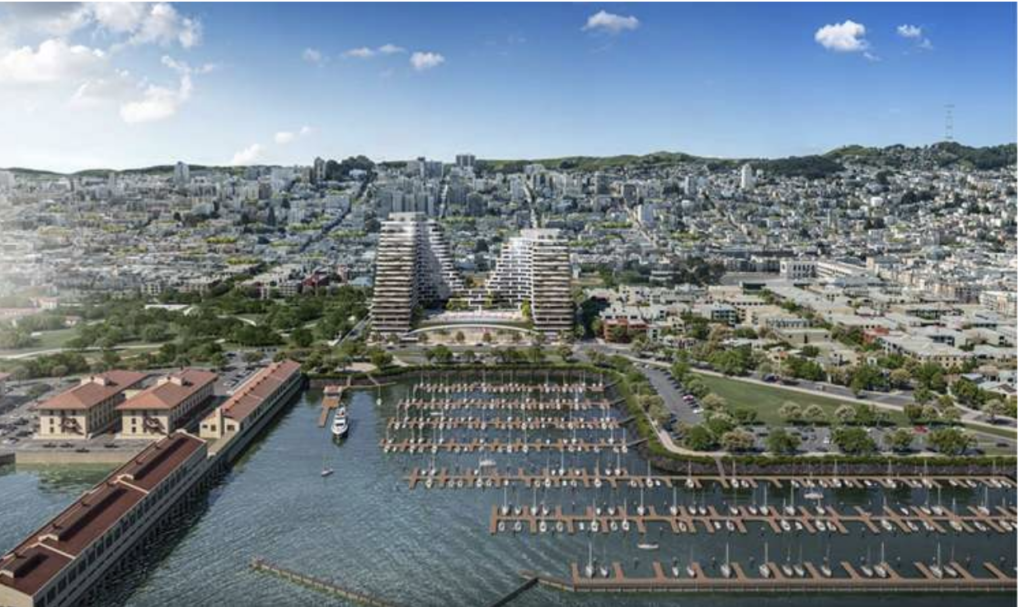
The whole situation drips with political irony: The reason a project of this size can go forward with no hearings or review is largely due to legislation promoted by state Sen. Scott Wiener, who is now headed to Congress. The Marina District, where many residents oppose the waterfront development, has always voted heavily for Wiener.
Sup. Stephen Sherrill, who publicly opposes the project and is trying to find a way to curtail it, endorsed Wiener for Congress.
You reap what you sow.
But back to the lawsuit.
The case cites reams of data showing that PG&E, also named in the complaint, operated a steam power plant on the site more than 100 years ago, using toxic hydrocarbons as fuel. The company also operated a gas plant nearby, which used coal in high-temperature furnaces to create natural gas—and that process left behind a stew of toxic chemicals that the company has never cleaned up.
The state water board has ruled that the area is safe for commercial and industrial uses—but not for residential uses.
Sherrill argues, and the lawsuit asserts, that the state law allowing housing developments to proceed with nothing but ministerial review mandates that those projects be in places where 75 percent of the surrounding area is “urban use.”
The Marina Safeway is, of course, next to Marina Green and Fort Mason, which are primarily recreational and open space uses.
But the city argues that since both parks have a parking lot, they count as “urban use.” By that standard, the plaintiffs argue, Yosemite National Park, which also has a parking lot, would count as an “urban use.”
The plaintiffs are the YesAnd Foundation, Neighborhoods United SF, and four Marina residents. The residents argue that the dust and debris from construction would subject them to high levels of dangerous chemicals.
From the complaint:
For unknown reasons, the City and County of San Francisco’s Planning Department is unlawfully rubber-stamping a massive development project under AB 2011’s “streamlined” review process despite that the project fails to meet the statutory requirements for streamlined review, and is not enforcing the developer’s statutory obligations to perform the required environmental and health and safety assessments necessary to protect neighbors and future occupants from exposure to the serious hazardous wastes that are known to be present on the project site.
The lawsuit is in federal court in part because the plaintiffs argue that the city and the state didn’t follow their own rules. The streamlining bill includes some exceptions, and sites that have toxic contamination are generally not eligible for the fast-track treatment.
From the complaint:
AB 2011 still requires critical environmental and health and safety oversight. Specifically, the project developer is still statutorily mandated to complete an environmental assessment to determine if there has been a release of hazardous substances on the site. Then, if the assessment identifies an environmental condition, the developer must then prepare a detailed “preliminary endangerment assessment” to determine if there are any health and safety concerns as a result of potential hazardous exposure before the project is approved. Then, a plan must be put in place to “remove” or “mitigate[] to a level of insignificance” any hazardous substances to prevent significant effects and exposure, both during construction and after.
But since the city approved the project:
Not only will there be no remediation of hazardous waste on the Site before the massive construction project involving excavation of up to 30 feet below ground surface across an enormous area is undertaken, but there also won’t be even a close to complete understanding of exactly what hazardous wastes exists, where they are located, how the construction could intersect with those wastes, or how the hazardous wastes and the construction could threaten the health of the Site’s immediate neighbors, the health of residents down gradient of the Site, the health of visitors to the popular parks nearby (the Marina Green and Fort Mason), the health of the construction workers on the Site, and of the health of future residents of the development.
The Planning Department’s Bulletin Number 9, discussing the AB 2011 process, initially said that a project that needs extensive environmental review is not eligible for streamlining. According to the complaint, after Marina District residents complained about the Safeway project, that language changed:
On August 14, 2026, after approval of the Project for streamlining review the Planning Department changed its Bulletin No. 9. It now provides that “[i]f a recognized environmental condition is found, the project sponsor shall prepare a preliminary endangerment assessment. If a release of a hazardous substance is found to exist on the site, before the City issues a certificate of occupancy, the release shall be removed, or any significant effects of the release shall be mitigated to a level of insignificance in compliance with current state and federal requirements. If a potential for exposure to significant hazards from surrounding properties or activities is found to exist, before the the [sic] City issues a certificate of occupancy, the effects of the potential exposure shall be mitigated to a level of insignificance in compliance with current state and federal requirement.”
In other words: Toxic waste sites are still eligible for the fast track, as long as the developer figures out what to do about the hazards later.
Federal courts often move slowly, and by the time this case goes to trial, the developer could have broken ground and started construction. So plaintiffs are asking for some sort of relief, which could include an injunction against any construction until the legal issues are resolved.
This will be a key legal test not only of this project, but of the AB 2011 approach to housing development, and in a larger sense, the Yimby movements insistence that pretty much any new apartment building, pretty much anywhere that doesn’t clearly displace vulnerable communities, is a good thing.
The Marina Safeway project could displace some nearby residents, the complaint argues, since seniors and people with young kids would have to move away to avoid the impacts of construction. But it’s not a low-income neighborhood, and adding 1,600 rich people won’t change the demographics that much.
Still: Prior to the Wiener and Yimby backed “streamlining” bills, a project like this would have required not only public hearings but likely a full review under the California Environmental Quality Act, and its approval could have been appealed to the Board of Supes. Since most board members defer to the district supe, and Sherrill opposes the project, it might have died there.
Instead, if the lawsuit fails, the biggest, tallest housing since the days of the Fontana Towers, which helped spur height limits on the waterfront, will move forward. The developers and the city say that any toxic issues can be resolved once the existing Safeway closes and demolition starts, but at that point, investors will have put up at least $250 million and it will be nearly impossible to derail the project.
Most residential developments on toxic waste sites have been sold or rented to working class people, often non-white people. We don’t have a lot of history of very, very rich people moving into an area that isn’t safe for human habitation.
But we might be about to start.