This week the multiplex offers something for all age groups—at least all the age groups Hollywood takes much note of—what with the arrival of a new Avatar (videogame-like action for the permanently adolescent), a soap-operatic thriller more or less for adults (bestseller-based The Housemaid), and a new SpongeBob Movie (for kids, though this is the only one of the three I’d particularly want to see). For the entire family that stays together because they pray together, there’s also David, a Bible-derived animated musical.
Those seeking relief from the holiday season’s hectic side will quite likely welcome these mainstream arrivals as affording a wee mental vacation. But if you’d rather chew on meatier audiovisual entertainment, there are several incoming options this weekend. Two are the kind of big creative swings well-established auteurs are inclined to make at point of career peak (or summation), positively dripping with prestige, ambition and sometimes over-weening stylistic “mastery.”
Bi Gan’s 2018 Long Day’s Journey Into Night was a lush, opaque neo-noir romance (no relation to the O’Neill play) that did not lack for self-conscious bravado—its entire last hour was a stunningly elaborate single shot, in 3D yet. Only the Chinese writer-director’s second feature, it nonetheless seemed to position him as a world great, at least in his own estimation. The new Resurrection, which opens at the Roxie this Fri/19, is even more dazzlingly hubristic.
Its 156 minutes utilize a sci-fi premise as an excuse to trip through what (at least initially) feels like the entire history of cinema, moving through different genres, techniques, and periods. Those who found Long Day somewhat impenetrable—especially since it was misleadingly marketed to Chinese audiences as a simple love story—will be even more baffled by this exquisite-corpse structure of cryptic, successive narratives. Taken as pure phantasmagoria, however it achieves a level of aesthetic sumptuousness that’s its own reward.
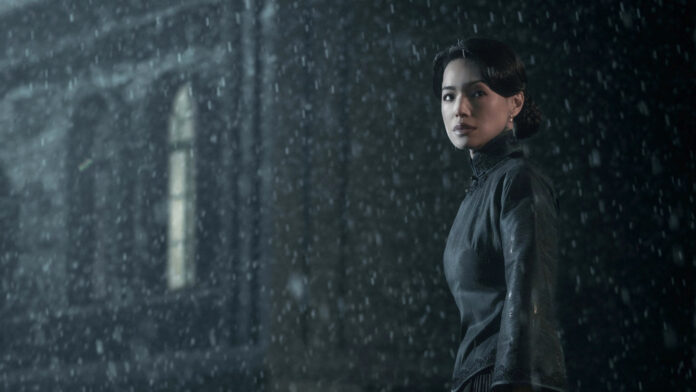
In the future, we are informed, humanity has discovered the secret to eternal life, albeit at the cost of losing the ability to dream. Those who still possess it are called “deliriants,” and are variously envied and hunted. One such is the being known as Qiu (among other names), portrayed in all his guises by sometime boy-band star Jackson Yee. His dreaming life is coveted by a Miss Shu aka Mother (Shu Qi), who literally installs a film projector inside his body to watch the scenarios he experiences unfold.
The first is a mock silent film of the German Expressionist school, with nods to Melies, Murnau, Metropolis, and more. Not a word is spoken aloud until twenty minutes in, when the screen format expands to “wide.” Subsequent episodes encompass crime drama, intrigue at the site of a ruined Buddhist temple, a sentimental caper involving a con man and orphaned little girl, then finally a hyperbolic urban gangster tale. The latter’s serpentine Odd Man Out-like flight is handled in another insanely complicated single shot, albeit at half the length of the one in Long Day. Finally the film leaps into a metaphysical ozone, because why not.
What does it all mean? To be honest, it frequently doesn’t feel like Bi Gan “means” much at all—he’s just reveling in a near-endless bag of tricks and homages. In its referential artifices, Resurrection can recall prior genre mashups by the likes of Jeunet and Lelouch, among other directors whose salutes to the medium itself were less 8 1/2-style introversion than a wildly externalized mash note to a century’s celluloid spectacle.
Some of the middle sections here struck me as a tad dull, at least compared to the early flamboyance, and this degree of expensive indulgence can be borderline-wearying. (Speaking of which, Coppola’s Megalopolis will return to select theaters on January 1.) Still, there is something exhilarating about seeing a real talent given this much rope, throwing himself out there to both impress acrobatically and twist in the wind. Resurrection is an experience.

Already well-versed in the business of manufacturing “masterpieces” is the Italian director Paolo Sorrentino, who at least since 2008’s Il Divo has—often in tandem with the actor Toni Servillo—appointed himself heir to Fellini, Visconti, Petri, and the rest. He is unquestionably accomplished. But I have an inherent skepticism towards directors who style is so self-consciously grandiose, you can almost hear them rehearsing their awards acceptance speeches on the soundtrack. The Great Beauty was his La Dolce Vita; The Hand of God his Amarcord. Imitation may be the highest form of flattery, but it is not high art, no matter how much it looks like high art.
Sorrentino’s new La Grazia, which opens at SF’s Opera Plaza Cinemas this Fri/19, has Servillo again as an elder statesman facing the sunset of his career. Mariano De Santis is a legal scholar turned President who’s steered the nation through a half-dozen major crises (this being Italy, the government frequently self-destructs), and has seen his two children reach middle-age—one a successful musician now based in Canada, the other (Anna Ferzetti as Dorotea) his own most valued advisor.
Their mother, the love of his life, died some time ago. But he remains tormented by her one known infidelity 40 years earlier, particularly since she refused to name the person she’d cheated with. And in the present day, his exit is complicated by the need to make decisions on three thorny issues: Whether to sign a pro-euthanasia law popularly embraced as merciful, but staunchly opposed by the Vatican; plus two possible pardons of convicted killers, one a battered wife who turned on her abuser, the other a man who put “out of her misery” a spouse whom Alzheimer’s had reduced to violent rages.
These plot strands are deftly woven together and neatly resolved. But Sorrentino, who’s also done a number of commercials for luxury brands, is an incorrigible showoff, forever calling attention to a lavish setting or perfectly framed landscape. It’s all too typical that early on there’s an entirely gratuitous scene expending several slo-mo minutes on watching a foreign dignitary awkwardly walk a red carpet from limo to greeting party—forcing us to admire the meticulously flamboyant staging of a trivial incident involving a character never seen or heard from again.
Presumably La Grazia means more to Italians, at least on the political level, but even there the director is too calculating to go out on any truly controversial limbs. (He’s also considered something of a pretentious middlebrow by many homegrown observers, purveying a nostalgia- and tourist-friendly notion of national identity.) Even the film’s occasional humor is self-congratulatory. We’re meant to be delighted by the dancing-bear incongruity of De Santis deigning to listen to rap music, or tolerating the bossy boisterousness of an old female friend played by Milvia Marigliano. “See! Even a great man enjoys a bit of nonsense!,” Sorrentino seems to be saying.
This impeccably crafted fictitious biopic will no doubt be enjoyed by many, and I don’t begrudge them that. But I’m not sure it actually has anything to say. And this director has been gilding a sort of old windbag’s wistfulness for “the good old days” so long already, where can he go from here? He’s only 55 years old. To keep that mojo running, will his future works need to retreat to the mid-19th-century era of Garibaldi?
Those two elephantine movies about male identity crises are complemented this week by three more tightly focused titles in which women are mad as hell and not gonna take it anymore. Pierre Saint-Martin Castellanos’ first feature We Shall Not Be Moved has veteran actress Luisa Huertas as Socorro, a vinegary, semi-retired lawyer whose life has been shadowed for over half a century by a sibling’s death. He was one among many students and miscellaneous civilians shot by military forces while protesting governmental oppression in late 1968, during what’s known as the Tlatelolco Massacre. (The death toll remains disputed, with estimates ranging from the dozens to the hundreds.)
One day the surprise arrival of a package from a recently-deceased former associate brings what our heroine always wanted: Evidence of the apparent killer’s identity. While basically housebound, she pulls every string within reach to exact belated revenge on her brother’s probable murderer, whom she’s now seen in an old photo holding up his battered body with a trophy hunter’s grin. Nothing less than “eye for an eye” retribution will do.
Shot in crisp B&W, this indictment of historic wrongs and ongoing corruption does not neglect elements of gallows humor—Socorro is a spiky piece of work, living in a state of domestic cold war with a relative, physically frail at times yet willing to lie, cheat, and steal to reach her goal. Her main ally is a ponytailed building superintendent she’d once saved from prison, played with great comic spark by Jose Alberto Patino. This year’s Mexican submission to the Oscars’ Best International Feature competition, We Shall rigorously eschews sentimentality. Nonetheless, it arrives at a closure that is bittersweet and validating. It opens at SF’s Roxie Theater on Thu/18.
Another figure reluctantly locked in the past is the subject of documentary Suburban Fury, from always-interesting if none-too-prolific Rohinson Devor’s (The Woman Chaser, Zoo). It begins with the announcement “At her request, Sara Jane Moore was the only person interviewed for this film.” Moore was one of two women who attempted to assassinate Gerald Ford fifty years ago, during his brief Presidency. The other was Lynette “Squeaky” Fromme, who’d been part of the Manson “Family.”
More inexplicable, perhaps, was the similar effort (just 17 days later, on Sept. 22 in SF) by this middle-aged, well-heeled housewife—even if she’d already been divorced three times and drifted into revolutionary activism by the time of the incident outside Union Square’s St. Francis Hotel. She appeared so low-risk, both the Secret Service and local police had dismissed her as “no threat” despite her previous alerts. Like Fromme, she missed her target, then was given a life sentence. Both women spent decades in prison—during which each made one brief, successful escape—that ended in parole during the late Oughties.
No one ever really questioned why Squeaky “did it”…after all, she was in a cult, wasn’t she? Moore’s motivations were more mysterious, and they remain so after Fury’s two hours. She is very cogent and articulate in her nineties (she passed away just four months ago), yet at the same time evasive. Maybe it’s just that at no point in her life did she resemble someone who might seek to overthrow the government, align with Black Panthers, or feel a certain solidarity with the Symbionese Liberation Army after they kidnapped heiress Patty Hearst. We see a lot of studio glamour shots of her from the 1950s or early 60s; later, her look and manner were very much suburban hausfrau. What was going on beneath that misleadingly square surface? Even in old age, presumably intending to set the record straight, she is poised and cagey.
The most interesting thing about Fury is how it eventually witnesses manifestations of an inner struggle she can’t or won’t address directly. Speaking to Devor on her own terms (mostly in the rear of a car atop Twin Peaks), for a project one assumes she initiated, she becomes increasingly frustrated and irate, snapping at him. One suspects it’s not because of anything he says, but rather because she’s realized she doesn’t really want to revisit this past—let alone explain herself—after all. It’s an absorbing if slow-moving inquiry those ultimate fascination lies precisely in being about someone who gets less and less cooperative with the filmmaking process. Suburban Fury opens at the Roxie Theater Fri/19; Devor will be present in person at the next day’s show.
Finally, returning for one night is a popular classic reflecting the tight societal restraints women of Moore’s generation and class grew up with. Released a decade ago, Todd Haynes’ Carol was an adaptation of Ripley writer Patricia Highsmith’s 1952 The Price of Salt, an atypically personal, non-genre novel originally published under a pseudonym—she didn’t want the commercial success she’d already enjoyed from Strangers on a Train (and Hitchcok’s film of it) terminated by association with then-taboo “lesbian fiction.”
Book and movie are both very much about the strangling demands of such faithfulness to “respectability.” Carol (Cate Blanchett) is a refined, elegant Manhattan wife and mother who crosses the path of younger Therese (Rooney Mara). Their bond is immediate, but it’s… well, the love that dare not speak its name. When the men in their dissatisfying personal lives suss this threat to the heterosexual claim on womanhood, things get ugly and complicated in a hurry.
An austere film, the better to reflect its characters’ repression, Carol was nonetheless a hit, and is considered one of the best screen lesbian narratives ever. This special 10th Anniversary screening will be presented by Frameline at ACT’s Toni Rembe Theater—just steps from Sara Jane Moore’s missed shot five decades earlier!—on Sun/21, 7pm.
Haynes (Poison, Safe, Far From Heaven, I’m Not There, et al.) will accept an inaugural Frameline Queer Lens Award, joined onstage for a Q&A by his longtime producer Christine Vachon (Past Lives, The Brutalist, First Reformed, Still Alice, Happiness, Go Fish, etc. etc.). Also involved in the live event will be their May December actor Charles Melton (Riverdale), as well as hostess with the mostest Peaches Christ. Full details including ticket info are here.