Mark Mothersbaugh has spent a lifetime proving that the boundaries between pop music, art, and sound design were always imaginary.
Long before his music seeped into living rooms through children’s television, movie theaters, or animation studios, Mothersbaugh was already obsessed with making things—constantly, compulsively, and without hierarchy.
Sound, image, concept, performance: it was all part of the same creative impulse.
That restless drive is what brings him back to San Francisco, where the Red Room Orchestra, one of the city’s most inventive live ensembles, will devote an entire evening to his film and TV music as part of SF Sketchfest 2026, which runs January 15-February 1.
The Sun/18 performance at Great American Music Hall marks a first for the orchestra, which has built a reputation interpreting iconic soundtracks but has never before centered a single composer.
And Mothersbaugh won’t be honored from a distance. He’ll be in the room, joining the ensemble on select pieces and transforming the performance into something unrepeatable.
“It’ll be the only night that my music sounds like this,” Mothersbaugh tells 48 Hills. “That’s what I love about it. So the people in the audience are going to hear it like nobody’s ever going to hear it again.”
That fleeting quality—the idea that art is most alive in the moment it’s made, heard, and shared—has quietly guided Mothersbaugh’s career from the beginning, even when he didn’t yet know where it would lead.

Before he became one of the most recognizable composers in film and TV, Mothersbaugh was best known as the frontman and conceptual architect of Devo, the Akron, OH band that turned satire, synths, and social critique into a New Wave blueprint.
Their debut album, 1978’s Q: Are We Not Men? A: We Are Devo!, produced by Brian Eno and David Bowie, went gold; two years later, Freedom of Choice reached platinum status.
Yet, commercial success was never the point—it was merely a byproduct of something more pointed.
“The idea that we were questioning humans,” says Mothersbaugh. “What does it mean to be at the top of the food chain? Does that mean you can destroy nature?”
Devo’s philosophy of “de-evolution”—borrowed, reframed, and weaponized through pop—wasn’t meant as a punchline. It was an observation, warning, and, in hindsight, a conceptual bridge to how Mothersbaugh would eventually approach film scoring: music not as background decoration, but as commentary—sometimes playful and sometimes unsettling, but always intentional.
Unlike many composers who arrive in Hollywood armed with conservatory training and orchestral credentials, Mothersbaugh arrived sideways.
He didn’t study composition. He didn’t read sheet music fluently. He went to school as a visual artist and learned by doing—trusting instinct over instruction.
“I hadn’t anticipated it, but I always somehow knew I would be in a band,” he says.
The door into film opened less through strategy than coincidence and community—starting with an Off-Broadway Ionesco play he scored for Dean Stockwell.
When Stockwell went on to direct Neil Young’s musical comedy Human Highway (1982), he dropped Mothersbaugh’s music into the edit. What began as theater music drove the film’s score.
“After that,” Mothersbaugh says, “I became much more aware of the possibility of doing that in film and TV.”
The real turning point, though, came through Paul Reubens, a name that looms large in the origin stories of both Mothersbaugh and fellow musician-turned-film-score composer Danny Elfman.
“Danny and I both owe so much to Paul Reubens,” says Mothersbaugh. “He really kick-started both of our careers.”
Reubens had already worked with Elfman on Pee-wee’s Big Adventure. Mothersbaugh, meanwhile, was still deep in Devo mode and had turned that project down while touring.
But when Reubens returned with an offer to score his series “Pee-wee’s Playhouse,” Mothersbaugh jumped at the chance—without fully understanding how TV scoring worked.
“I said, ‘How would that work?’” he recalls. “And he said, ‘Well, I’ll give you a tape, and you just write music to it.’”
What followed was a production schedule that now feels almost mythical. On Monday, Mothersbaugh would receive the episode on tape; on Tuesday, he’d write an album’s worth of music; on Wednesday, he’d record it.
Without the benefit of the internet, more specifically email and digital file sharing, he’d mail the recordings from LA to New York on Thursday with the clock ticking.
Once the tape was received the next day, the music was quickly mixed into the show. On Saturday, he’d watch the finished project on TV, along with everyone else.
Although the process was chaotic, exhausting, and had a steep learning curve, Mothersbaugh took to it with the same zeal that Herman brought to playtime. “I love this job,” Mothersbaugh remembers thinking after the first week. “I love performing, but making new music and making new art is always a priority.”
Reubens’ instructions were minimal, according to the then nascent composer: “‘Whenever things are happy, make them really happy. If you go sad, make it really sad. If it gets scary, make it really scary.’”
That was it. No notes. No executives hovering over his shoulder.
The result was a quirky synth-heavy score that didn’t just launch Mothersbaugh’s composing career—it established his voice: whimsical without being childish, emotional without sentimentality, and unafraid of absurdity.
“I used a Fairlight [synthesizer] to play a lot of the sounds,” he says. “And some of those sounds are just my voice.”
Those limitations weren’t obstacles; they were catalysts, forcing him to write in a specific way that prized personality over polish.
As Mothersbaugh moved deeper into film—scoring Wes Anderson’s Rushmore, The Royal Tenenbaums, and The Life Aquatic; Rugrats, The Lego Movie, Thor: Ragnarok, and beyond—he developed a reputation for something that can’t be taught: instinct.
Even before a final cut exists, he hears themes forming. “What made me successful is that I almost always hear what a movie or a TV show’s music is going to sound like the first time I watch it,” says Mothersbaugh.
That ability—to translate abstraction into sound—is why he thrives across genres, from live-action film to animation, where music often carries half the emotional weight.
“If you listen to the movie without the music,” he says, “and you just hear the dialogue and the sound effects … once you hear the music, it brings it to life.”
It’s also why the Red Room Orchestra tribute means so much to him now. “These are very special people,” Mothersbaugh says of orchestral musicians. “They play it perfectly the first time.”
He describes the miracle of live musicians—breathing, sweating, arriving from different cities, carrying the day’s weather into the room.
“That’s why you go back with an orchestra and put humans in it,” he says. “People are breathing and, you know, their hearts are beating.”
For Mothersbaugh, hearing his music reinterpreted live isn’t nostalgia—it’s renewal.
“They’re going to turn it into something new,” says the composer. “It’ll be the same piece of music, but it might be better.”

That spirit of creative risk is part of what first drew him to San Francisco—and why the city still feels foundational to his story.
“The first time I was there [in 1977], we played at [legendary punk venue] Mabuhay Gardens,” Mothersbaugh recalls. “I was really impressed with the punk and underground scene there.”
Devo came back seven times before returning to work with Neil Young on Human Highway, even recreating the band’s magical Mabuhay Gardens gigs for the film. The city stuck.
“We always love San Francisco,” he says. “It’s one of the three cities I’d want to live in.”
It’s fitting, then, that this tribute—equal parts film score, pop history, and living performance—happens here.
At an age when many artists look backward, Mothersbaugh is still building forward: designing new instruments, writing solo pieces, and planning performances that defy categorization.
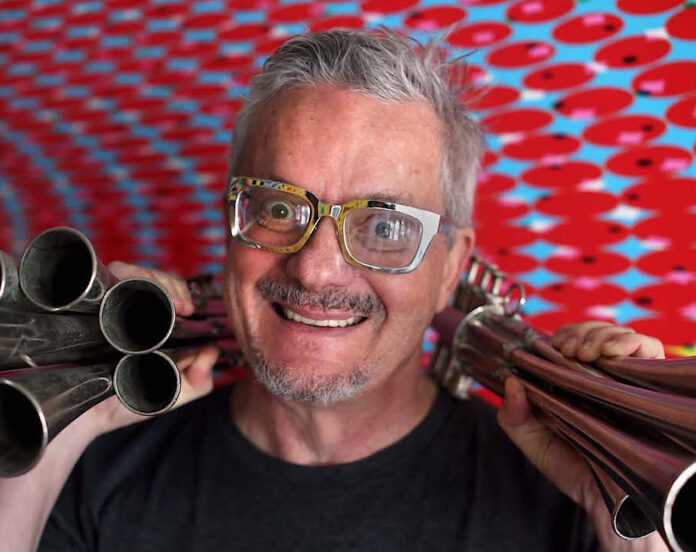
“I’m going to be playing out in Joshua Tree in a few months,” he says, describing his accompanying instrument that blends bird calls, tuned foghorns, doorbells, and glockenspiel tones. “It’s going to sound different from anything else.”
That’s the throughline. From Devo to “Pee-wee’s Playhouse,” from Wes Anderson films to SF Sketchfest, Mark Mothersbaugh has never stopped asking what sound can do—and how far it can stretch before it breaks.
And for one night in San Francisco, with the Red Room Orchestra and a room full of listeners who understand that art only truly exists when it’s alive, he’ll get to hear his own cinematic worlds rebuilt in real time.
“No matter what happens,” says Mothersbaugh, “it’ll be a great night.”
THE RED ROOM ORCHESTRA WITH MARK MOTHERSBAUGH Sun/18. Great American Music Hall, SF. More info here.