It’s October 10, 2017. The San Francisco Planning Commission is discussing a report on the future of jobs, housing, and growth. A few minutes into public comment, a slightly rumpled man with a graying beard steps up to the microphone and introduces himself: “John Elberling.”
No need to mention that he runs one of the largest affordable housing nonprofits in the city. Everybody on the commission knows who he is. So does almost everyone in the crowded room.
“I’ve heard a lot of numbers here today,” Elberling says. “What I didn’t hear is the word ‘gentrification.’ I didn’t hear about the human cost of accommodating growth when that commercial growth is clearly more than we can accommodate. I’ve seen a lot of plans, but I’ve never seen an anti-gentrification plan, how to avoid ethnic cleansing, the destruction of the Mission, the Black Community and so many other communities by market forces. Where is it?
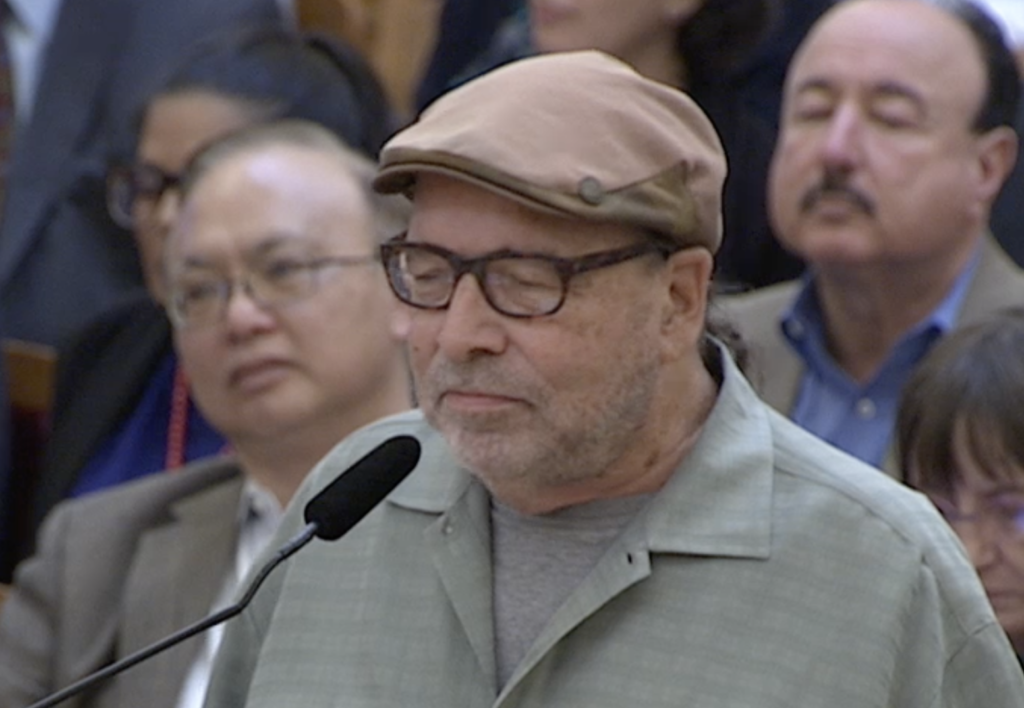
“This department,” he continues, “still believes that commercial development doesn’t lead to gentrification, because you believe that pouring gasoline on a fire doesn’t make it worse. … As far as I’m concerned, this commission is no better than the Redevelopment Commission that bulldozed the Western Addition and South of Market 40 years ago.”
At that point, his time expired, the commission secretary promptly cuts off the mike.
I will miss moments like that in San Francisco. Elberling had the institutional memory, the understanding of the intricacies and impact of city planning decisions, the deep insistence on economic and housing justice, and the willingness to stand up and call out public officials who aren’t doing their jobs.
Elbo, as he was affectionately called, died this week after a battle with leukemia. He hadn’t been well for a while, and he slowed down in the past couple of years.
Still, he loved life: The last time I had lunch with him, he ordered a cheeseburger, rare, with both French fries and onion rings, and downed two or three pints of ale. He laughed at me when I got a Bud Light and a turkey sandwich with a side salad; what kind of weak sauce is that?

He could be blunt, even a curmudgeon. I remember calling him one time in the middle of some important political fight that involved him, and asking him if it was a good time to talk. “Why are you bothering me?” he said. “I’m in New Orleans for the jazz festival. Goodbye.” And that was that.
But he was a key part of a critical movement in San Francisco, an urban environmentalism that dates back to the 1970s. He fought redevelopment in Soma, winning key concessions that included the formation of Tenants and Owners Development Corporation, which built more than 1,000 units of housing for people displaced by the bulldozers. He ran the organization since the 1980s.
Along with Sue Hestor, he was one of the founders of San Franciscans for Reasonable Growth, which fought excessive office development and won some critical victories. I remember a letter he wrote to the planners in the early 1980s, talking about a lack of code-compliance for windows in a pending skyscraper; in an earthquake, he said, the glass would fall out and shatter on the streets like “a shrapnel bomblet. I beg you, weakly, to rein this in.”
Guy could turn a phrase.
He helped draft and pass Proposition M, the landmark office-limitation measure in 1986. He drove Mayor Dianne Feinstein nuts; “Now John,” she would say, “downtown is the golden goose.” But he kept up the battle over the decades, reminding generations of planners that the office boom might be good for developers and landlords, but it wasn’t good for everyone else—and, as he would constantly remind people, it was creating a monocrop economy by destroying light industry and blue collar jobs in favor of the finance and later tech industries.
Now, of course, we know he was right.
J.K. Dineen, in a generally accurate obit, mentioned the controversies that the Yimbys and right-wing critics dragged up against Elberling in his later years. Yes, John lived in a tiny apartment in one of TODCO’s buildings. I always thought that was a good thing: If the CEO of a housing organization lived with the clients, problems would get fixed quickly. If the elevator went out, Elbo had to walk up the stairs, too, just like the other seniors. More CEOs should act like that.
And, yes, he figured out a way to use TODCO’s real estate portfolio to fund campaigns for the San Francisco left. Good for him. The other side has always had millionaires and billionaires to fund their Astroturf groups and right-wing candidates. We had Elberling and TODCO, with a tiny fraction of their money, funding legitimate grassroots efforts.
Elbo didn’t care about the criticism: “Fuck ’em,” he said.
Rest in Power, John.
(Full disclosure: TODCO donated to 48hills in our early days, and has given a limited amount of money to our fundraisers in recent years.)