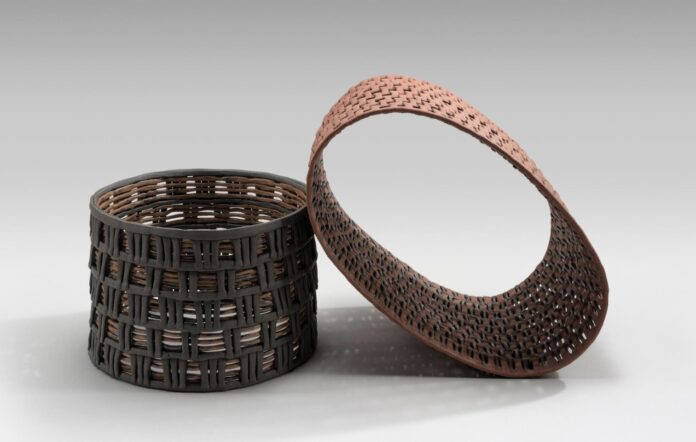
Ceramic sculptor Karyn Gabriel is drawn to clay for its tactility and limitless possibilities, but also because she finds it humbling. She says that due to its malleable quality, clay has its own demands and requires a deep understanding of material and process to guide the form toward its own logic.
“My work is a dialogue with clay, grounded in reverence for repetition and craft, at once elemental, transparent, and detailed. I’m not sure my work answers these questions but I do constantly ask myself: What value does beauty play in our chaotic lives? Is beauty important? What do objects we surround ourselves say about us?” Gabriel told 48hills.
Gabriel was born in Long Branch, New Jersey, aka the Jersey Shore, about 45 minutes outside of New York City. Her family moved to Michigan when she was 10 and she remained there through college, completing her BFA from the University of Michigan, Ann Arbor in 1989, with a concentration in Interior Architecture. When Gabriel was 11, her family took a cross-country road trip with San Francisco as the final destination.
“During our visit, we climbed up the hill to North Beach’s Coit Tower and took in views overlooking the city, bay, and mountains beyond. I loved how San Francisco was hugged by the hills and water. So, standing on top of the brick retaining wall that wrapped the hillside for the best vantage point, I declared, ‘I’m going to live here one day.’ That feeling never left me and 16 years later, in December 1990, I moved to San Francisco,” Gabriel said.
In 2004, Gabriel moved temporarily to Portland, Oregon after receiving a Full Merit Scholarship to Oregon College of Art and Craft to complete a two-year Post-Baccalaureate Program Certificate. She returned to the Bay Area in 2009 and currently lives in Fairfax where she finds the Marin County enclave nestled within rolling hills and open land to the coast to be the best of both worlds.
“It’s close to the city with all the amazing opportunities and art scene—so many different modes of expression, a tight-knit community that gives me a true sense of belonging, and a growing network of events that supports and connects artists together. And yet, I can mountain bike up Mt. Tamalpais from my neighborhood or drive the backroads to the ocean in less than 45 minutes,” she said.
Gabriel has been an architectural designer for over 25 years and attributes its language to her interest in three-dimensional sculpture. She has discovered a constant balancing act between her problem-solving, creative thinking skills and a more intuitive process to mine the mystery, curiosity, and vulnerability that she believes making art demands. Starting an art practice as a second career later in life was a conscious choice that gave her a kind of freedom.
“At a certain point in my design career, I grew tired of creating projects on paper for someone else to build. I desperately wanted a throughline from idea to realization, to dip my hands into a material and be responsible for the final object,” she said.
Around that same time, Gabriel attended a meditation retreat in Arizona’s high desert and began playing with the available art materials, especially clay, and observed her hands moving without conscious direction.
“Figurative forms emerged as if energy were flowing through me, tapping into the unconscious. I was hooked,” Gabriel said.
Gabriel recognizes that her architectural background provided a foundation and a faith in ideas and certain capabilities. She says she wouldn’t be an artist today without having experienced this circuitous career path.
“I never believed I’d find the courage to pursue being a studio artist. As an undergrad, the quintessential ‘blank canvas’ felt so intimidating that I chose architecture and design for their structure and creative framework. In hindsight, my design career prepared me for a life in the arts, not only through process and aesthetics, but by helping develop my voice, confidence, and grounding my work with a distinct point of view,” she said.
Gabriel counts among her influences British ceramic artist Gordon Baldwin and mixed-media artist Rose Simpson of New Mexico.
“Baldwin’s organic, asymmetrical sculptures, rich with textural surfaces and gestural mark-making, shaped my understanding of how abstract art can be imbued with spirit and elemental humanity. And Simpson is a powerful bad ass whose monumental figurative sculptures exude a raw emotional depth, confidence and self-assured power all tied together with clarity of purpose,” Gabriel said.
More recently, Gabriel’s experience of Colombian artist Olga de Amaral’s exhibition at the Cartier Foundation in Paris was huge.
“With works of woven gold and fiber that combine architectural scale with extraordinary handwork, thousands of tiny textile elements come together to create a monumental presence that envelops the viewer. It’s such intricate work that bridges immersive, architectural art with a deep reverence for craft, and I find that truly inspirational,” Gabriel said.
An avid hiker, biker, and kayaker, the natural world lends inspiration as well. In particular the high desert landscape of the American Southwest remains a beloved environment for the artist.
“Its vast, craggy red rock moonscapes hold a stillness I seek in my work. What appears devoid of life is actually filled with life if you pay close attention—how else could a tiny cactus grow from a rock crevice?”
Inspiration surfaces as well through the materiality and process of folk/craft traditions where storytelling, cultural symbolism, and decorative beauty is embedded in everyday objects.
“I’m searching for rhythms and connections between objects I encounter, the people around me, and even chance moments, as a way to navigate and make sense of my environment. I’m drawn to the structural undercurrents that lie just below the surface. Revealing this hidden connective tissue is central to my work. My ceramic sculptures pare form to its essence, revealing a slightly brutal beauty while exposing the skeletal framework left behind once the outer layers peel away,” she said.
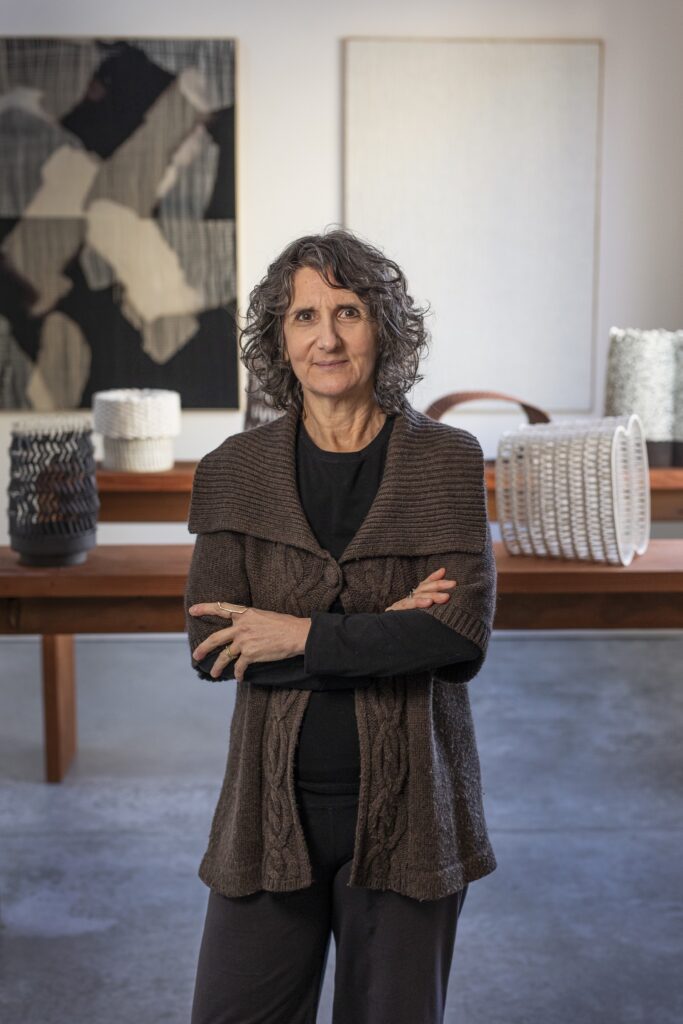
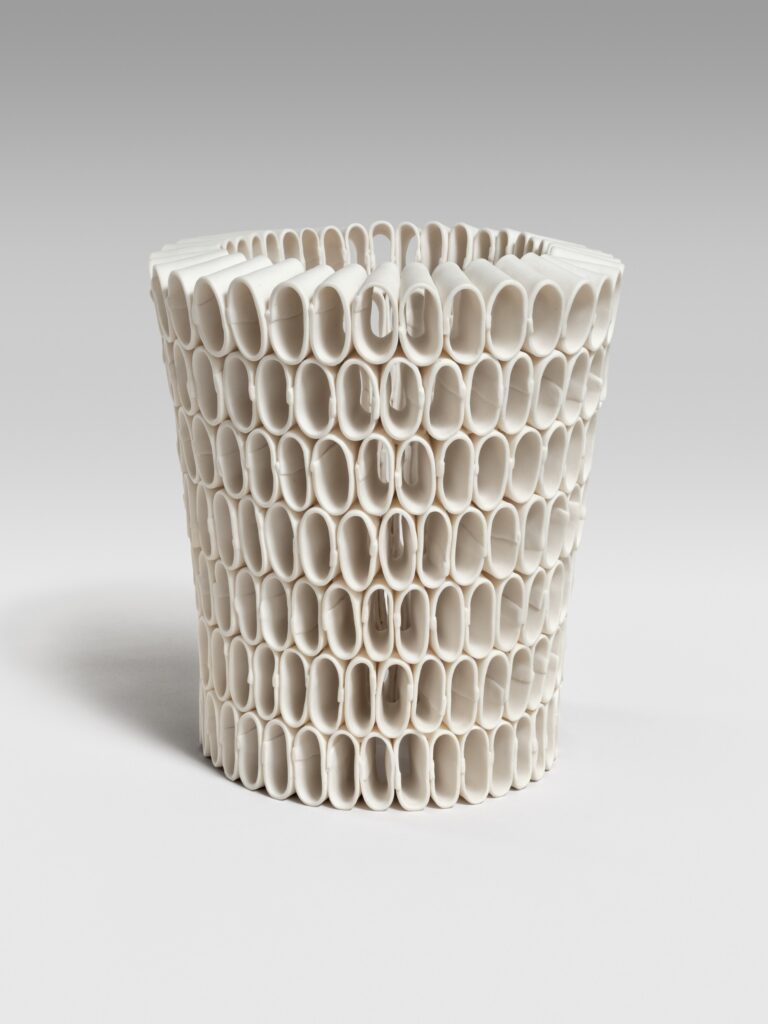
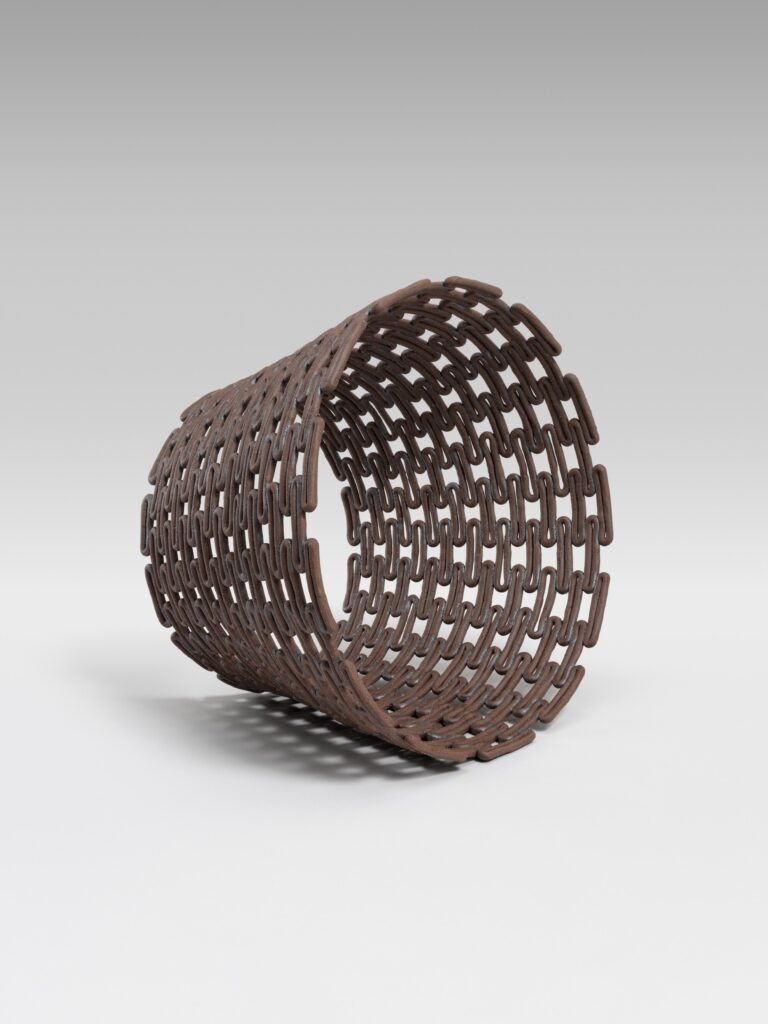
Considering pattern as her visual language, Gabriel feels obsessed with light and shadow, exploring forms that feel “simultaneously contained and porous.” She describes her open-ended pieces, Ripple and Aspen Brick, as works that function like skins that hold negative space while exploring fragility and translucency.
“They generate additional patterns through light and shadow, which I think of as an important ‘fourth dimension’ in my work,” she said.
Her process-oriented approach sometimes includes quick thumbnail sketches to capture a thought, but mostly she prefers to jump right in.
“Clay is so responsive, grounding, and pliable, it feels good in the hand. The making informs and shapes the work and I embrace the dance rather than fight it. It’s a mutual relationship—it needs my touch to become something more, while demanding respect in return. Clay is a living material that allows me to leave a tangible mark. For me, creating with my hands is just as important as the final outcome.”
Gabriel’s home studio is a converted storage room with a separate entrance. In a small but mighty 175-square-foot space created in 2018, Gabriel has two large worktables, shelving for finished sculptures and works in progress, and an electric kiln, which allows her to engage all phases of production and finishing in her own studio.
“It’s a scrappy setup without running water, so I use a bucket system for everything ceramics requires. With limited natural light, I recently upgraded from a handful of shadowy clamp-on lights to a proper lighting system that supports everything from detailed making and cleanup to photography,” she said.
Gabriel uses every inch of the space, including the walls, where she mounts small ceramic sketch studies.
“Keeping these pieces in my peripheral view allows ideas to percolate on their own timeline. I often combine sketches into new sculptural forms, testing quick thoughts and gestures throughout the day. The walls also facilitate the assembly and production of large-scale wall hangings,” she said.
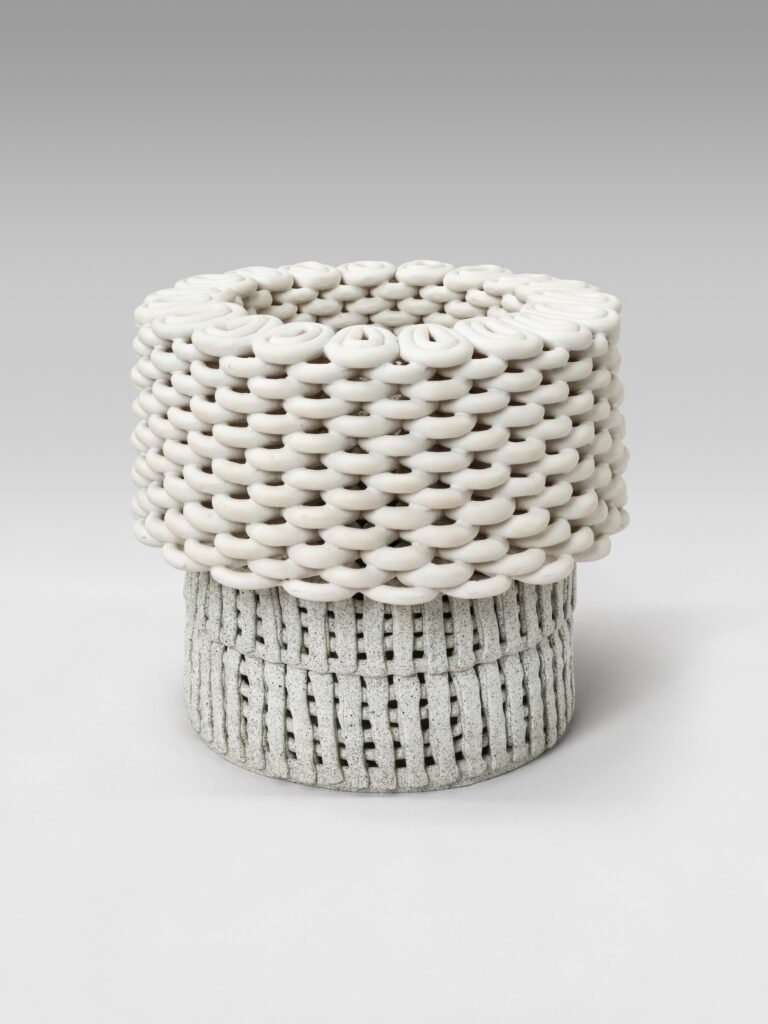
Typically in the studio by 10am after handling administrative work and doing yoga in the morning, Gabriel gets to work on hand-built sculptures using traditional methods such as coil and slab construction.
“Modularity and repetition play a huge role in my process. I’m drawn to the rhythm and almost meditative quality repetition brings. Similar to a mantra, it quiets the mind and allows me to settle into the practice,” Gabriel said.
She mentions that a professor once told her, ‘Only through making work, will the new work come.’ That memory pushes her into the studio every day, whether she’s feeling it or not.
“It keeps my creative muscle limber and there’s nothing quite like digging into a fresh bag of clay to dance with!” she said.
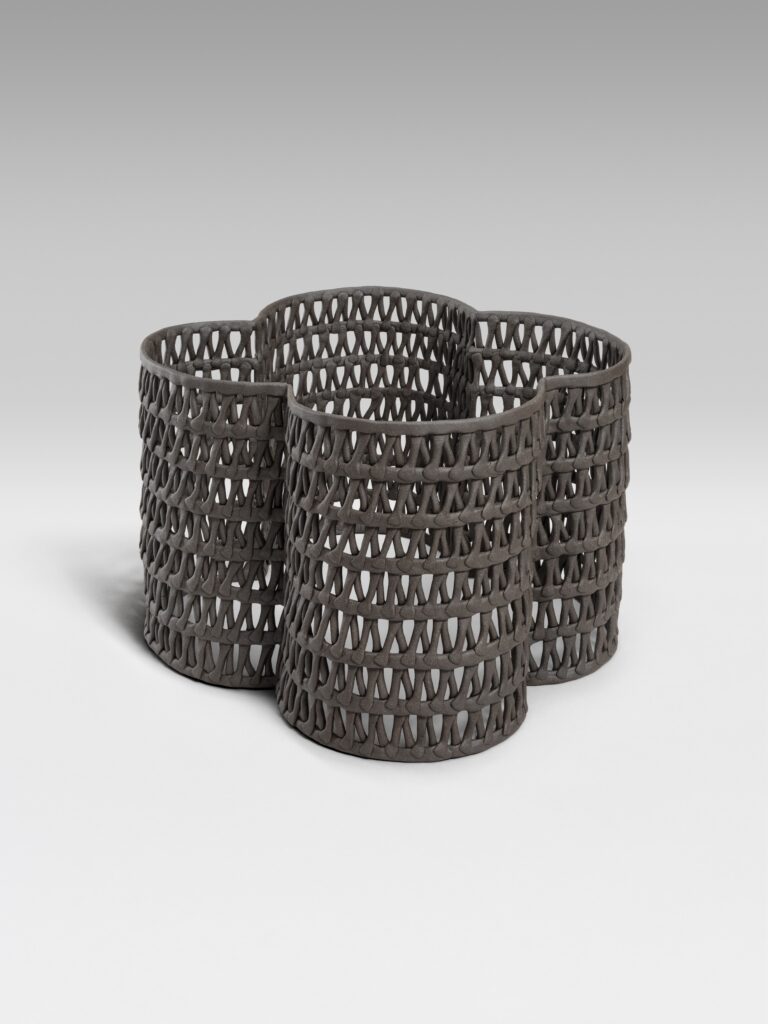
Gabriel’s first passion is travel (she’s planning an adventure to Southern Africa in the fall) where she wanders cities “stumbling into the unexpected or the ordinary” and indulges a penchant for collecting: Kilim rugs from Turkey, tapestries from India, and folk art from Mexico. She feels drawn to work that is rooted in place and crafted objects used as vessels for cultural storytelling. Currently, that reference point is traditional, functional woven fish traps used in Indigenous cultures.
“The impulse to embellish everyday and ritual objects feels like a fundamental expression of our humanity. I see my work as a continuation of this expression, a marker in our contemporary story,” she said.
This year, Gabriel is also developing patterns inspired by textile structures, chain-link construction, and small details found in the natural and built environments. Using a single building block and repetition, she is experimenting with new constructions while focusing on celebrating subtle traces of hand mark-making.
While Gabriel is always keeping purity and the beauty of simplicity top of mind, she is creating rich complexity within elemental forms. In this way, she has been working on new pieces that highlight contrast and tension while referencing vernacular and industrial architecture (such as grain soils and water towers) for their austere formal beauty as a jumping off point for sculpture studies. This is evidenced in her recent piece, Round House.
Recent local exhibitions include Fiber & Fire at Sausalito Center for the Arts; Holding Space: Pattern, Form, Thread, a two-person exhibition at Hugomento in San Francisco; The Crocker Kingsley—A Biennial National Competition at Crocker Museum of Art in Sacramento; and Beyond Color: The Language of Black and White at Bedford Gallery in Walnut Creek.
This spring, Gabriel is included in the group juried exhibition, Overtime 26, at San Francisco’s Center for Architecture + Design, through May 29; the invitational group exhibition, Language of Abstraction, through June 5 at Pence Gallery in Davis; and she will be participating in Marin Open Studios, Weekend 1: May 2 and 3. Additionally, Gabriel will be interviewed on The Potters Cast in April and she is considering teaching a workshop sometime this year.
Ceramic sculptor Karyn Gabriel continues her inquiry into creating quiet but complex forms in clay, born not only from a complementary architectural career that reveals two sides to a single coin, but through a deep connection to nature and time-tested traditions. As she does so, she invites viewers of her work to come along with her; to pause, slow down, and linger with curiosity.
“Chaos and noise are a constant in our lives. I hope my work offers a moment of calm and, dare I say, even an opportunity to celebrate our capacity for creativity.”
For more information, visit her website at karyngabriel.com and on Instagram.