It feels like a bleak moment for the future of credible news reporting. Biased platforms, drastic staffing cuts, corporate media mergers, AI, the current White House’s overt hostility towards a free press, and various other factors are all further eroding a realm that hasn’t been in robust health since the last century. (PS Support this publication’s fight against all that here.)
So there’s something wistfully sad as well as inspiring about Steal This Story, Please!, which opens in Bay Area theaters this Fri/17. Carl Deal and Tia Lessin’s documentary is a portrait of Amy Goodman, the well-known journalist who is frequently also called an “activist”—often accusingly, as if approaching issues that mainstream outlets and/or government officials won’t touch were a cause for suspicion, rather than what a good investigative reporter should do.
The increasingly cowed media atmosphere under Trump 2.0 lends additional poignancy to this film’s title. Goodman only wishes bigger outlets would amplify her coverage in their own stories, instead of avoiding anything that might trigger yet another late-night Presidential tweeting tantrum. His administration’s attitude is crisply captured at the start here, when footage shot in late 2018 captures her chasing a senior Trump advisor through a building during a UN summit in Poland. He refuses to answer any question, on any subject, before finally scramming behind a locked US delegation door. As a government official, why is he so afraid to hazard even the most tepid on-the-record statement about his bosses’ policies? The fear is so palpable, he won’t even give Goodman eye contact.
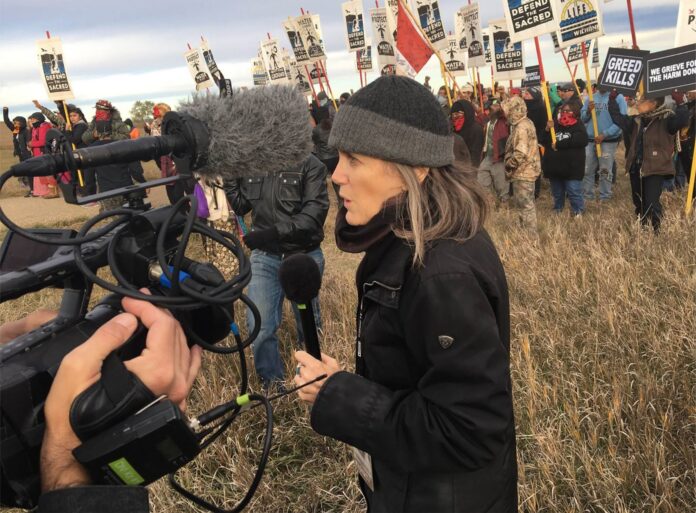
Steal outlines her personal background (politically progressive Jewish parents, ancestors who didn’t all escape the Holocaust), entree into journalism (smitten with The Phil Donahue Show, she wound up grateful its employment brushoff inadvertently led to a career in independent media), and numerous hairy moments in the field. Those included being beaten by Indonesian soldiers after witnessing a massacre in East Timor, plus risky forays into Nigeria (when reporting on Big Oil abuses) and elsewhere. Such expeditions “taught me how critical it was that we expose what is done in our name” she says, i.e. the US propping up dictators and corruption abroad to further its own financial or political interests.
As co-host and executive producer for the daily Democracy Now! program, she anchors one of the last widely disseminated outlets for news that takes no advertising, corporate or governmental funding. Early on, it had regular commentaries from Mumia Abu-Jamal. It dared to go where others feared to tread on myriad other fronts, including reporting on toxic air pollution in Manhattan after 9/11 (reportedly more people died of eventual related health conditions than in the terrorist attack itself), police brutality outside the 2008 GOP national convention, “connecting the dots” on climate change and escalating natural disasters, et al.
Unpretentious, no-nonsense and likable—though we do get a brief glimpse of temperament when others complicate her job by bungling theirs—Goodman is too busy to let the filmmakers in close, if indeed she has any private life worth mentioning. This movie’s focus, like hers, is all on the issues and their often-underreported truths, whether that involves Palestinians or pipelines.
Steal’s workmanlike competency only heightens the sense that she’s becoming a unicorn. Or at least an endangered species, even more so now that the current administration has finally realized Republicans’ long-cherished dream of basically gutting NPR and PBS. Let’s hope the day doesn’t arrive when, like the independent Russian media professionals in recent documentary My Undesirable Friends, she doesn’t have to flee the country in order to keep reporting on it. Goodman will appear in person for Q&A sessions at several opening-weekend shows, including at SF’s Roxie, Berkeley’s Elmwood, Marin’s Smith Rafael Film Center, and Rialto Cinemas Sebastopol. A full list of venues and dates can be found here.
Other movies this week:
The Christophers
For some time now people have been bemoaning the imminent demise of the moderately budgeted commercial feature, given shrinking horizons for funding and exhibition. Yet that is the realm in which Steven Soderbergh has chosen to move forward—and not so long after he’d claimed he was fed up enough with the industry to retire from it. (Many features later, he’s admitted that announcement was premature.) This droll intrigue is his latest to depend more on a clever screenplay and canny casting than mall-flick trappings that require a much bigger budget. It’s probably his best such effort since 2022’s Kimi.
Ian McKellan plays Julian Sklar, an English painter who stopped making new work decades ago, the creative well having apparently run dry. His famously acidic personality has alienated family, ex-wives, many fans, and the world in general. Still, his canvases remain worth a fortune—and their scarcity means any “new” additions to the canon would be of astronomical value.
Though mostly incommunicado with “dad,” his two offspring by different women (James Corden, Baby Reindeer’s Jessica Gunning) are very keen on getting the most they can from the ailing octogenarian’s eventual estate. They’re aware he started but failed to complete a portrait series called “The Christophers”—so they surreptitiously engage an art restorer (Michaela Coel as Lori) to gain access to them under false pretenses, then “finish the job” for semi-fraudulent but lucrative future sale.
Crazy-old-tosspot Julian isn’t quite so fuzzy as he seems, however. He soon susses not only that Lori is working undercover, but was once a huge, even obsessive fan of his. Tables get turned, and would-be con artists become conned victims before this twisty quasi-caper tale is done. Having been let down by his last starring vehicle The Critic (though he chewed its scenery ably enough), McKellan makes the most of Ed Soloman’s far superior script here. He limns a complex character who’s insensitive, obnoxious, and self-absorbed in many ways, but also capable of kindness and repentance—as well as artistic brilliance.
This is an intelligent entertainment that does not descend to familiar caricatures (re: the art world), offering considerable narrative and other satisfactions. The Christophers opens Fri/17 at Bay Area theaters.
Eastern European Auteurs: ‘Kontinental ’25,’ ‘Dry Leaf’
Two of the more distinctive directors to emerge from the shadow of the old and new iron curtains in recent years have new films playing locally this week. Radu Jude is the mastermind behind such frequently manic examinations of Romania at a cultural crossroads as Bad Luck or Loony Porn and Do Not Expect Too Much From the End of the World. His last release, Dracula, was a crude, garish indulgence I found impossible to get through. But Kontinental ’25 (which was actually made earlier) finds him at his most restrained, delivering a cutting if not always clear social critique.
Orsolya (Eszter Tompa) is a bailiff tasked with evicting a former-athlete homeless man from the Transylvanian cellar where he’s been squatting—the whole building is to be razed for a boutique hotel. After giving him time to pack up, she returns to find he’s killed himself, which causes a certain amount of public (mostly online) consternation. Orsolya is consumed with guilt, though it’s a rather performative kind. Sending her husband and children off on a vacation without her, she seems less interested in soul-searching than whining self-piteously to various parties. They include her argumentative mother (Annamaria Biluska), a priest (Serban Pavlu), and Adonis Tanta as a former student (she was once a teacher) she spends a long drunken night with.
Even if Jupe’s episodic screenplay doesn’t really go anywhere, it still has bite, the overall indictment being of a society that would like to do the right thing, but will gladly settle for complaining how doing the wrong thing isn’t its fault. Kontinental ’25 opens Fri/17 at SF’s Roxie Theater.
By contrast, Dry Leaf (playing just Sun/19 at SF’s 4-Star) is a meditative three-hour road movie Georgian writer-director Alexandre Koderidze, whose prior What Do We See When We Look At the Sky? was another epic of minutiae. That was a romance touched by magical realism; this is an ostensible missing-person drama, as Irakli (the filmmaker’s father David K.) is disturbed when his 28-year-old daughter “runs away.” Lisa did leave a temporary-goodbye letter, however cryptic, so there’s no point contacting police. Aware she was working on something about rural soccer fields (she’s a sports photographer), he sets off to find her in the hinterlands, accompanied by her editor Levan.
It is not the least of Leaf’s idiosyncrasies that Levan is heard but never seen—and he isn’t the only character here who’s invisible to the naked eye. The two traverse backroads and query agreeable strangers, the camera often giving equal attention to dogs, cats, livestock. The tranquil warmth of the natural world suggests such passing human crises have little real import. Koderidze’s film doesn’t insist on engagement (there’s no real suspense, or “plot” beyond a premise) so much as it requires surrender to its spectral calm and placid rhythms. It’s a pleasing warm bath of a movie, though it takes some getting used to the disconcerting choice of a low-res digital shooting format—offering a lyrical wallow in you might call Blur-O-Vision.