
The best and the worst of academic housing policy was on display Wednesday at a conference at UCLA.
The morning’s events at the Lufkin Center featured two panels—one on why the Yimby narrative on housing will never work, and one on why it will.
The first panel was full of data: Charts, graphs, economic analysis. The second panel had no data at all, just assumptions that have little basis in fact.
Leading off the first panel, UCLA economic sociologist Michael Storper noted that the Yimby agenda rests of five assumptions: That the nation has a housing shortage, which is causing prices to rise; that the shortage is due to a long term failure to build housing; that the failure is due to regulations and Nimby neighbors; and that eliminating zoning and other obstacles to construction will solve the problem and bring prices down.
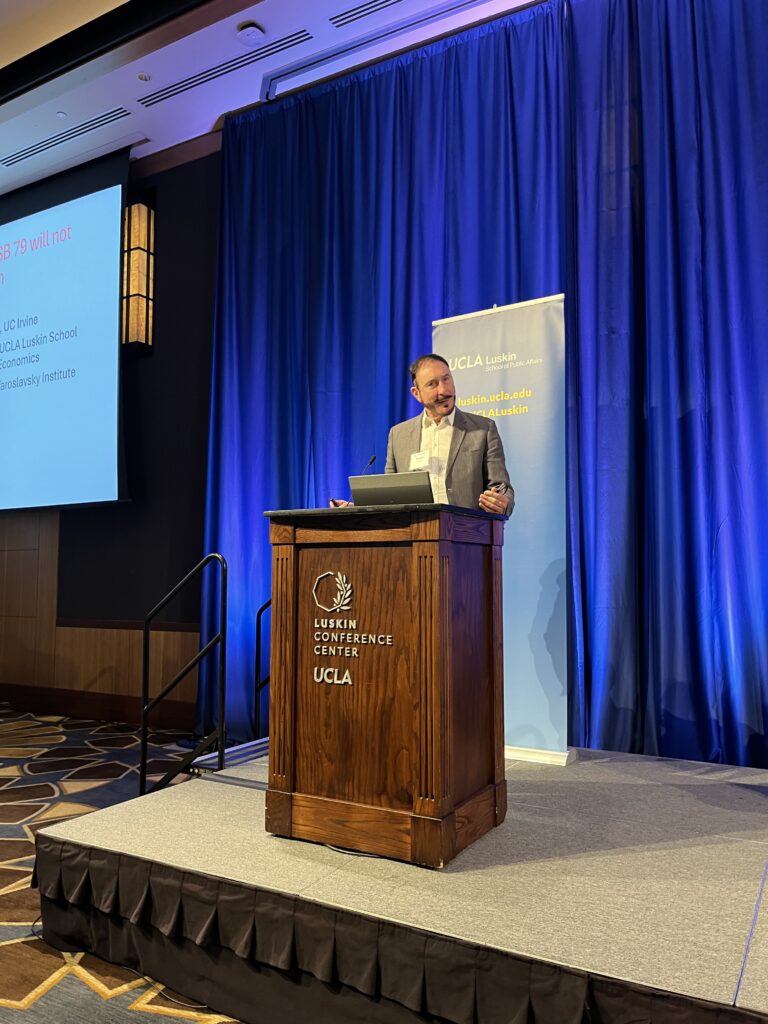
“Not one of those assumptions stands up to the evidence,” he said.
Schuyler Louie, a PhD candidate in economics at UC Irvine, and the author of a key paper on housing prices, told us the economic inequality, not regulation, is the source of high housing prices.
He had slides. He had graphs. He had comparative statics from an econ 101 textbook. Since 1900, he said, housing construction in the United States has outpaced population growth, even when you account for the reduction in household size.
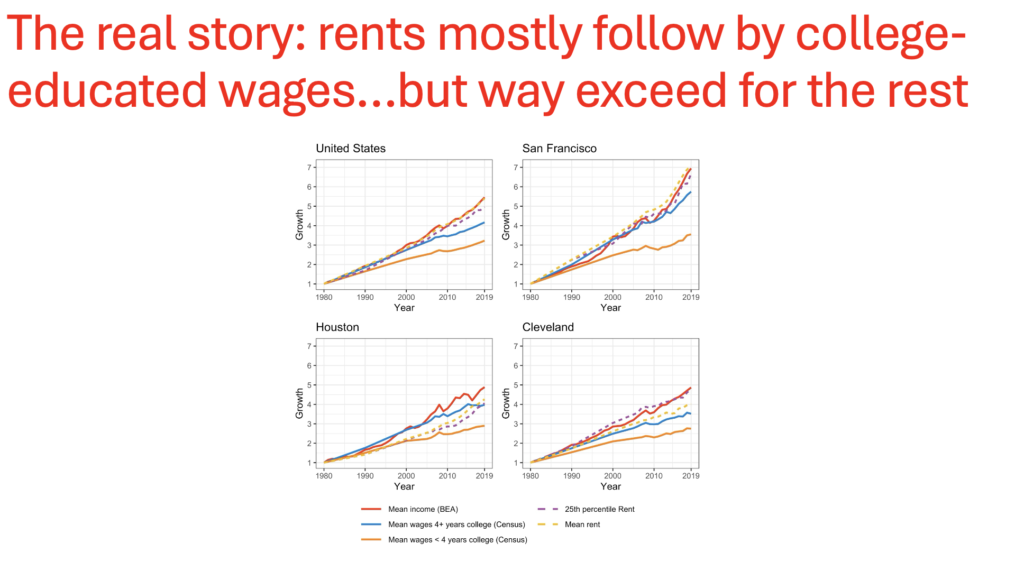
But since 2000, and a bit before, the gap between what college educated people earn and what the 60 percent of workers without a college degree earn has skyrocketed. So had the gap between the top ten percent and the rest of us.
The increase in rich people moving to cities has far more to do with housing prices than “constraints” on supply, Louie said.
Storper, again using data, pointed out that even in the most optimistic scenarios, removing all constraints to development might bring prices down to the level that an average working family can afford—in 50 years or more. Developers, he said, have no incentive to flood the market with lots of new housing; if prices go down, the developers lose money.
He also said that increasing density through upzoning encourages some property owners to hold back on building, because prices might go up even more in the future.
The massive influx of wealth into urban areas, and the investments by private capital into the housing market, have done far more to raise prices than zoning limits: “In some markets,” he said, “cash offers are more than half of the total” of single-family housing sales.
Zev Yaroslavsky, the former LA City Council member and County Supervisor, who was moderating the debate, noted that taxes on the rich would do a lot to address that affordable housing crisis. “There is no shortage of housing in Los Angeles if can afford $4,000 a month for a two-bedroom apartment,” he said. “There is not a housing shortage, there is an affordable housing shortage, and I hope the Yimbys will quote both parts of my statement.
“You have to address the question of enough is enough,” Yaroslavsky said. said. “The problem is that so many wealthy folks today don’t want to give anything up, they just want more.”
Taxing the rich would have a huge impact on housing prices.
So, Storper said, would a national commitment to social housing.
Storper said that a central political problem is that the Yimby movement, with its simplistic supply-and-demand argument, has sucked up all the air in the political debate. Nobody in the news media or politics wants to address the real issue: “We are trying to row upstream against a tidal wave of economic inequality.”
We talked after the program, and he told me that it was almost impossible to get any national news media to publish anything that challenges the neoliberal Yimby line.
So then the Yimbys came out.
Paavo Monkkonen, who also teaches at UCLA, said that his hometown of Culver City added 20,000 new jobs and only 1,000 housing units, driving up prices. But then he said that developers are only going to build in places with high zoning capacity and high rents—which would not include Culver City. Huh?
He praised SB 79, because it will add the capacity to build 3 million more housing units in the state, in places that are already expensive. The new housing will also be expensive, he said, but there will be more of it.
He presented no evidence that SB 79 will do anything to lower housing prices.
Michael Manville, another UCLA Yimby, said that SB 79 will allow more housing on transit corridors. “The new housing will be more affordable,” he said, “because it will be smaller.”
Tiny condos and apartments for people who have no kids.
“Will this new housing be expensive? Yes, new housing is expensive,” he said.
That alone should have been grounds to say that the Yimby argument on affordability fails.
Storper told me that he’s not against density, or rebuilding cities; he lives in Paris, where much of the city is far more dense than San Francisco or LA. (Ten percent of the housing in Paris is non-market social housing.)
But if we are going to severely disrupt cities by demolishing existing uses, forcing existing residents out, and increasing density when there is no money for the transit and other public infrastructure to handle the growth, there needs to be a valuable social purpose.
“The lie they are selling is that the overriding purpose is lower housing prices,” he said. “And that’s just not true.”