Flock Safety has been in the news a lot lately. The private surveillance company has come under fire in Georgia and across California for allegations of disturbing privacy violations.
It’s not surprising, considering some of the company’s seed money came from Peter Thiel, who started Palantir, which has now become one of the federal government’s largest, and most well-funded, partners in setting up a privatized surveillance state.
In the Bay Area, and across the country, Flock has set up an extensive network of cameras that track not just your license plate or your car, but your movements. New Flock technologies like Pan, Tilt, Zoom (PTZ) or FreeForm are focused on people rather than vehicles, documenting innocent people’s daily movements without even the suspicion of a crime.
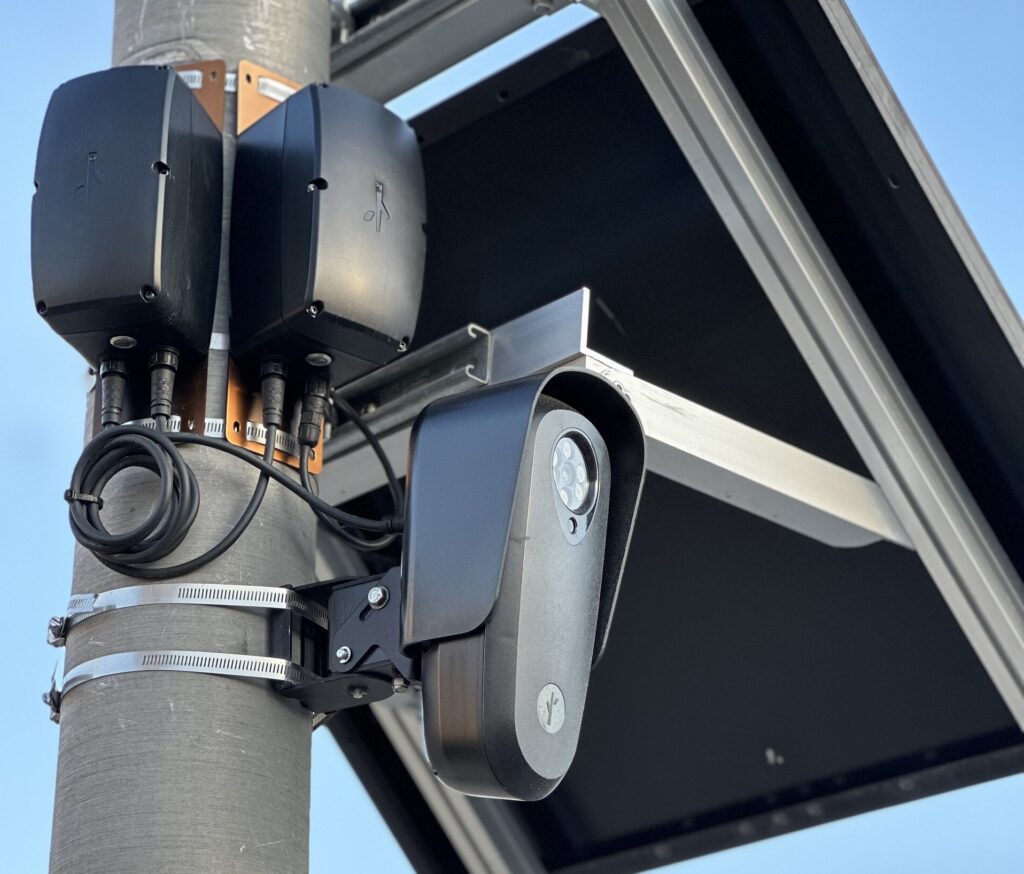
Flock’s Automated License Plate Reader cameras are the most common Flock Safety hardware and, at least in the Bay Area, they are everywhere.
The powerful network that Flock has created is already rampantly out of control and, with seemingly no enforcement of the existing regulations meant to stop it, the public is at risk.
Flock’s well-polished website features a section entitled “Articles and Resources” at the bottom. The first tab in this section is an e-book designed for law enforcement with the header “Your Plan for Tech-Enhanced Public Safety.”
This is striking because, far from enhancing public safety with tech, Flock has materially made the vast majority of the public less safe, and continues to do so unabated.
Despite widespread public outrage both in the Bay Area and elsewhere, municipal and state officials have done vanishingly little to enforce the existing laws, let alone institute new restrictions, on Flock’s ever-expanding surveillance network.

If you’ve driven anywhere in the Bay Area’s nine counties over the past nine months, your plate has been documented by the small, round black cameras.
ALPR cameras are a 50-year-old technology developed by an arm of the British Home Office, but Flock’s deployment of them revolutionizes the technology by connecting it to a sprawling, nationwide network with AI capabilities. California’s arm of this network is accessible to federal law enforcement officers despite a state law explicitly prohibiting such sharing.
In 2016, California’s state assembly passed SB-34 which explicitly bans the sharing of ALPR data with out-of-state agencies. In light of this law and revelations in the past nine months that federal agencies like Customs and Border Patrol and ICE have widespread access to Flock ALPR data, some municipalities have responded by canceling or pausing contracts, while others have reupped and given Flock more leeway.
Saira Hussain, senior ataff attorney at the Electronic Frontier Foundation, told us that in 2023 EFF wrote letters to more than 70 agencies within the Golden State that EFF concluded were in violation of SB-34. The responses varied widely.
“Many agencies did … responded to us, some agencies failed to respond to us all together and some agencies said ‘we are not interested in changing our policies.’ One of those agencies, the city of El Cajon, is now being sued by the Attorney General Rob Bonta,” Hussain told 48Hills in a phone interview.
The El Cajon lawsuit, filed in Oakland this January, is one of several municipal disputes around ALPR data in California.
In March 2024, shortly after the passage of Prop E, which widely expanded surveillance powers in the San Francisco, city officials deployed more than 400 Flock ALPR cameras on the streets. In December 2025, Oakland City Council voted to continue its contract with Flock Safety despite contentions from community organizers. As of March 2026, Berkeley City Council deferred its contract with Flock Safety, which expires in July. Also in March, the Richmond City Council voted to reactivate its Flock cameras, in a contentious 4-3 vote, after pausing the contract last December when reports showed that local license plate data was searchable by federal agencies.
Alternatively, a group of smaller Bay Area cities have chosen to end or pause their contracts with the Georgia-based surveillance company explicitly because of the out-of-state sharing. Mountain View ostensibly ended its relationship with the surveillance company after federal agents accessed the city’s ALPR data, in violation of state law. Santa Cruz Police Chief Bernie Escalante admitted during a City Council meeting that out-of-state law enforcement agencies had accessed his city’s ALPR data, which resulted in the city council voting to terminate the contract by February, albeit with a caveat to reopen.
In January 2026, Los Altos City Council voted to end its contract with the Flock citing similar concerns. Last November, EFF and the ACLU sued San Jose police for its use of Flock’s ALPR data as warrantless searches.
All of these examples highlight the existing legal restrictions around ALPRs and their data.
So one of the central legal concerns moving forward is how to get city officials to respond to the public’s demands for the removal of the cameras.
As Flock has spread throughout the country, so too has DeFlock, an open-source mapping project, which has gained traction in several states. The organization is on the radar of Flock’s CEO Langley, who referred to it as a “terrorist organization.”
Chris and Bob, two members of DeFlock, outlined both the overarching power of the technology and how regulators have already failed to keep it in check.
“I think the regulations are there, like many states have regulations about where surveillance can be placed, how it can be used and who can use it, how it’s stored, who can access it. But the majority of it, the vast majority of it goes entirely unenforced,” Chris told us, specifically mentioning the El Cajon lawsuit.
Bob echoed those sentiments, albeit with a slightly different perspective.
“To me, it’s a demonstration of why nobody can be trusted with this kind of thing. But yea, certainly a lack of enforcement of those laws, lack of any actual repercussions for breaking them is contributing.”
The distinction between an unregulated space and an unenforced space is important because, especially in California, distinct laws prohibit the distribution of ALPR data in the way Flock does to draw outlandish profits. Thus, there are avenues for regular citizens to combat these attacks on our privacies and civil liberties.
According to two experts familiar with both the legal parameters around data sharing and the technology itself, there are three different ways that agencies in and outside the state access Flock’s data.
The first is intentional formal access, where existing contracts allow officers to run searches on the Flock platform. Second is intentional informal access, where officers from outside California can access Flock data based on a toggle sharing feature on the platform. Third is informal back door access, where agencies or officers from outside the state use local police contacts to run the searches for them.
Hussain and Sarah Hamid, Director of Strategic Campaigns at EFF, outlined what these access pathways look like in practice.
The first, intentional formal access, is limited, and most federal agencies save for the Postal Service, do not have a federal contract. Flock has been reticent to engage federal agencies because Motorola’s contract with ICE and other federal agencies drew public outrage during the first Trump term. That said, federal agents still have access to Flock’s data through the lookup pool.
“People are very leery of that. Flock has been very deliberate, it does not have an ICE contract, but national lookup is a pool that folks opt into and in that lookup pool there are a number of federal agencies but they are usually not ICE or CBP,” Hamid told us.
Intentional informal access, the second pathway, is naturally less direct and harder to track, as it will appear as local activity. Hussain, referencing a 404Media report that cited 4,000 instances of immigration related searches by federal officials, explains:
“This looks like ICE and CBP agents going to local law enforcement agents and saying ‘hey can you run this plate for us’ so this happened about 4,000 times.”
Informal back door access happens when federal agencies have “direct or access to ALPR systems,” Hamid explained. “It can look like a joint operation or technical support or temporary access, and it grants the federal user a window into the system.”
Another another huge factor, Hamid explained, was nonauthorized access.
“Law enforcement claimed ‘we didn’t know. We just accidentally toggled this feature.’ The front end is set up in a way that it’s very easy to share multiple features outside of your jurisdiction without knowing that you are, which creates misconfigured sharing,” Hamid said.
Similarly, there has been evidence of easily accessible data available on the open internet. Researcher Ben Jordan and 404Media were able to access 70 of Flock’s cameras, all unencrypted, without inputting any username or password. All of these cameras provided both a live feed and stored footage of any cars or people in the surrounding areas. Adding insult to injury, the data was all easily deletable, though Jordan didn’t do so as it would be illegal. This kind of access is not just huge security risks but a public safety risk as this data is quickly accessible to any stalker or creep on the internet.
Despite Flock’s marketing materials as a technological advancement for public safety, evidence over just the past few months indicates that the powerful technology, accessible by hundreds of different agencies at any given time, poses a massive threat to regular citizens.
“We need lawmakers to recognize that their individual decisions have much deeper consequences than that one single decision that’s being put in front of them …,” Hamid said.
In April 2024, Toledo police held a man at gunpoint and sicced a dog on him after Flock’s ALPR cameras misidentified his license plates as stolen. In August, 2024, a Kansas police chief used Flock’s ALPR network to track his ex-girlfriend and her new partner more than 160 times over four months. In November of last year, EFF reported that Flock’s ALPR network was used to surveil protestors across the country. EFF identified four that logged searches associated with No Kings protests in June and October of 2025. Texas deputies used the ALPR network there to surveil a woman seeking an abortion, under the pretext of a missing person case.
In February, 2026, the SF Standard reported that an SFPD officer was under investigation for using Flock’s ALPR network to track his wife’s stolen car. In April, 2026, a FOIA request revealed that Flock executives tapped into a private network of cameras at a Dunwoody Jewish Community Center, while children were swimming in the pool. Not a week later, the Dunwoody City Council voted unanimously to approve “several Flock related contracts.”
All of these examples are cause for concern—but together are demonstrative of a pattern of civil liberties violations, technological overreach and criminal violations.
Part of the reason Flock’s network is now so extensive is because of its marketing approach, namely that it goes through municipal governments where purchasing decisions are less regulated.
“We’ve reached a point now where enough of those single decisions have been made that what we’re seeing with the surveillance of protestors, what we’re seeing with the surveillance of abortion seekers,” Hamid said. “What we’re seeing with the surveillance of minorities, what we’re seeing is a constant risk. It’s ubiquitous. Because we let all of these individual purchasing decisions accumulate into that ecosystem of mass surveillance where now that capacity is there those cameras are there those filters are there. Everywhere.”
The ubiquity of this invasive technology, combined with its constant cataloguing and its fundamentally insecure nature, provides a perfect storm for the kind of dystopia that would have seemed like science fiction just a few years ago.
Flock’s ALPR cameras are widely accessible, without encryption, across the internet. The technology is actively being used by federal officials to target, intimidate and harass innocent civilians across the country.
“It’s unreasonable to think you won’t appear in someone’s camera lens at any given moment while out in public,” Bob, of DeFlock, said in a written statement. “It is NOT unreasonable to assume your patterns of life won’t be tagged and cataloged for weeks on end, for whatever reason, by a private or public entity, if no particularized and individualized suspicion exists that you’ve committed a crime.”