This week sees the San Francisco Silent Film Festival (Wed/6-Sun/10) return to its ancestral home of the Castro Theatre, the first such local screen event to have its entire schedule at the venue since its recent re-opening. A century ago the Castro was just four years old, but silent cinema was at its zenith—no one could have possibly predicted that the very next annum would ring its death knell, in the form of a part-“talking” picture called The Jazz Singer. By 1930, silents were history, at least as far as the American industry and public were concerned. (In some other countries the transition to sound was slower, due to the expense of the technology involved.)
That changeover was lamented by some then, and some ever since, with Mary Pickford dissing the new medium “like putting lip rouge on the Venus de Milo.” It took time for “talkies” to get past awkward original growing pains and re-approach the visual storytelling mastery it had achieved while mute.
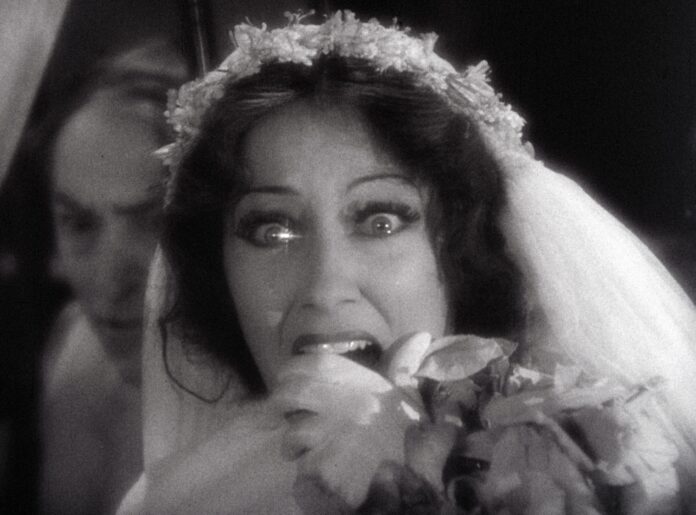
This 29th edition of SFSFF begins and ends with prime examples of that mastery, though Queen Kelly has long been lamented as one that got away—a project never truly completed, its director Erich von Stroheim cut loose and production suspended by star Gloria Swanson three months into a runaway shoot that commenced in late 1928. To kick things off on Wed/6, the festival is screening a restoration/reconstruction by Milestone Films’ Dennis Doros (who supervised an earlier version forty years ago) and Amy Heller. Their “re-imagining” includes some previously unseen footage, and a new score by Eli Denson.
Penned by von Stroheim, its story starts as a racy bit of Ruritania with an imperious monarch (Seena Owen) dismayed to see her ne’er-do-well aristocrat fiancee (Walter Byron) get involved with a convent girl he’s seen, coveted, then kidnapped—“Kitty” Kelly, played by Swanson of course. Then things get gruesomely complicated…though just how gruesome and how complicated would depend on what Queen Kelly vision you accessed. On both scripted page and screen, it went through many iterations, none salvageable enough to avoid leaving its marquee name nearly $1 million in debt.
Swanson, a huge star since a series of hit collaborations with Cecil B. de Mille starting in 1919, was among the very first to reject a lucrative long-term studio contract in favor of the artistic freedom afforded by starting her own company. “Gloria Productions” was launched with help from her investor-paramour Joseph P. Kennedy—yes, JFK’s dad. She was a very savvy businesswoman who’d ably steered her own career to date. So she figured she could manage the notoriously hard-to-handle director—whose prior films (including Foolish Wives and Greed) had mostly been scandalous hits, yet grew so costly under his reckless stewardship that by this juncture he was considered a bad financial risk.
Things apparently went well at first; Swanson appreciated her director’s exacting nature and impressive onscreen results. But von Stroheim’s budget-ballooning extravagance soon worried the producers, who simultaneously grew concerned their expensive project was becoming an anomaly amidst the new craze for “talkies.” Eventually, those factors plus the director’s eye for sordid detail—Swanson apparently found some harshly realistic scenes set in East Africa truly distasteful—led to his being fired, then the film basically abandoned.
It did eventually get released four years later, albeit only in Europe and Latin America, as a feature cobbled together with material shot later on by others. (Its star made sure those African sequences got cut entirely.) But most people only knew ever knew it as a “lost film.” Their curiosity was teased in a brief clip ostensibly depicting fictional star Norma Desmond’s original silent career in the 1950 Sunset Boulevard, which returned Swanson to the big screen in triumph. With heavy irony, it also cast von Stroheim as her erstwhile-director turned long-suffering chauffeur. Offscreen, the latter never completed another directorial feature after their shared earlier debacle, spending his remaining three decades mostly as a supporting actor. What will this Queen Kelly be like? Who knows—but the prospects are tantalizing.
The closing night selection on Sun/10 is another film famous for meeting a tragic fate—though in fact that legend is false, since contrary to popular myth 1928’s The Crowd was a solid if unspectacular financial success for still-new studio MGM. It was a pet project for director King Vidor, who could call his own shots after 1925’s war epic The Big Parade, the highest-grossing film of the entire silent period. (That is, if you discount the 1915 Birth of a Nation, released when there was no accurate accounting of box-office grosses.) That vast canvas whetted his appetite for a story about the “little people,” ordinary working Joes and Janes. He cast unknown James Murray and moderately-known Eleanor Boardman (who happened to be Mrs. Vidor) as two likable if nondescript New Yorkers whose love weathers various travails.

If these lives are deliberately writ “small,” devoid of standard glamour, Vidor’s treatment nonetheless is a showcase for both location shooting and studio-bound stylistic wizardry—The Crowd is rightly considered one of the crowning artistic achievements of Hollywood’s pre-talkie epoch. While MGM managed to get the director to shoot several happy endings as a sop to presumably skittish distributors, notably the enduring choice turned out to be the original “unhappy” fadeout. It’s one of the most memorably heartrending sequences of the era. All the more so because leading man Murray would end up lost in “the crowd” just a few years later, an embittered alcoholic panhandler turned apparent suicide. (In 1936, the year of his death, he made an uncredited final appearance as an extra in classic 1906 earthquake melodrama San Francisco.)
Unusually, there are no vehicles for leading silent clowns Chaplin, Keaton, or Lloyd in Silent Fest this year. But there’s a program of early shorts from Laurel & Hardy, who would define movie comedy for many in the first decade of sound. In addition to Swanson—seen not just in Queen Kelly but 1924’s The Humming Bird, playing a Parisienne crime queenpin—female stars to be glimpsed include two of the era’s most beloved flappers. The irrepressible Clara Bow goes Hawaiian as an island wild child in 1927’s Hula, directed by Victor Fleming of subsequent Wizard of Oz and Gone With the Wind fame. Beauteous Marie Prevost is a spoilt millionairess who decides to do a Pygmalion-style makeover of a working-class slob (Matt Moore) in the prior year’s The Caveman. It was directed by Lewis Milestone, who’d also soon get up to bigger/better things, including the 1930 All Quiet On the Western Front.
Prevost was a favorite for expatriate German director Ernst Lubitsch, though she’s absent from his So This Is Paris, another 1926 release. It’s a frothy, spicy Jazz Age concoction full of his signature playful wit. Additional leading auteurs featured in this year’s program include future three-time Oscar winner William Wyler (Ben-Hur), with pleasing early-career 1927 western Blazing Days, and Danish master Carl Th. Dreyer’s 1922 Love One Another, made before his masterpieces The Passion of Joan of Arc and Vampyr. 1931 late silent Tabu, a “Story of the South Seas” shot on Bora Bora, would prove the swan song for German pictorial wizard F.W. Murnau, of Nosferatu and Sunrise—he died in a car accident before it reached theaters.
By the time that misfortune occurred, Hollywood was considered the “capitol” of filmmaking worldwide. But while that commercial supremacy was already formidable in the Roaring Twenties, even some of Tinsel Town’s own talents then thought that in purely artistic terms, the Germans stood at the head of the global class.
SFSFF features no less than four German features this time around, including the aforementioned Dreyer and 1929’s Sensation in Wintergarten aka Their Son, whose Italian director Gennaro Righelli was also working outside his own native land. Director/star Harry Piel’s 1927 His Greatest Bluff has him as twins involved in a colorful criminal scheme whose finagling vamp is no other than pre-fame Marlene Dietrich, as a shady lady in cahoots with a dwarf.
An even greater curiosity is the 1930 Bookkeeper Kremke, the only movie directed by Marie M. Harder, who was head of the Social Democrat Party’s film division. It’s a simultaneously poetical and political tale of socioeconomic strife, with the title figure a proud white-collar worker laid low when he’s replaced by an adding machine, even as his daughter falls for a strapping prole. After the Nazis came to power, Harder died in a Mexican plane crash—and Germany fast lost its reputation for filmmaking excellence.
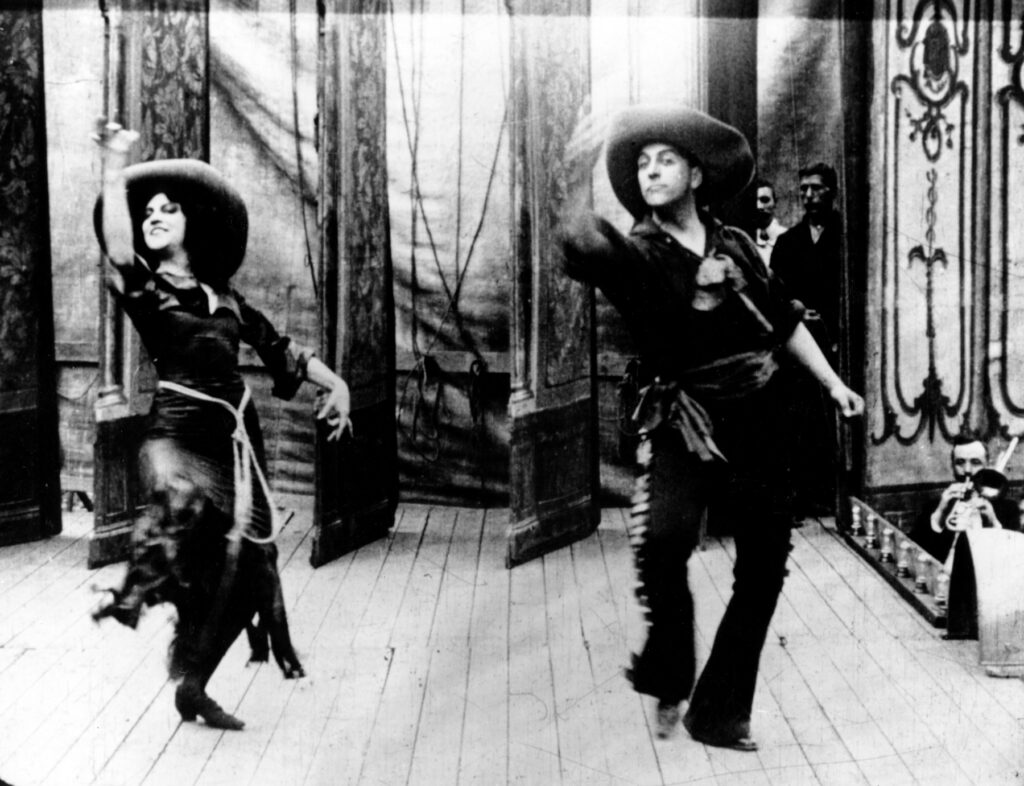
Denmark had its own silent cinema “golden age” in the ‘teens, the sophistication and exportable popularity of its films only rivaled then by Italy’s industry. A double bill showcases two Danish stars once widely known internationally: Asta Nielsen got her big break in 1910’s 40-minute The Abyss, as a respectable “nice” woman who turns very naughty upon meeting a circus cowboy. Their racy stage dance features a degree of hip-grinding you won’t be prepared for in a 116-year-old film. Her career endured for decades, largely in Germany—until she, too, preferred not to work with Nazis.
On the other hand, another hugely successful early screen idol died the same year hour-long The Clown came out in 1917, a possible suicide. Vlademar Psilander plays a different circus performer, one thrown into despair when his wife strays with a high-society dandy. The actor made nearly 100 films in just seven years—so many that they continued to get released well after his death.
Two Polish features demonstrate that country’s celluloid artistry in the late silent era. Based on a novella by Nobel Prize winner Henryk Sienkiewicz (who wrote the historical epic Quo Vadis), Janko the Musician (1930) offers a story of talent transcending impoverished beginnings. Two years later, The White Trail rode the then-popular vogue of “mountain films,” with a cast of real-life ski champions and much spectacular alpine footage, including the inevitable avalanche-rescue climax.
Other highlights in the Silent program include High Treason, a large-scale, in many respects remarkably prescient 1929 British sci-fi cautionary tale in which nations of the near future teeter on the edge of another catastrophic world war. Abram Room’s 1927 Russian Bed and Sofa is an impressionistic, nuanced domestic drama of a Moscow marriage imperiled when the husband’s old military buddy moves into their already-cramped flat—and rushes to fill the emotional needs of the neglected wife. Jean Vigo & Boris Kaufman’s 1930 A Propos de Nice and Alberto Cavalcanti’s Paris-shot 1926 Rien que les heures are dazzling sub-feature-length “city symphonies” that both celebrate and excoriate their chosen locales in essayistic, semi-narrative, expanded-documentary terms. Probably the most unusual program this year, however, is “Japanese Paper Film Project”—a compilation of 1930s animated and live-action shorts processed in charmingly low-tech means.
There’s still more in the 29th SF Silent Film Fest, where as usual each film will be accompanied live by a diverse array of musical soloists and ensembles. For full info on the May 6-10 event at the Castro Theater, including schedule and ticket details, go to www.silentfilm.org
***
If instead you yearn for sound, color and elaborate fantasy trappings that can be watched at home, however, this would be a great time to head over to arthouse streaming platform Ovid. It has just added a treasure chest full of fascinating fantasies from (mostly) Czechoslovakia, made within a quarter-century span from 1963 to 1986. The earliest is Jiri Weiss’ The Golden Fern, a widescreen B&W adaptation of a Jan Drda “modern fairy tale.” Set in indeterminate “olden times,” it finds a handsome shepherd falling for a beautiful wood nymph—though his love proves the more fickle. It’s a slow, strange, somber and lyrical fable for grownups.
More tongue-in-cheek is the 1969 horror anthology Prague Nights, whose trio of supernatural tales all involve witchy femmes fatale. Flat-out comical, indeed quite hilarious, is Oldrich Lipsky’s 1981 The Mysterious Castle in the Carpathians, a goofy mashup of Jules Verne, convoluted intrigue, lavishly cluttered production design and operatic excerpts. It features contributions from “special collaborative artist” Jan Svankmajer, the famed stop-motion animator.
‘Toon fans can wallow at length via two remarkable titles, Jiri Barta’s hour-long 1986 stop-motion epic The Pied Piper—one of the most disturbing treatments of that reliably-disturbing fable—and Jozsef Gemes’ 1983 Hungarian Heroic Times, a tale of disillusioning knightly adventure that is one of the most painterly animated features ever made. As if all that isn’t enough, as of Fri/8 Ovid is also streaming the Quay Brothers’ first full-length film in two decades. Sanatorium Under the Sign of the Hourglass, is a surreal nightmare mixing Cabinet of Dr. Caligari-style live action and Svankmajer-like stop motion that’s derived from writings by Bruno Schulz, the Polish author whose material also inspired their original breakthrough Street of Crocodiles forty years ago. It’s a mysterious, dreamlike objet d’art with a rich score by Timothy Nelson, plus orchestral passages from Alfred Schittke.
Last but not least, Ovid has on tap the thing you didn’t know you needed: A 1974 Lithuanian rock opera. The Devil’s Bride is a wacky extravagance in which angels kicked out of Heaven (for partying too hard) include one Satanic imp who then strikes a deal with an Earthly fisherman. Needless to say, that turns out to be a soul-hazarding gamble requiring many wailing vocals, acid guitar solos and raucous dance numbers before Good triumphs. Where has this mongrel union between Song of Norway and Jesus Christ Superstarbeen all my life? Well, now it’s on Ovid.