Last Friday, I hopped on the Yellow Line to experience The Still Point, choreographer Sophia Stoller and Iris Company‘s 70-minute immersive multimedia exploration of the liminal space between sleeping and waking, which ran through July 25 at SOMArts. Using projection, shadow play, site-specific performance, props, and audience participation, the work challenged how its audience reacted to and moved through space. Developed over nine years, Stoller’s movement language, created with fellow choreographer Majella Bess and an expansive ensemble, demonstrated how boundary-shifting dance theater can enrich the city’s already vibrant contemporary dance scene.
At the doors, I was given a ticket bearing a single word: “WATER.” I stepped into green lights, mellow techno, and indistinct conversation, feeling as though I’d entered another dimension. Already, I could feel the world being established by the creators in the booths and behind the dressing room curtain. One by one, dancers emerged into the common area and congregated near the entrance: Ale Preciado, Reese Windust, and Tina Diaz. They took their places in a casual, unbothered manner, remaining stoic and present, as though any movement could spontaneously happen.
A voice was heard from the back of the room, slowly working its way forward, and we saw a human wrapped in blue-indigo fabric poeticizing the concept of paralysis. This character, formally known as “Soul,” played by Ava Shannon, delivered a monologue weaving standard pre-show housekeeping into an introduction to four ideas: WATER, SAND, SHADOW, and VOID. The effect blurred the boundary between performance and reality, inviting the audience to inhabit the liminal space before the journey had even begun. It felt purposeful, moving beyond the preconceived notion that contemporary art must simply viscerally provoke its audience.
After Soul delivered the requisite safety announcements, the four ensemble dancers directed us into separate groups based on the words printed on our cards, leading us through the hall, behind the curtain, and into our corresponding sections, almost like a museum tour. I proceeded with a group to the WATER room, led by VOID devising ensemble member, Tai Lum.
WATER
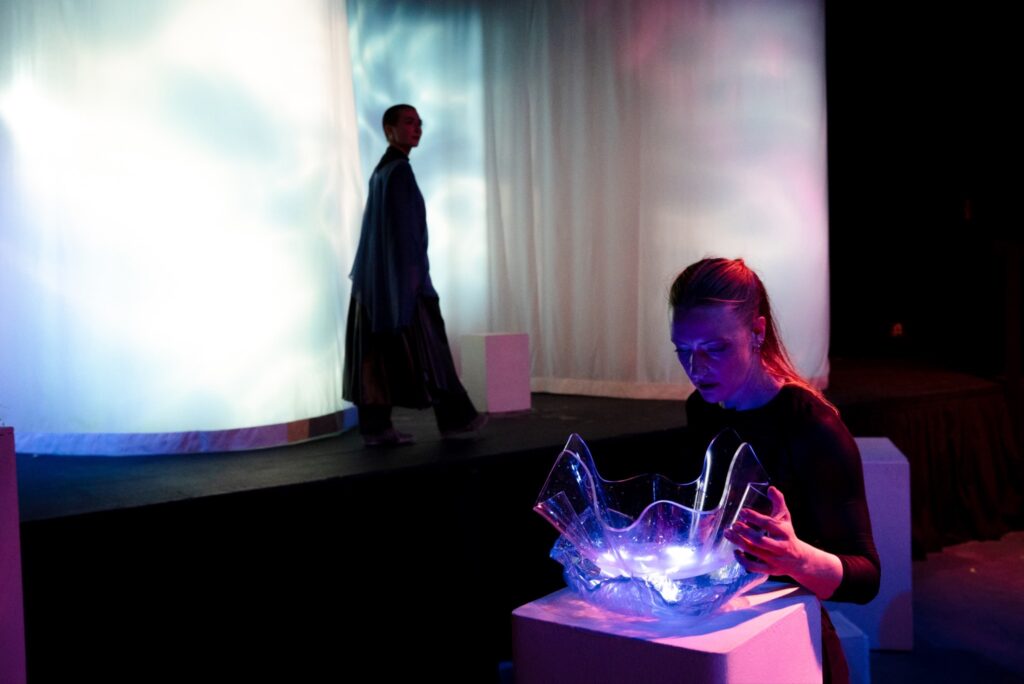
Entering the WATER sector felt like stepping into an aquarium, submerged in royal blue light and an aquatic soundscape conceived by Justin Scheid and Drew Corey. Principal dancer Haylee Nichele occupied an elevated platform surrounded by pedestals holding glass beakers of actual water. Cradling one of beakers, she mirrored the movement of the water inside. Nichele physically communicated water’s legato yet fickle nature through sudden drops, expansive shifts of weight, fluid arms, and spiraled arcs of the body. Her playful leaps between platforms evoked a child hopping from rock to rock across a pond, while her swaying and counterbalancing reinforced this sense of buoyancy. She further dissolved the fourth wall by pouring water over herself and making contact with audience members, drawing us deeper into the world she created. Nichele’s performance and the room’s sensory design led me to consider my own relationship with water, feeling an imagined chill run down my spine before settling over my body like a lullaby.
SAND
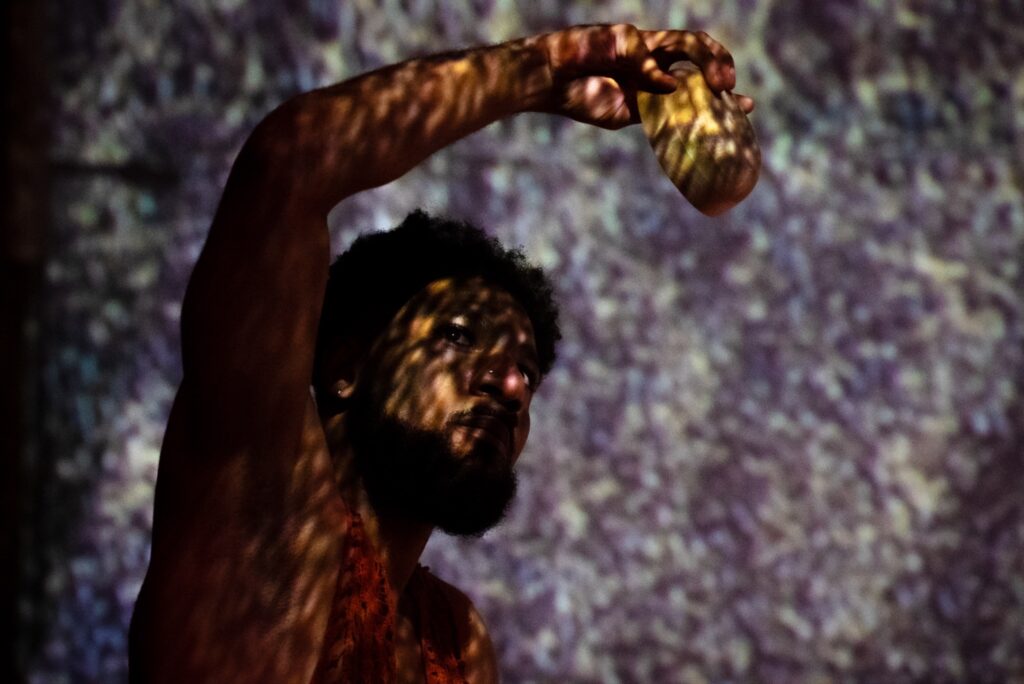
We moved on to the SAND sector, immediately greeted by the satisfying ambience of pebbles dropping and a blurry, beige-lit projection designed by Aron Altmark and Visual Endeavors. Two figures squirmed and wiggled beneath a sheet like desert chameleons burrowing into the sand for protection. Gradually, yet intentionally, they emerged, beginning the partnership between the two SAND principals, Kevyn Butler and Will Ervin Jr. Their trust and patience were palpable in their duet. There were moments when Ervin moved emphatically and expansively away from Butler, only for Butler to respond with intentional resistance, gently redirecting him.
Every lift and counterbalance felt as though they had melted into each other’s bodies. A bowl of sand sat on a table beneath a sheet, and at one point Ervin scooped up a handful, slowly letting it disperse back into the bowl. Butler responded by softening and slowing his movement, much like the settling sediment in Ervin’s hand, allowing gravity to carry his weight as he lowered closer and closer to the ground. Their presence in their movement, with each other, and in the objects surrounding them, was so absorbing that I found myself wanting to follow them back beneath the sheet from whence they came.
SHADOW
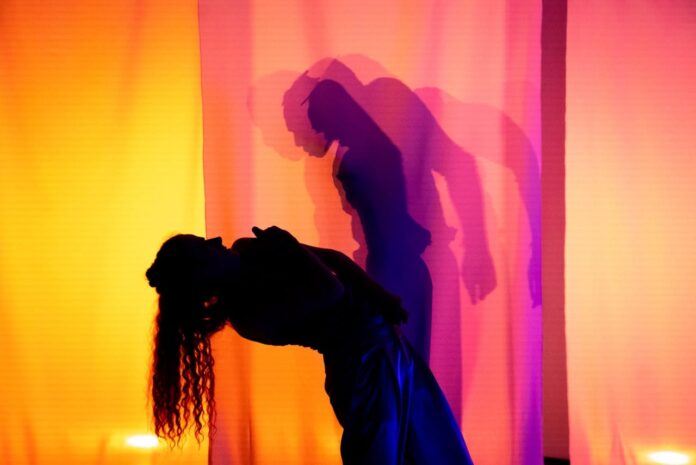
As we entered the SHADOW realm, we were welcomed by five large white sheets and two shadows moving slowly behind them, like a sunset-colored puppet show in slow motion. The partnership contrasted sharply with the previous duet. Though still responsive, it felt darker and more sinister. Yet, with each step beyond the sheet, the characteristics and motives of these figures became more apparent. From what I witnessed, one SHADOW represented the id, while the other embodied the ego. Id, played by Jae Neal, demonstrated reserved, almost ashamed mannerisms in response to Ego, played by Livanna Maislen, whose aggressive, confrontational, and sensual movement communicated a far more unrestrained set of desires.
As the duet progressed, the two repeatedly wounded one another in a vicious cycle of pursuit, separation, and inevitable reunion. It was a poisonous relationship that seemed incapable of breaking free from itself. Maislen and Neal’s solo work, in addition to their partnership, demonstrated a remarkable understanding of character, motivation, reaction, and expression. I also credit the show’s dramaturg, Claire Elliot, for helping bring such a raw and emotionally complex relationship to life through movement.
VOID
Stepped into the last realm, VOID, felt immediately very different from the other realms—empty, disconnected, stark, and devoid of real human connection. VOID principals Majella Bess and Marcel Mejia feverishly pieced together a foam puzzle with the assistance of a few audience members. Throughout the building process we saw them struggle, disagree, argue, rearrange, throw away, and come back to this seemingly unending puzzle. The duet between Bess and Mejia felt supportive yet disconnected, as if reaching for answers beyond either one of them. They grabbed a round piece of foam and rolled it up the staircase, much like Sisyphus. They remained suspended between the search for meaning and the fear of finding it, a threshold neither character seemed willing, or able, to escape.
The walkthrough’s resolution then became clear as the sheets separating each realm were torn down, revealing that these worlds had always coexisted. SHADOW and VOID danced together first, like old friends, or past versions of themselves, followed by SAND and WATER, WATER and SHADOW, and other pairings. Some dancers broke away to engage the audience. The swelling music and synchronized movement built to a visceral finale that immersed the audience so completely they, too, began to dance.
When the performance ended, the audience stood frozen, exchanging silent glances as though no one wanted to break the spell. It is rare for something so abstract and open to interpretation to feel so emotionally clear. Stoller and her collaborators had created more than an immersive performance; in The Still Point, they had left space for audiences to find their own meaning. That generosity, more than anything, is what lingers long after The Still Point comes to an end.