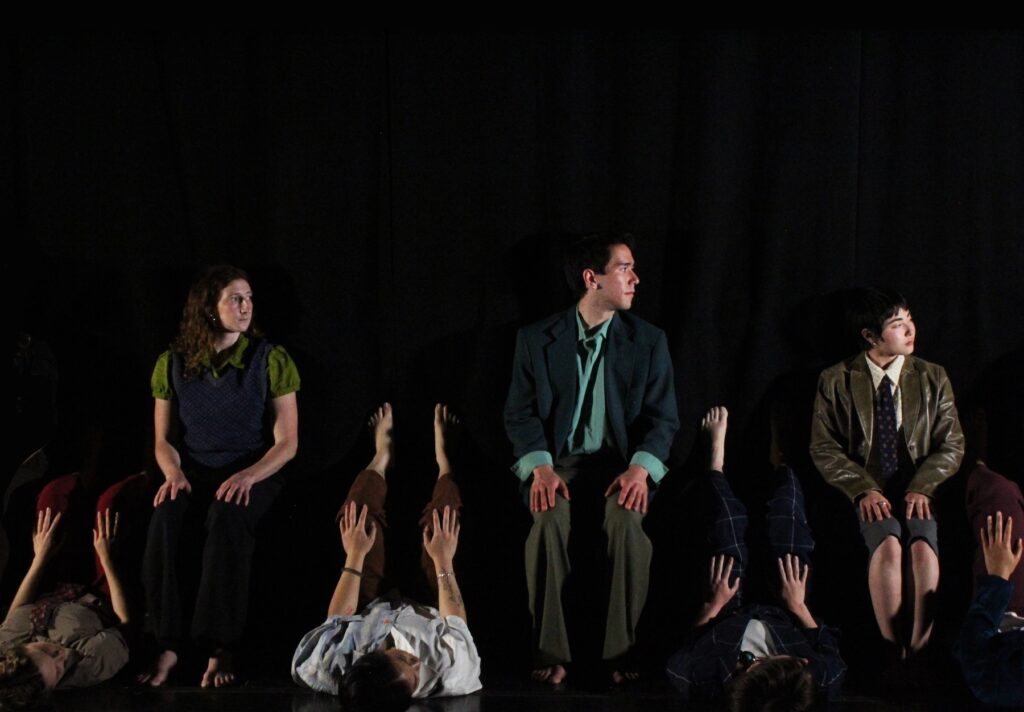
As audience members filed into seats before the premiere of Tether Dance Project’s first full-length work, “Escapement,” which played July 10-12 at Joe Goode Annex, nine white chairs sat arranged in uniform rows of three on the stage, looking marooned in the black box theater with no curtain or wings to hide behind.
The chairs, along with keyboards, two sets of costumes for each cast member–one colorful, one muted—and the dancers’ own shadows, growing and shrinking against the barren walls as they moved through the space, were building blocks for a narrative structure inspired by Tether’s co-directors’ experience of living in San Francisco after leaving college behind. The work reflected on how some moments of connection can come and go, while others lead to life-long relationships—and both have the power to shape who we are.
This premiere follows Tether Dance Project’s November show “Flux and Form,” which presented a range of works by various choreographers, promoting and creating paid performance opportunities that Tether hopes to continue building on. The collaborative performance came weeks after “Ignite,” a community workshop for local emerging artists hosted in collaboration with Pearl Street Dance Collective, a fellow San Francisco dance troupe formed and run by early career dancers Elizabeth Wiehle and Bella Soo-Hoo, also members of the “Escapement” cast.
Teo Lin-Bianco, Tatiana Steiner, and Ella Wright, co-founders of Tether Dance Project, a modern dance group born of the trio’s senior thesis project while dance majors at UC Berkeley in 2023, welcomed show attendees barefoot, in costume and makeup. The three choreographed and directed “Escapement,” while also part of the 12-person cast, all of whom were credited for choreographic contribution to the work.
The two-act piece shines a light on our productivity-driven society that drains us of joy and individualism, the keyboards and electric sounds a clever nod to the tech bubble of the Bay Area. But the larger story focuses on the work’s two soloists, Tai Lum and Ava Shannon, and how their connection changes them and their relationship to their environment. Ahead of the start of the program, Steiner encouraged the audience, “to consider how we each continually negotiate the balance between structure and freedom.”
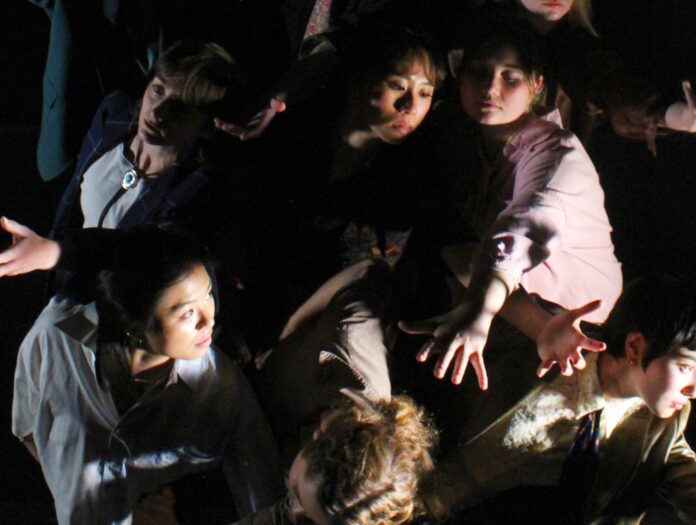
The lights went dark as a ticking clock began before the stage was suddenly illuminated in unison with the music turning electronic, a steady thumping bass revealing a cast of nine dancers sitting in the white chairs typing steadily on keyboards balanced on their laps. Occasionally a dancer would try to stray from their task at hand before being pulled back into the rhythm of expectation, this urge to break free being demonstrated later by different individuals biting their own outstretched arm before pulling away abruptly and going back to the same movement as their fellow group members.
Setting precedent for a rearrangement of chairs that happened countless times over the course of the show, the dancers clustered their seats together, making their way to standing on the chairs, their uniformity taking on a new level of intensity as they went from bobbing their heads aggressively in unison to swaying their bodies together as one large mass. The tightness of the ensemble work remained strong through the majority of the night, another standout moment occurring later in act one through a section of flocking, the group constantly changing direction, each step appearing as if it had been coded into their bodies as they moved to Dani Siciliano’s “Walk the Line.”
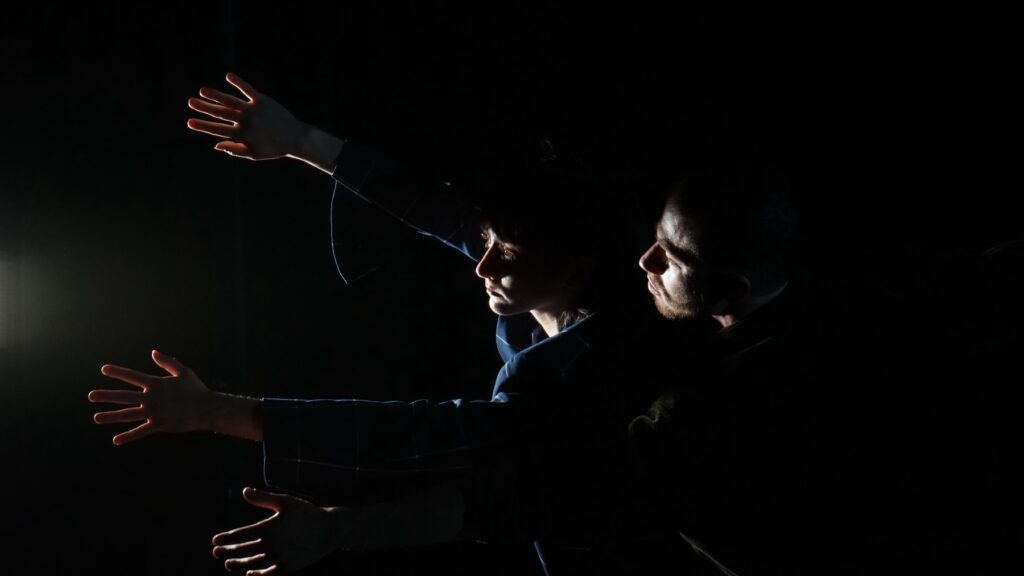
When soloist Lum enters in a yellow button-up shirt and red tie, eventually finding his way to fellow soloist Ava Shannon, wearing a purple button-up, the two dancers break off from the larger ensemble. In the first act, Lum seems to be an inspiration of sorts to Shannon, his movements supple and precise, as they watch closely, sometimes frustrated in just observing their counterpart, other times trying to emulate his movement. Shannon, however, is crisp and determined in their own movement, attacking each step with an unflinching self assuredness.

The phrase that stayed with me most is Lum going from being bent at the hip, his chest against his thigh as he balances on one leg. With his other leg in attitude as he slowly rises and extends his chest up and arms out behind him, chin lifted toward the sky, Lum’s movement conjures a swan. His faithful watcher, Shannon tries to do the same multiple times, stopping themselves in a jerky uncoordinated motion before falling over. But eventually, Shannon learns to control themself and there is the breathtaking moment where Shannon and Lim move as one, finding joy in their shared movement that also maintains their individuality.
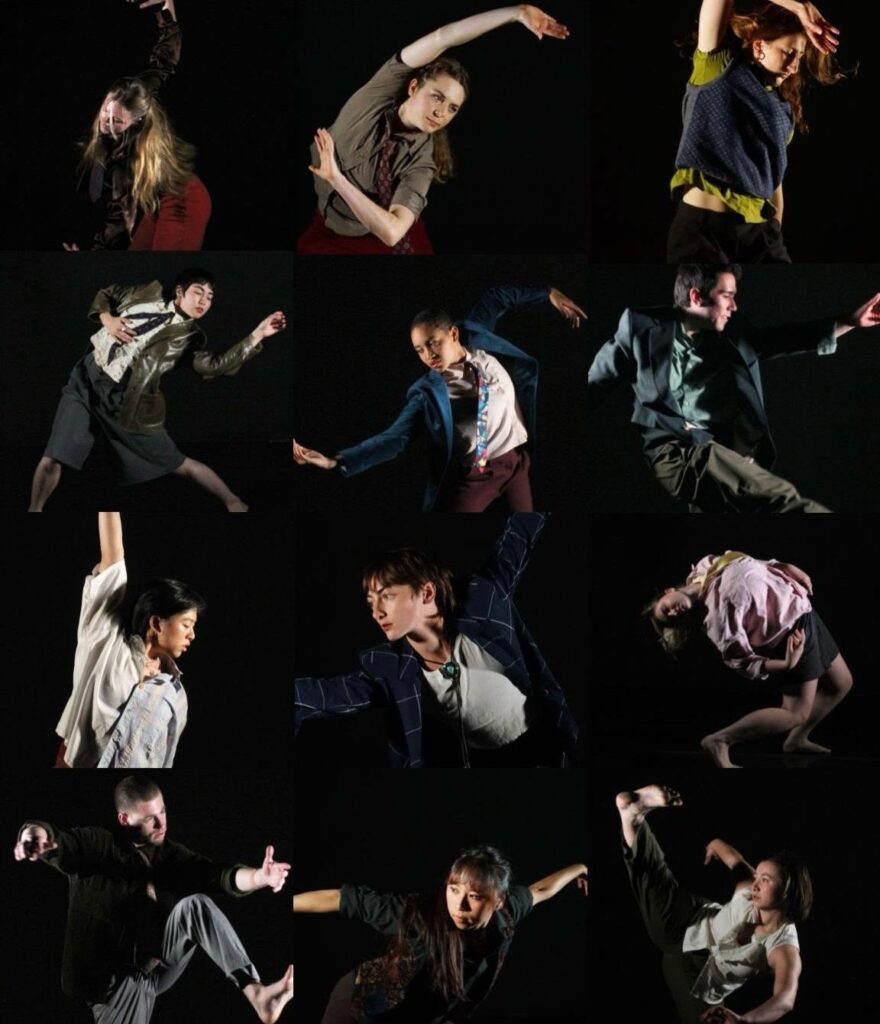
Across both acts, the perspective shifts from Shannon to Lum, also shifting the story for audience members. There is the ongoing struggle of the work’s protagonists falling into the trap of wanting to join the hustle of the larger group, and being stuck in the larger group along with more solo work, further highlighting their each of their talents. At times, Shannon has a virtuosic quality, moving balletically with buoyant ballonnés, while other times showing their mastery of groundwork, raising and lowering themselves on their forearms before threading a leg through to somehow find themselves standing again in one effortless motion. Lum, too, demonstrates impressive range, moving between pliant to powerful all in the same phrase, with a knack for comedic timing, making the audience chuckle on a few separate occasions.
Though 70 minutes, “Escapement” goes by quickly, its high energy passages danced to house and techno beats, and its slower lyrical sections to stringed instruments and saxophone. Riley Richardson, the lighting designer, enhanced the evening in providing an ambience that reflected the intensity of the work’s most energized sections, and allowed the solo work to shine intimately.
This premiere pointed to promise for what’s to come for audiences if the work of these emerging artists continues, individuals who are cultivating a supportive, community-oriented future for dance in San Francisco.