First-person documentaries have become something of a plague in recent decades—as many good ones as there have been, there are many more in which the filmmaker’s need to be the center of attention simply gets in the way of their ostensible subject matter. It takes real skill to keep such efforts from turning into gratuitous vanity projects.
Though he shoulders a lot of blame for the subgenre’s ubiquity, Michael Moore is actually among the few who’ve been able to pull it off, his own frequent onscreen presence being wry and self-deprecating as he investigates various sociopolitical ails (gun control in Bowling for Columbine, healthcare in Sicko, etc.). 1989’s Roger & Me, where he doggedly pursued answers to the auto-industry abandonment that killed his Flint, MI hometown’s economy, is widely viewed as planting the seed for so many documentaries since in which the director is also on-camera “star.”
But four years earlier, that soil got loosened with Sherman’s March, a more modest commercial success that nonetheless earned considerable praise, and exerted long-term influence. Native North Carolinan Ross McElwee had already been working in nonfiction cinema for a while, without attracting much notice, when he got the idea of making film about the titular event: The Union General’s “scorched earth” campaign from Atlanta to Savannah in 1864, which hastened the Civil War to its bitter end. But a breakup in his private life jarred the director’s focus, and as he was approaching 40, no end of family members and friends swooped in to advise him on the more important business of “settling down.”
The result was a disarmingly funny portrait of modern Southern society, as well as the parade of prospective female partners this eligible bachelor was gently arm-twisted into giving a tryout. McElwee certainly didn’t invent the “personal essay” documentary form—it had existed for some time already, albeit largely in more experimental circles—but he made it entertaining, relatable, and amply imitable.
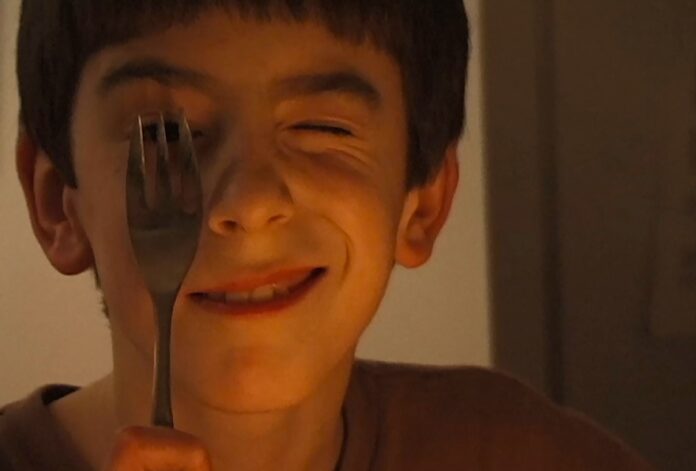
Arriving every half-decade or so, his subsequent features likewise artfully mixed autobiographical elements with larger themes, either historical or current-events-focused. Gradually his audience diminished; I can’t recall seeing his last couple movies, and it’s been 15 years since 2011’s Photographic Memory. The new Remake, which opens at SF’s Roxie Theater this Fri/24, suggests some reasons for that gap. For one, McElwee is simply older (he’s 78 now); the marriage he did eventually enter into ended after almost a quarter century; and his son Adrian died after years of struggle with alcohol, drug, and mental health issues.
This is, unsurprisingly, a much more melancholy piece than the director’s prior works. It’s also more obvious in the limits of its disclosure. While McElwee’s raffish style (and his frequently filter-free interviewees) previously suggested he held nothing back, here we’re aware that some topics are too painful to do more than dance around. We never do get a grip on why his marriage ended (though it’s hinted that was the wife’s call), though he later enters a second wedlock. In retrospect, McElwee admits that Memory was less than fully forthcoming about Adrian’s “problems.” Dad had hoped his troubled adult offspring was “heading in the right direction,” and the film was perhaps a gesture of wishful-thinking optimism in that regard.
Adrian was an avid skateboarder and skier who initially seemed a magnetic golden child. But his worrying mood swings brought an eventual diagnosis of bipolar disorder, something whose symptoms often don’t manifest until late teens or early 20s. He was in and out of addiction rehab. He’s already been deceased several years when Remake begins, having died of an OD in his own father’s house.
It’s evident McElwee feels both compelled and reluctant to confront the loss. What more could have been done? Was Adrian’s wayward path heavily if unintentionally shadowed by his parent’s? The younger man was famous-by-association, thanks to dad’s diaristic films. Like many children of artists, he dabbled aspirationally in the same field, working on a prospective documentary about his own life, milieu, and substance-abuse issues. But the footage we see from that endeavor just seems like your typical twentysomething’s glorified home movies of friends partying and goofing around—there’s no evident insight, just the kind of self-indulgence that would only amuse actual participants.

More ruminative than revealing (or even moving), Remake is nonetheless impressive as a statement of ambivalence and helplessness. How can a parent explain away a child’s eventual ruin, or excuse themselves from any blame, whether deserved or not? They can’t. They can only grapple with those unresolved emotions. His latest finds McElwee nearing the end of a creative road that was long comingled with personal journeys. (One of the most poignant aspects here is that his memorably idiosyncratic, outspoken lifelong friend Charleen—whom he’s been filming for at least 50 years—is now so senile, she no longer remembers ever being on camera.) While his characteristic warm and humor are still present, there’s no missing the implicit takeaway: Not every movie, or life, has a happy ending.
The Roxie has another couple programs arriving this weekend that lean towards nonfiction reportage and exploration. On Sun/26 at 1 pm there’s an “ADA Celebration” afternoon dedicated to the 1990 passing of the Americans with Disabilities Act, which belatedly provided sweeping address of access issues in public facilities and other concerns. (Incredibly, one reason it took so long was because conservative evangelicals had objected to the law providing any protections for people with HIV, whom they considered sinful.)
The long road to that win is glimpsed in video collective Queer Blue Light’s Sign 504 Now!, which chronicles the 26-day sit-in by over 150 blind, deaf, epileptic, wheelchair-bound, et al. activists at SF’s Federal Office Building in 1977—as well as a subsequent DC trip by many of the same people to lobby the White House. This vintage B&W half hour captures the excited empowerment of participants who to a large extent had previously lived in alienated isolation, and were experiencing a community united by shared concerns for the first time.
That revival screening will be followed by a panel discussion led moderated by Crip Camp’s Jim LeBrecht. Then there will be a showing of the feature Vivien’s Wild Ride, a directorial debut for its subject—though Vivien Hillgrove has a long history in dialogue, sound, and picture editing within the Bay Area’s film worlds, including early labor in the industrial-educational, porn, and experimental realms. She went on to bigger things, working on projects for American Zoetrope, Philip Kaufman, and Walter Murch, notably The Right Stuff, Amadeus, The Unbearable Lightness of Being, and Henry & June.
But that wade into starry, major-studio cinema wound up turning her towards the documentary field, in particular a long collaboration with Lourdes Portillo. Now well into her 80s, Hillgrove remains busy. Yet much of Wild Ride is about the serious challenge that’s arisen to her professional and creative life, in the form of macular degeneration. (Or to put it in layman’s terms, gradual loss of sight.) She’ll appear in person at the still-new documentary’s screening; the whole program will be ASL-interpreted. More info here.
Also opening at the same venue this Fri/24 is a week’s run of Roxie First Looks #11, the latest installment in an ongoing series there providing Oscar-qualifying theatrical release to filmmakers’ shorts. The seven titles on this program run a gamut in style, origin and theme. Local documentarian Dana Nachman’s The Second Life of Freddie Nole is a 21-minute portrait of a man whose own harsh past experience has led him to providing practical advice and material support to those just released from prison.
Likewise of local interest is Jason Ward’s The Motorcycle Man, a comedic miniature with John Glover as a crusty old counterculture veteran holding court on a saloon patio in the Santa Cruz Mountains. There’s also animation (Avery Kroll’s The Piano), suspense narrative (Jane Sanger’s UK Feathers and Blood), a Baby’s Day Out-style live action whimsy (Kevin Haefelin’s Clay), and more. Probably the highlight is another ‘toon, Alli Sadegiani’s The View, a wordless Swedish sociopolitical allegory with special guest appearances from The Purple One. The Sun/26 screening will be followed by a Q&A with available filmmakers. Showtimes and more info are here.
Also arriving this week:
Her Private Hell
Danish Nicolas Winding Refn looked set to be one of the more exciting commercial directors of the early 21st century, first with the Pusher trilogy, then dynamic UK biopic Bronson and exhilaratingly arty action flick Drive, a surprise mainstream hit. But that last-named was 11 years ago, and since then the director has shifted into lower gear. His subsequent movies (Only God Forgives, The Neon Demon) and TV series (Too Old To Die Young, Copenhagen Cowboy) all drew accusations of prioritizing mannered style over minimal content. Hell, his first feature in a full decade, hardly reverses that course. It’s a sumptuous-looking if rather sterile sci-fi fantasy/posefest in which such concerns as character and plot seem to barely factor, while lighting and composition get refined to an almost suffocating degree.
In an ill-defined futurescape of pink and blue neon shrouded in treacherous mist, naive young Hunter (Kristine Froseth) is invited into the luxury highrise flat where Elle (Sophie Thatcher) uneasily cohabits with her barely older stepmother Dominique (Havana Rose Liu). The latter duo compete for the attentions of their frequently absent father and husband Johnny Thunders (Dougray Scott). Meanwhile, there’s a killer running loose called the Leather Man, and an AWOL soldier called Private K (Charles Melton) who’s “searching for his daughter in the underworld.” Both tend to leave a trail of corpses behind them.
Despite bursts of cartoonish fighting and gore, there’s a glacial quality to everything here, with the actors basically used as models—their glam attire and the planes of their facial structures under luridly colored gels get more attention than, um, psychology. (This is particularly disappointing in the case of Melton, who looks great but makes an infinitely more generic impression than he did in his breakout role, as the husband in Todd Haynes’ May December.)
Refn’s love of exploitation cinema—full disclosure, I once wrote an article for his website about that field—is reflected in deliberate echoes of De Palma, vintage Italian sci-fi (like Mario Bava’s Planet of the Vampires), and a lush old-school orchestral score from 84-year-old Pino Donaggio of Carrie and Don’t Look Now fame. But this near-abstract fantasia exists so exclusively on the surface, it doesn’t seem worth the trouble of sussing if there’s anything at all underneath. The violence and sex (including de rigueur lipstick-lesbian interludes) also feel like genre-trope homages, too removed from any real feeling to be appreciated on more than aesthetic grounds.
Almost certainly shot exclusively on soundstages, to a claustrophobic effect that’s sort of like Barbie’s Twin Peaks/ Blade Runner Dream House, this spacey mix of cattiness and mystery ends up one of those movies that would ideally be projected as backdrop in a dance club—it’s that campily decorative, with little to be gained from actually hearing the dialogue. It opens in theaters nationwide Fri/24.
Young Mothers
By contrast, all substance and little style—though they’re certainly competent-enough filmmakers—is the reliable imprint of Belgium’s Dardenne brothers. Working in a neorealist tradition of naturalistic dramas, often deploying neophyte actors, hand-held camera and available light, they have compiled a remarkably consistent oeuvre since the international success of their narrative feature debut Le Promesse 30 years ago. In the way of such things, they have perhaps fallen a bit out of arthouse fashion since. But such recent efforts as Young Ahmed and Tori and Lokita struck me as among their best—typically strong fictive portraits of troubled youth beset by economic and other disadvantages.
Young Mothers, which bypassed the Bay Area in its theatrical run, is not quite in the same league. Though it won the screenplay prize at Cannes, to my eye its episodic division between five principal protagonists resulted in a less potent whole than their prior, more unified stories. Still, it’s well worthwhile.
The heroines here are all unwed teens in a Banneux maternity shelter, of varying ethnic backgrounds and personal challenges. The only one (Elsa Houben) who has a stable, supportive boyfriend is an addict in tenuous recovery; another (Lucie Laruelle) is terrified her baby’s father will abandon them, which of course the irresponsible jerk soon does. Another (Janaina Halloy Fokan) has been strong-armed into giving birth by her own controlling, alcoholic mother.
These and other juvenile protagonists are, of course, immature—too young to be raising children themselves, coping unevenly with a forced, steep learning curve. Without ever getting moralistic about it, Young Mothers sees them through those difficulties, becoming wise enough to confront some tough choices. If the multistrand storytelling doesn’t translate into one of the Dardennes’ most powerful efforts, it nonetheless makes for a smart, sympathetic two hours of credible human drama. It’s currently available on streaming platforms from Music Box Films, and releases to DVD on July 28.