One of the sturdiest long-term professional/personal associations in cinema has got to be that between the subjects of BAMPFA’s new series, “Nathaniel Dorsky & Jerome Hiler: Film Offerings” (runs Fri/14 through August 29). The two-week four-program retrospective provides a partial career overview for two experimentalists who met in the mid-1960s, moved to San Francisco in 1971, and have lived here ever since as life partners. Both began as newcomers quickly absorbed into NYC’s peak underground movie scene. Now in their eighties, they remain active practitioners of an art form that is still valued, even if it is no longer central to any cultural zeitgeist.
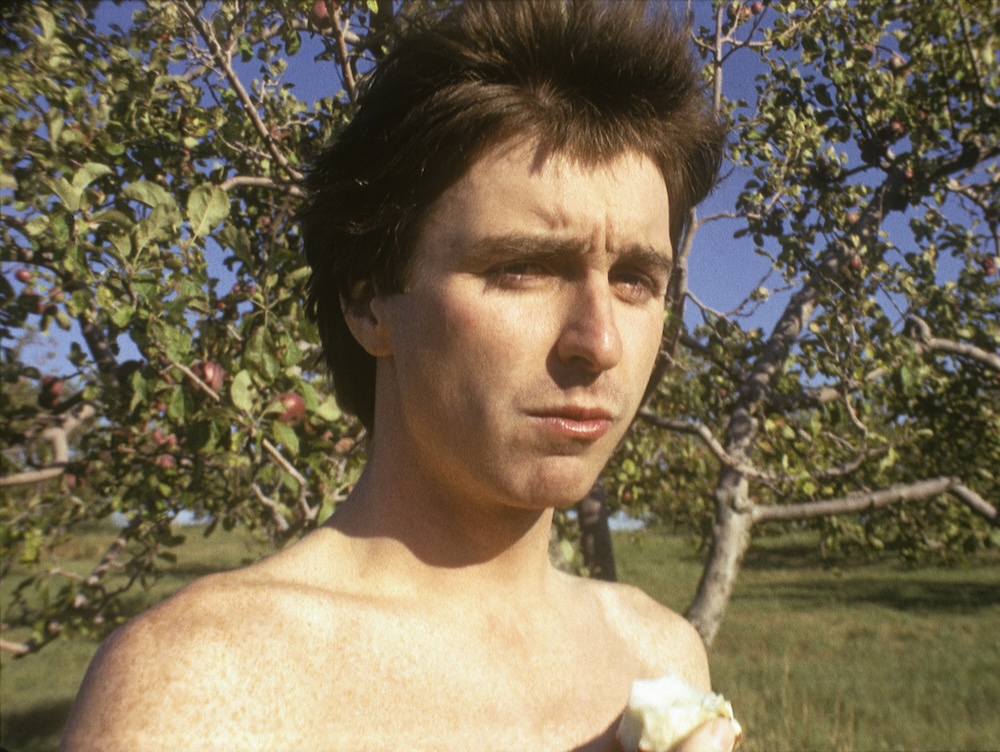
Their initial life together on the East Coast is captured in Dorsky’s Hours for Jerome, which commences the series this Fri/14. While more explicitly diaristic than some later work, it’s a silent abstraction of sorts, offering a panoply of nature views, everyday tasks, glimpsed friends, pets, cityscapes, street scenes, and more—all shot in the late 1960s, but not edited into its final form until 1982. The result is at once deceptively “random” and rhapsodic. It will be shown with two very early Dorsky pieces (among his few sound films); on Sun/16 he’ll present five titles from the last 30 years. Fri/21 brings a quartet of shorts by Hiler, who took a long sabbatical from the medium in the ’70s and ’80s, but likewise works primarily in a non-narrative, silent idiom sans digital technology.

Both men have been noted for having light as their principal object of study—even more so than it is in all moviemaking in general. Nowhere is that more evident than in Dorsky’s Arboretum Cycle, the final BAMPFA program on Sat/29. This 127-minute, seven-part epic, filmed and edited in 2017, is a not-so-still-life of the Botanical Gardens in Golden Gate Park, its flora (with occasional guest appearances from fauna) changing over the course of seasons.
The 16mm camera is trained on flowering boughs, lichen-covered bark, small fern groves, and so forth. Rarely do we get a “big picture” perspective sufficient to capture, say, an entire tree. Yet the sense conveyed is not of tranquility, but busy activity, small worlds constantly changing with wind, light and growth. Dorsky often makes aperture adjustments during a shot, so an image crisp in full sunlight becomes something entirely different when reduced to a few points of glimmering illumination.
All these films require close attention—and reward it. Dorsky and Hiler will be on hand for discussion at each screening, affording an opportunity all the more rare because they have fairly exacting standards for exhibition, and have never released their works to home formats.
Also arriving this week:
Hard Times in the Heartland: ‘Union County,’ ‘The Rivals of Amziah King’
Two new features, one microcosmic and the other splashy, probe life in regions usually ignored by narrative cinema.

Writer-director Adam Meeks’ first feature Union County, which opens at SF’s Roxie Fri/14, centers on hapless, close-mouthed Cody (English actor Will Poulter) as he’s released back to his rural Ohio community after a jail stint. We don’t find out much about what got him in trouble… but we do realize soon that he’s not very good at staying out of it. Brother Jack (Noah Centineo), who’s also on probation and subject to drug testing, gets Cody a job at a local lumber mill.
Yet in no time at all, they’re both found in violation of parole terms, then put in separate rehab facilities. In his own new situation, Cody finds not just support from fellow recovering addicts, but possible romantic interest from a counselor (Elise Kibler) he had already met at a party. Still, his resistance is weak—he’ll have to fight his own demons.
Expanding this story from his same-named prior short, Meeks draws authenticity from the location shooting and the use of many on-camera performers who are real-life participants in the Adult Recovery Court of Bellefontaine, Ohio. It’s a well-crafted, quietly compelling movie that could have been better: Good as he is, Poulter’s character lacks much definition, which is something you could say for the arguably over-restrained screenplay as a whole. Nonetheless, Union County has an appealing air of fundamental truth.
I’m not so sure the same can be said about The Rivals of Amziah King, a flamboyant second feature from Andrew Patterson, whose offbeat southwestern sci-fi debut The Vast of Night made a small splash in 2019. This has been described as a “crowdpleaser,” which is apt enough. But it’s the kind that sets my teeth a bit on edge, with a filmmaker visibly experiencing that sophomore agitation in which they must wow you at every step—no degree of contrivance or stylistic overkill is too much.
Matthew McConaughey, who hasn’t starred in a movie for several years, plays the titular figure… who is maybe a little too much Matthew McConaughey’s fantasy of himself, in the same way nearly every Tom Cruise role offers an idealized self-image. Amziah is rural Oklahoma’s most beloved rascal, a beekeeper and honey manufacturer who lays on the charm as thick as you-know-what. His plant has been operating at a loss, but then he’s not in it for the money. In any case, his real passion is leading a nonpro bluegrass/Americana ensemble that plays covers of songs by the Avett Brothers and such (though the film doesn’t point out that these are covers). This motormouthed, ADD-acting prairie prince’s good deeds extend to sweeping up into his benevolent circle Kateri (Angelina LookingGlass), whom he’d once foster-parented, and who’s re-encountered as a waitressing young adult. She beams at him adoringly—as we’re also encouraged to do.
But Amziah has enemies who covet his operation. At the midpoint a drastic turn of events turns the film from a semi-musical, mostly comedic star vehicle into a murder mystery with an amateur female sleuth. We eventually get a villain in the form of Kurt Russell as a MAGA-type crooked monopolist.
Patterson reaches for the kind of sweeping, antic sociopolitical statement One Battle After Another achieved—an admirable goal. But as far as real substance goes, I’m not sure his results aren’t closer to a gussied-up Smokey and the Bandit. I’ll be more interested in what this writer-director has to say when he’s not trying quite so hard to impress. Rivals opens Fri/14 at Bay Area theaters including SF’s AMC Metreon.
Teenage Sex, Or A Lack Thereof: ‘Olmo,’ ‘Camp Miasma’
Summer means many things, and in celluloid terms that often encompasses horny teen comedies and slasher flicks in which those same desires get crudely moralistic punishment. Two resourceful spins on those familiar formulas arrive this weekend.
The title figure in Mexican director (Duck Season) Fernando Eimbcke’s United States-shot latest is Olmo (Alvan Uttapa), who at 14 is at that awkward stage where his hormones rage towards adulthood but everyone still insists on treating him like a child. He gets only eye-rolls of infinite condescension from his next door neighbor, the slightly older, intimidatingly sexy Nina (Melanie Frometa). Her attitude changes when a party she’s attending this summer night requires a stereo—she’ll let Olmo and his friend Miguel (Diego Olmedo) tag along, if they bring one.
Of course, there are snags: Olmo is unlikely to get permission to “borrow” his audiophile parents’ setup. And in any case, his fatigued mother Cecilia (Andrea Suarez Paz) must work a double shift, and big sis Ana (Rosa Armendariz) already has permission to go roller-disco-ing. So it is a furiously resistant Olmo’s duty to stay home and mind his father Nestor (Gustavo Sanchez Parra), whom multiple sclerosis has turned into a bedridden invalid. Needless to say, our somewhat bratty hero is going to attend that party no matter what.
Set in the late 1970s in a New Mexico border town, this is the kind of pleasant domestic-drama flashback that stealthily works its way towards considerable emotional impact. The thorny father-son dynamic is well-drawn without being gratuitously spelled out—we just feel Nestor’s humiliation at how physical deterioration has ebbed his parental authority—and Parra, who made his screen debut in Amores Perros a quarter-century ago, is superb. Opening at the Roxie this Fri/14, Olmo starts out as a humorous teen-lust nostalgia piece, but ends up somewhere well worth the journey.
Much more complicatedly meta in its cinematic referentiality is Teenage Sex and Death at Camp Miasma, the third feature from Jane Schoenbrun of I Saw the TV Glow and We’re All Going to the World’s Fair fame. Though they’ve attracted strong critical and fan support, I’ve found the transgender writer-director’s movies to date more engaging in theory than execution—and this latest is no exception.
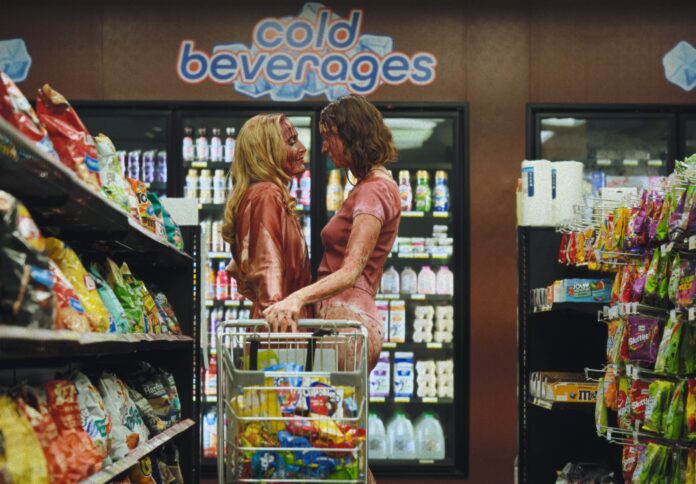
It does start out promisingly, with opening credits that chart the fictitious Camp Miasma series, a multimedia horror franchise that began with a culty 1980s indie slasher and has since degenerated into endless, negligible sequels. After a breakout Sundance Festival debut, queer filmmaker Kris (Hacks’ Hannah Einbinder) gets hired by a studio to conceive a reboot.
She’s enough of a terminal horror geek that she uses this excuse to track down Billy Presley (Gillian Anderson), who played the “final girl” (“with a trans twist”) in the original film but has been a recluse since. Turns out she is actually living on the abandoned summer camp that was that film’s shooting location. Needless to say, this wintertime meetup becomes an increasingly line-blurring dive into horror tropes, faux-vintage clips, over-the-top gore effects, lesbian frisson, and masked-killer menace.
Riffing on the likes of Sleepaway Camp and Friday the 13th, Schoenbrun also probes the outer limits of creative self-consciousness in having a heroine who talks very “academically” (as Billy grouses) about the intersection between gender and genre. Kris eventually admits she feels freest from hangups about sex when fantasizing about “penetrative” slasher victimhood. (That faceless Miasma killer is even called “Little Death,” heh heh.) But so much upmarket fan service ultimately just runs in circles, as affectionately detailed as its homages are in aesthetic terms. They don’t lead anywhere profound—or even fun, as the pacing frequently lulls during nearly two full hours.
However, others are very likely to disagree with that assessment, as numerous early rave reviews already attest. It may well be that Schoenbrun’s peculiar viewpoint—which clutches the transgressive content and contradictory messages of horror movies for comfort, like a teddy bear—is just a generational thing I can’t quite grok. Camp Miasma opens in Bay Area theaters including the Alamo Drafthouse New Mission and AMC Kabuki on Fri/14.