We are Under The Stars people. You know the drill, lovers of music and culture. This weekly column stays on message with strong-ass opinions, presenting new music releases and upcoming shows, hustling with the changes, and thinking outside the margins. Hop in. And thanks for spending some time with us. Let’s go…
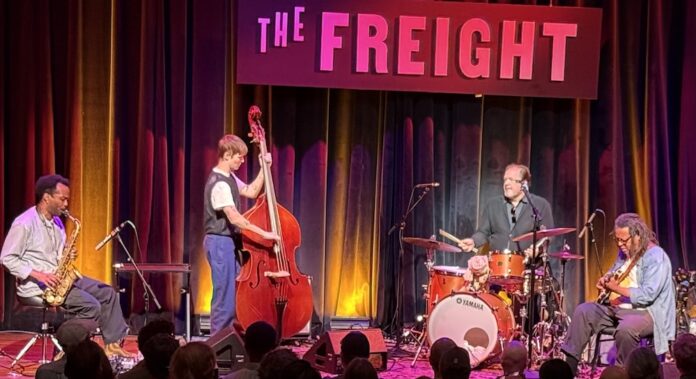
REVIEW: JEFF PARKER ETA IVTET AT THE FREIGHT, AUGUST 22
Listen. Many folks—and I do mean many, including myself—were scratching their heads after the glorious booking of SML and Tortoise at Noise Pop earlier this year. And then… no bassist Anna Butterss with SML? No Jeff Parker on guitar with Tortoise? WTF, Mang? Both shows were beyond adequate. Attending both, I have to say SML still somehow over-performed. But those magical players were greatly missed.
Anyone who has kept up to date knows that all of these musicians take bigger gigs when they become available, so you can’t dislike Butterss and Parker taking support touring positions on Flea’s tour of his solo jazz album Honora and making some extra scratch, right?
Yet the question remained: When were Bay Area folks gonna get that spectral slippery jazz blessing when all the members are present and live in the moment?
That “oh snap” moment seemed to be on its way with the announcement back in May of Happy Today, the third album from LA-based guitarist Jeff Parker and his long-running ETA IVtet, which features drummer Jay Bellerose, bassist Butterss, and saxophonist Josh Johnson. All encompass that sonic bullet train that goes from ambient sleepytime tea mellow to Zen Buddha improv/higher listening organized rhythm. (Fans of the band know what I’m saying.) That thing they do as a collective has influenced many other bands in the “jazz” idiom today—and I’m using the term loosely, like a “stretched out elastic waistband in your sweatpants” type of manner.
They ran out dates for a mini tour, and Berkeley turned out being its only Northern California gig, a show put on collectively by The Freight and (((folkYEAH!)))—and it immediately sold out. The whole thing felt like sort of an indirect “we’re sorry” to the Bay Area.
A line stretched halfway down Addison Street an hour-plus before Parker and crew hit the stage on Saturday night, and it appeared that the unspoken apology had been accepted. Understand this was a night in the Bay that had other, mega choices (Pearl and The Oysters at The Independent; The Charities at Cafe du Nord; night one of The Breeders at the Castro Theater; night three of the SF Bay Pop festival at Bottom of the Hill; a free techno party, albeit corporate—Tec-Troit it was not—in Salesforce Park), but this plush running shoes lot, myself included, knew where they wanted to be and showed up. Early.
Outside Lands was but a faint memory; at The Freight, you enter, make a choice on food and beverages, and immediately sit down. If you listened closely, you caught Jeru The Damaja and DJ Premier over the sound system reminding everyone who could hear them about the production genius of ’90s boom-bap hip-hop. Kudos to The Freight.
Donning a Lord Quas t-shirt under his collared shirt, dedicated Madlib fan Parker led the ETA IVtet out on stage to rousing applause, thanked everyone for coming, and immediately, got to it.
During an hour-long opening set with a serene aura and droning textures, Josh Johnson delivered repetitive runs on the sax; Butterss added modal vibes from the bass. Parker found his way, adding guitar ramblings, then chords, now colors, gently ushering the live round-robin down the road, while Johnson’s sax lines get processed through an EFX filter and dissipate like a kind breeze. It was mellow, methodical, and rad all at once. Audience members gave the occasional yelp, holler, or whoop.
When the IVtet returned for a second set, they immediately got to uptempo, slippery jazz levels, with Bellerose putting those bass drum codas at the end of sentences, while Butterss searched for the tonal framework, running patterns and scales. Upon achieving success, they would turn the bass toward Johnson, and he rolled out gentle dub waves of sax tones through an EFX pedal.
In response, Parker started floating out those dub waves as well, putting his guitar chords and colors through a similar EFX, giving the segment new feels, to the audience’s agreement. That led into a final segment which again saw Bellrose leading in rhythm, a straight-ahead jazzy arrangement, with Johnson once again on sax, tripling his sound through pedals, flapping this sensation through the wind, Parker coloring and comping a similar pattern. The musicians joined together for a hug, as they did at the end of the first set. Their attentive and mindful audience gave them their due: a minutes-long standing ovation.
Does that mean everyone got it?
It may be decades before there is formal recognition of the way Parker and his players, and various offshoots of this ever-growing network, have shaken jazz up. (I’m not opting for using the term “re-energized,” since the culture was already rolling differently.)
Jazz had to get off the dusty shelf and become interactive.
The urgency of both the late, great jaime branch and recently departed trombone player Ryan Porter, close friend and bandmate of Kamasi Washington, invited a younger generation into the jazz space. They gave new eyes, ears, and brains the ability to connect with Miles Davis, John Coltrane, and Sonny Rollins. They made space at the jazz table so the storied genre could flourish in the 21st century.
Parker has also been doing just that. At times, when Parker and co. are all rolling in their improvisational non-verbal communication mind-meld on stage, they look just as awestruck as the crowd.
But it doesn’t take a high IQ to pay witness to just how rare and uncommon this type of performance is. That’s what was evident on most folks’ faces as they exited, looking for the parking garage.
ALICE COLTRANE, ASHRAM TAPES (MATADOR)
I was reconnecting with a friend I had not seen in years—decades—after I ran into them at a random show. We were listening to music, sipping—maybe somebody was smoking something—and he started to explain his relationship with his cassette tape deck repairman.
The guy had been working on two of his vintage Nakamichi cassette decks for over a year to fix a playback issue. My buddy is a Deadhead; he’s got two walls full of tapes, so the deck repair is vital to him. So he gets the decks back, and they’re no good. He texts his fix-it guy, telling him still they don’t work. And his guy texts back, “At all?” That had me rolling; it’s like weed went legal, but this guy has taken the weed guy’s place, in terms of operating completely outside standard time constraints.
After their second repair session, man, we had one deck working, so we popped on a mixtape made by a mutual friend of ours—no idea where she is today, but she’s in our thoughts. When Alice Coltrane’s Journey in Satchidananda featuring Pharoah Sanders came on, our laughs and yucks floated away.
Mid-summer, it was announced that Alice Coltrane’s ashram tapes would be released via Matador. Turiya Sings, Divine Songs, Infinite Chants, and Glorious Chants were recorded at the late jazz musician’s ashram outside of Los Angeles in the ‘80s and ‘90s, where the cassettes were distributed among members. Matador will debut the tapes—which pull up jazz, new age, gospel, and electronic music—on all formats for the first time, complete with full mixes and artwork. Stay tuned.
You can sign up for Coltrane’s mailing list to stay informed on their release here.
CARRÉ, CITRINE (TEMPA)
London-via-LA producer Carré needs to apply for dual citizenship.
The breadwinner, chicken-dinner slam jam that is track “Sense of Place” navigates slinky, dubby, late-summer humidity vibes with constant bass-weight pressure and just enough minimal melody to get a dance floor moving, bouncing, and grinding as the floor siren turns inward. Those cool, stretchy sound patches make you think you’re on that Alien: Romulus ship for a second. Proper dubstep, indeed.
“Static,” with its video game dankness, swiveling snark, and bass grumble, is in T-minus mode.
Song “Enough” is about that half-time, head-nodding biz, with keyboard that stab lighting your way to the elevated place. Lemme say this: Tempa is back on their bullshit, and that’s a great thing.
Pick it up here.