The weather in New York was unusually clear and pleasant on the late-summer morning of Sept. 11, 2001. But I didn’t know that when I woke up around 9:30 a.m.
I also didn’t know that, in many ways, this would be the first day of the rest of my life.
I had moved from San Francisco to New York two weeks earlier to get my master’s in journalism at NYU and was still acclimating to the time change. My apartment was on Broad Street, in a historic building where NYU rented several floors for student housing. Surrounded by the skyscrapers of Lower Manhattan—including the World Trade Center—and with my unit’s soundproof windows, it was always dark and remarkably quiet inside.
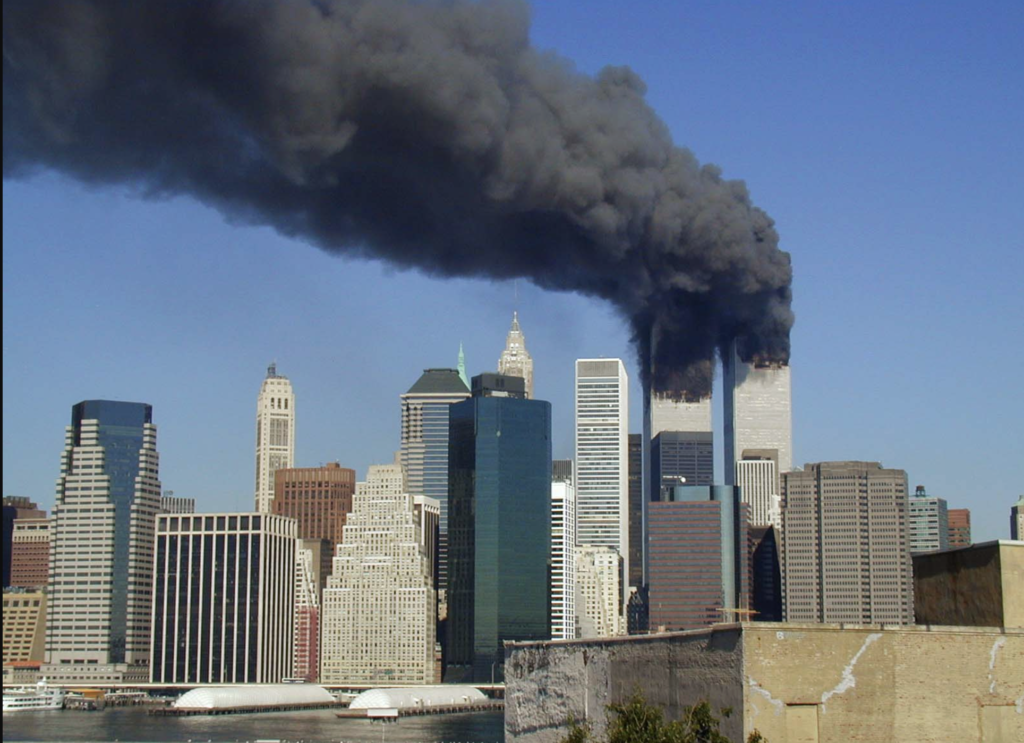
The World Trade Center had already become part of my everyday life. I used it as a subway entry point and for shopping. Lower Manhattan wasn’t really set up for residents then, so its stores were a godsend. I had just gone to Coach there to buy my mom a birthday present, a little leather coin purse.
My first interview for Writing, Reporting Workshop I—and by far the most nerve-racking because it was the first—was with a hot dog vendor outside the Twin Towers.
That Tuesday morning, however, my biggest problem was getting caffeinated.
By the time I woke up, American Airlines Flight 11 had crashed into the North Tower at 8:46 a.m., and United Airlines Flight 175 had struck the South Tower at 9:03. I knew none of this.
There were no smartphones, news alerts, or social media feeds. If you hadn’t turned on the television or radio or spoken to someone who knew what was happening, you could remain oblivious to a catastrophe unfolding blocks from your home.
As I left to walk the block to Starbucks, I encountered my RA, a fellow NYU student. Her face was ghostly pale.
“Are you OK?” she asked.
“Yeah,” I replied, confused.
“There was a terrorist attack on the World Trade Center,” she said.
Without further details, I assumed she meant something similar to the 1993 World Trade Center bombing, which killed six people and injured more than a thousand.
She seemed surprised when I continued toward the elevator.
“Where are you going?” she asked.
“Out to get coffee,” I said.
“Be careful,” she warned.
Walking to Starbucks, I could tell something much bigger was afoot. Wall Street traders in suits were standing in the street, pointing handheld digital camcorders toward something above us.
Debris fell from the sky like confetti, reminding me of New York ticker-tape parades and the more recent New Year’s Eve Calendar Tosses, when Downtown San Francisco office workers threw old paper from high-rise windows. But the mood wasn’t celebratory.
I reached Starbucks and put in my usual order: a venti triple iced soy latte. As I waited with my back to the window, I overheard a manager talking about closing. I couldn’t understand why an attack on the World Trade Center would affect us three blocks away.
Then came a tremendous crashing sound, followed by screams. I didn’t know it, but at 9:59 a.m., the South Tower had collapsed.
The Starbucks door was locked, and employees were told to stop working. Still unaware of what had just happened, I was fixated on getting my coffee. Four dollars and fifty cents was a lot of money for a student, and I had already paid. After some cajoling, I got my latte.
When I turned toward the window, throngs of people were running down the street in terror, trailed by a dense wall of white smoke. It looked like a scene from a Godzilla movie. Were fighter aircraft dropping bombs? None of it seemed real.
Within moments, everyone was ordered out. I had only enough time to shove the straw into my drink before I was outside and running. I couldn’t see anything. More troubling, I couldn’t hear anything. Where had everyone gone? Where was I going?
Through the haze, I saw the proverbial light at the end of the tunnel and ran toward it. It was a doorway. Inside, a man led me downstairs into a room where everyone was watching the morning’s events on television.
I saw footage of planes flying into the Twin Towers and the ensuing collapse, which I had just run from. I gasped, finally understanding the magnitude of the attacks, and everyone turned toward me, their expressions changing instantly.
I didn’t understand why until I looked in a restroom mirror. I was covered head to toe in white soot. I looked like the Abominable Snowman, still clutching my undrunk, soot-covered latte.
I washed my face and learned that I had stumbled into a homeless shelter. The man running it wanted everyone to say Christian prayers, but I wanted to get back to the one place that felt safe—my apartment. When I told him I was leaving, he said I couldn’t, explaining that in the military, you obey your commanding officer.
I reminded him that the government didn’t allow people like me in the military, so that didn’t apply to me. He grabbed my arm to stop me. I shook him off and left.
By then, the North Tower had collapsed at 10:28 a.m. The Twin Towers that defined the World Trade Center skyline had disappeared in 102 minutes.
Another hijacked airliner had struck the Pentagon, and a fourth crashed near Shanksville, Pennsylvania, after passengers and crew fought back. Among them was San Francisco gay public relations executive and competitive rugby player Mark Bingham. I interviewed his mother, Alice Hoagland, about her son’s courage under fire 14 years later.
And gay people weren’t fit to serve in the military?
I made my way home through the smoke, put my Starbucks cup on the kitchen counter, and discovered that an open window had let in a substantial amount of debris.
After showering, I found messages pouring into my cell phone and landline. Overwhelmed phone networks had prevented calls from getting through, and friends and family had no idea whether I was alive. Unable to call out reliably, I used a payphone to assure people I was safe.
There was something particularly strange about experiencing a catastrophe like this in 2001. Today, disaster arrives on the smartphone in our hands. On Sept. 11, every television and radio station carried the attacks, newspapers screamed them from the front page the following day, and missing-person posters appeared on the streets.
In Lower Manhattan, you didn’t even need the media. It was in the air; it came out of your water faucet. There was no scrolling past it. We were living inside it.
NYU ordered students in Lower Manhattan to evacuate amid fears that debris, fires, and infrastructure damage from the collapse of the Twin Towers could destabilize nearby buildings and trigger additional collapses.
I ignored the order because I didn’t want to sit in a school gym indefinitely. Eventually, my building forced everyone out for an inspection, but we were allowed back a couple of hours later. I returned to my apartment and stayed for two days.
Then campus police came pounding on my door. I was on a list of unaccounted-for students and had about a minute to leave. Wearing a Def Leppard T-shirt, vintage jeans, and dress shoes, I grabbed my messenger bag stuffed with my wallet, keys, Sony Discman, and oversized CD portfolio, full of hundreds of discs.
Music had always been my refuge, and if I had no idea where I was going or when I’d be back, I knew I wanted it with me.
I didn’t think to grab a jacket. Sept. 11 had been a beautiful late-summer day, but by the end of the week, the weather had turned cold and rainy. Suddenly, I was a displaced student without a jacket or change of clothes.
Disasters are made up of small practical problems, too. You still get cold and need clean clothes and a warm, safe place to sleep.
I climbed into a shuttle van with other NYU students. On the way to Washington Square, we passed the World Trade Center.
At dusk, its remains stood like a skeleton amid smoldering ashes and rubble. The place I had casually walked through to catch the subway and shopped for my mother’s birthday present had ceased to exist.
Neither it nor life as I knew it would ever look the same.
The next two weeks were a blur. An undergraduate Christian student rescued me from the school gym and let me stay in his dorm for a night—until he kicked me out after I disagreed with him that the Jews killed Jesus.
I spent another night with the only person I knew in New York, a San Francisco acquaintance who had also relocated there, before NYU put displaced students in Midtown hotels while our buildings were inspected.
I still had only the clothes I’d been wearing when campus police ordered me out, and no jacket. Each night, I washed them and hung them to dry for the next morning.
I kept going to class, pretending I was OK, as my mom begged me to come home to California in nightly conversations.
When students were finally permitted to return home, I entered my kitchen and saw my Starbucks cup on the counter. The venti triple iced soy latte I had been so determined to get on the morning of Sept. 11 was sitting exactly where I had left it, although some of the liquid had dissipated.
I had carried it through the collapse of the South Tower like a stuffed animal or security blanket, run through a cloud of dust with it, taken it into a homeless shelter, and carried it back through Lower Manhattan. I had never taken a sip.
Now it seemed like an artifact from another lifetime, because it wasn’t only Lower Manhattan that changed on Sept. 11. All of our lives did.
The attacks would lead directly to war in Afghanistan and help set the political stage for the war in Iraq, the creation of the Department of Homeland Security, sweeping changes in airport security and surveillance, and a different relationship with terrorism.
There were changes that couldn’t be legislated, too: the way we looked at unattended bags, reacted to low-flying airplanes, or felt our stomachs drop at breaking-news banners.
Only later did I begin to understand the scale of what I had lived through: 2,977 people were killed that morning, including hundreds of first responders who courageously rushed toward the devastation as thousands tried to escape.
But numbers couldn’t explain what 9/11 did to those who survived it—or the millions who watched from the Bay Area and beyond.
For me, 9/11 also changed the course of my education. Every story I was assigned for the rest of my two-year journalism program was related to the attacks.
We didn’t know it that morning, but we were living through a dividing line. There was the world before 9/11, and the world after it.
When I walked out of my apartment looking for coffee, I was still living in the first one. By the time I came home, covered in white dust and carrying an undrunk latte, I was living in the second.
After that morning, I went back to hot black coffee. I never ordered a venti triple iced soy latte again. I just couldn’t order one without going back to that day.