
Apparently, the supervisors from districts 5, 6, 7, and 8 think everything is going swimmingly at City Hall, that the mayor is doing a bang-up job, and that there’s no reason to challenge him on anything.
What an embarrassment.
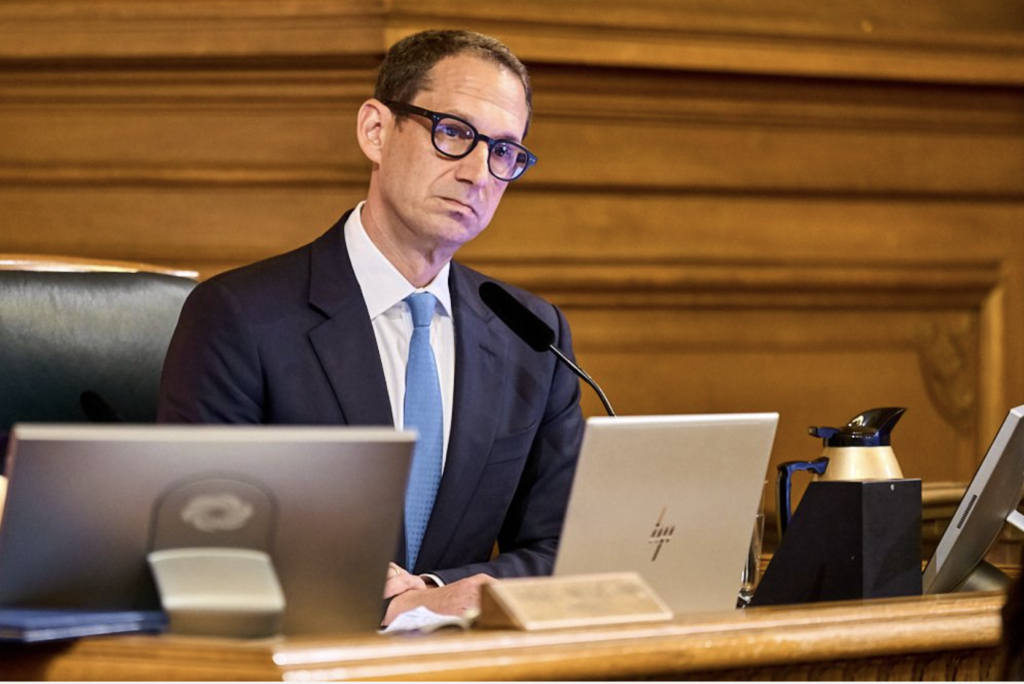
Mayor Daniel Lurie appears at the Board of Supes Tuesday/20 for Question Time. When London Breed was mayor, and the progressives had a majority on the board, Question Time was a real thing, a chance for the supes to challenge the mayor’s policies and for the mayor to defend them. The public learned a lot.
Now, the Lurie Majority seems to have no interest in asking the mayor a single thing.
The Mayor’s Office can’t come up with a paltry $250,000 to protect immigrants from ICE, including immigrants in in Districts 5, 6, 7, and 8, although that’s less than a third of what a single sheriff’s deputy makes in overtime tending to jails filled by Lurie’s policies. No supervisor wants to ask why?
Evictions are soaring, and tenants are getting displaced, including in Districts 5, 6, 7, and 8. The mayor has declared a rental emergency—but that hasn’t stopped the evictions. No supervisor wants to ask what he’s doing to protect their constituents?
Are we really supposed to believe that Sups. Bilal Mahmood, Matt Dorsey, Myrna Melgar and Rafael Mandelman think everything the mayor is doing is perfect? Or are they just unwilling to challenge him in public?
An embarrassment.

The non-issue Question Time, which just means the mayor can make a speech promoting himself, starts at 2pm.
The School Board voted last week to approve a new assignment policy that will make it difficult for any parent to send their kids to anything except a neighborhood school. Board President Matt Alexander made a classic statement: He said that parents have been thinking about their own kids, “but now it’s time to think about all kids.”
That’s what a School Board member should say. When my kids were at McKinley Elementary, the amazing, wonderful, hero principal, Bonnie Coffey Smith, used to remind parents all the time that “all of our kids are all of our kids.”
The problem is that San Francisco neighborhoods are segregated, not just by race but by income and wealth. It’s worth noting that folks in the real-estate industry have cheered this decision: It means homes in neighborhoods near “good” schools will be worth even more money.
Throwing money at government programs doesn’t always work—witness the cops and the military, where more money often means more waste and less effective results. But when it comes to education, by any metric, better funded schools do better for their students. More money means better outcomes; it’s a pretty straight-line correlation.
And neighborhood schools mean more inequality in funding.
The dirty secret of SFUSD is the role that PTAs play in providing extra cash for better enrichment, lower class sizes, and better facilities at schools that serve the kids of wealthy parents. Some PTAs raise more than $500,000 a year for relatively small elementary and middle schools. The parents at schools in working-class neighborhoods can’t possibly match that. So those schools don’t get the same benefits.
The whole idea of progressive taxation, which everyone in local politics claims to support, is that rich people should pay more, and some of that money should go to social programs that help the less well off.
Not when it comes to SFUSD PTAs.
A serious program for neighborhood schools should involve the basic concept of equity: The schools in areas that have been underfunded and marginalized for decades due to a legacy of historic racism should get the most money. That might anger the parents in the rich neighborhoods, who want their money to go to their kids, not to all kids—but that’s the price they have to pay for “neighborhood schools.”
School funding inequality is one of the roots of the nightmare that is Prop. 13, which most San Francisco officials agree needs reform.
For decades, local property taxes funded public schools in California. That created a problem: Rich communities, like Marin County, had way better schools than poorer communities, like Oakland. In 1971, the state Supreme Court ruled that the system violated the Equal Protection Clause of the US Constitution; rich districts had to share revenue with other districts.
Millions of racist white parents rebelled against spending their money educating non-white students, and that was part of the motivation for Prop. 13, which cut property taxes and devastated public schools—except in rich areas, that could use loopholes like PTA fundraising and other forms of outside money to get around the court decision.
I texted Alexander and asked him about the problem, and he agreed with me: The district needs some plan to make sure that money parents raise for schools in wealthy neighborhoods gets shared with schools where parents aren’t rich and don’t have free time to put together elaborate fundraisers. We agreed that the district should impose something like a 25 percent “tax” on all PTA fundraising above, say, $50,000, and that money should be shared with other schools.
Major league sports does this: The national TV money that the NFL gets is distributed to all teams, meaning the Green Bay Packers, who are in a small media market, can compete with teams in much bigger markets. MLB does a version of this: Some of the money the LA Dodgers get in the nation’s second-largest media market is shared with other teams.
“The other concept that we were playing with was a City-funded match … so some redistribution and some matching funds from the City as well,” Alexander told me.
We have to fix this problem, or neighborhood schools will be a failure.
Or we could fix Prop. 13 or tax the billionaires.
I went to see Dear San Francisco at Club Fugazi Saturday, and it has evolved considerably since Charles Lewis III reviewed it for us in 2021. It’s much more of a love letter to the city, along with the stunning acrobatics.
But it’s a love letter to a city that was, and still struggles to be—and that some of our new Tech Lords (and some politicians who get their money) want to destroy. The show celebrated a city where art and culture is more important than riches, where a fan of state Sen. Scott Wiener doesn’t talk about burning the whole city down to make room for a Techno-Yimby paradise, where the head of Y Combinator doesn’t call for the slow death of progressive supervisors.
Where does this kind of attitude come from? Even if, like Gary Tan, he claims he wasn’t serious, this is horrifying.
I don’t know if Mayor Lurie or Sen. Wiener have ever been to the show, but if their agenda is successful, and Yimby AI tech bros take over the city, 50 years from now there will be very little about this era to celebrate in art, music, or performance.