
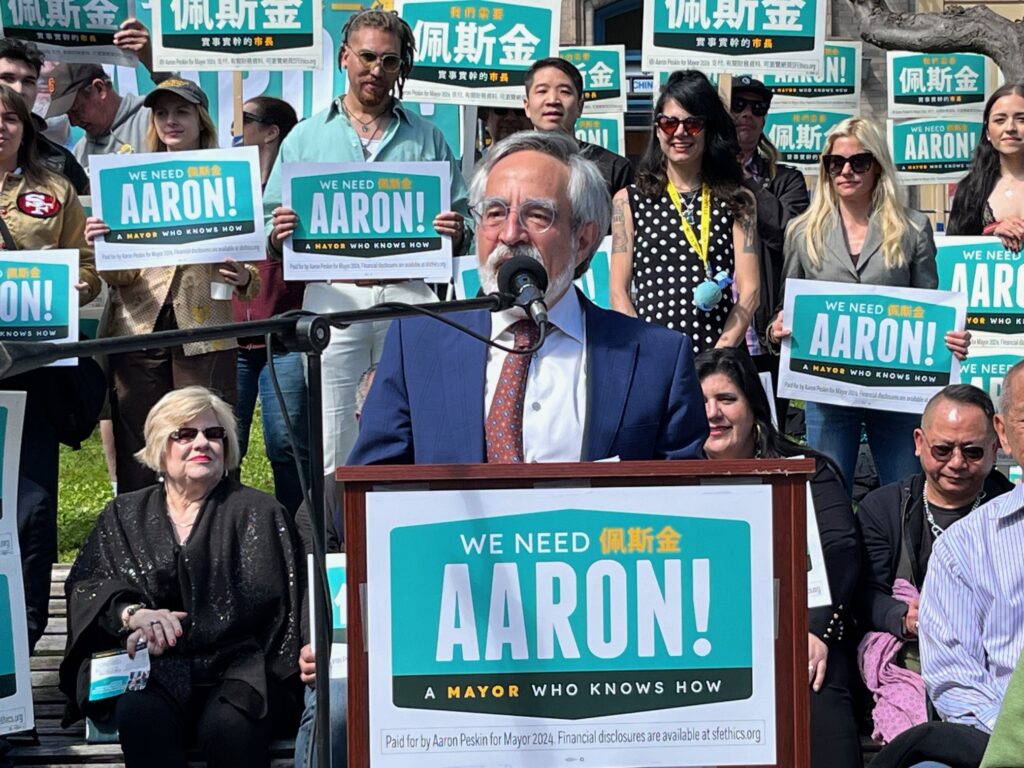
Pretty much everyone agrees that the language in the mayor’s reform measure, Prop. A, differs from the language in June’s Prop. B, which imposed lifetime term limits on supervisors. It was, to be blunt, a colossal screw-up that could allow, for example, Aaron Peskin to run again for supe.
The San Francisco City Attorney’s Office and Sup. Rafael Mandelman maintain that the mess is not that bad; Prop. A doesn’t really undermine lifetime term limits:
The city attorney’s office stated that November’s Prop. A would not undo June’s Prop. B. “Proposition A does not impact or make any changes to term limits,” read a statement from the office.
Mandelman, himself a former Oakland deputy city attorney, agreed, theorizing that the will of the voters from June and November would be “harmonized.”
But that’s not what the California courts have ruled.
Prop. A was drafted before Prop. B went on the ballot. It used the old City Charter language, which states that supervisors can only serve two consecutive terms.
So in drafting the sweeping overhaul language of the City Charter, Mandelman, who sponsored the bill on behalf of the mayor, included the language of the existing, pre-Prop. B, City Charter. That’s why the city attorney is going to argue that it doesn’t matter: Prop. B passed, and terms limits remain.
But there’s a precedent for this, and it doesn’t look good for supporters of lifetime term limits.
In September, 1998, the Board of Supes voted to approve an amendment to the Rent Ordinance related to owner-move-in evictions. At the time, someone who owned just 25 percent interest in a rental property could claim to be an “owner” for the purpose of evicting a tenant. Then, as now, OMI evictions were mostly a scam to get long-term tenants in rent-controlled apartments to leave, so the landlords could raise the rent to market rate.
Much of the time, the “owner” never moved in; the city didn’t, and doesn’t, monitor or enforce the law.
The ordinance, by the late Sup. Sue Bierman, sought to make a small dent in that crisis by mandating that a landlord own at least 50 percent interest in a building before qualifying for an OMI. Mayor Willie Brown signed the bill into law Oct. 2, 1998. It took effect Nov. 1.
Meanwhile, the Tenants Union was working on its own legislation to limit OMI evictions. A ballot measure the tenants were circulating in the summer of 1998 would have, among other things, mandated that a landlord own a property for three years before initiating an OMI; that was aimed at limiting speculators who bought buildings, evicted the tenants, and raised the rent.
Since that initiative was circulated before the Bierman amendment, it included the old, 25 percent ownership, language. In retrospect, that was a mistake.
The tenant measure passed on the November 1998 ballot as Prop. G. It took effect Dec. 18.
A few years later, a landlord named Leslie Garber bought a 25 percent interest in a building at 1830 Gough St. Garber moved to evict a tenant under the OMI provisions.
The tenant fought back, and Tom Drohan, a lawyer at Legal Assistance for the Elderly, argued that 25 percent was not enough to qualify as an owner. Drohan argued that the Bierman Amendment was still valid, because the voters never intended to overturn it. A trial court agreed.
But in June, 2006, the state Court of Appeal reversed that ruling, stating that the language of Prop. G was clear:
When a statute is amended by two different acts, the one passed later in time is the operative law. … Further, where two statutes or provisions conflict and are irreconcilable, the statute enacted last controls …. To reach Respondent’s position, the court would be required to rewrite section 37.9(a)(8) by incorporating the language of both Proposition G and the Bierman Amendment. We decline to do so. Such action is the province of a legislative body or the voters, not the court.
That decision screwed tenants. The landlords won, and hundreds of older people probably lost their homes.
But the Appeals Court made a ruling in a case that is exactly parallel to the question of Prop. A, and it’s still the defining law. “I feel like it’s pretty clear that they repealed the lifetime ban,” Mitchell Omerberg, a tenant lawyer who closely followed the 1998 discussion, told me.
The Tenants Union made a mistake in 1998. The Mayor’s Office and Mandelman made a mistake in 2026. The law appears to be the same: If a landlord can evict a senior with only 25 percent ownership, then Aaron Peskin can run again for supervisor.
(I don’t know if Peskin wants to run again. But if he does, I suspect he will have strong labor support: Incumbent Danny Sauter was one of only two supes today to side with the giant hotel corporations against the union workers on a key piece of legislation.)
I asked the City Attorney’s Office for any opinions related to Prop. G in 1998. Jen Kwart, the press person, kindly directed me to the Appeals Court decision. I asked if that meant Prop. A overturned Prop. B, but I haven’t received a response.