A key moment in the Budget and Appropriations Committee meeting Thursday:
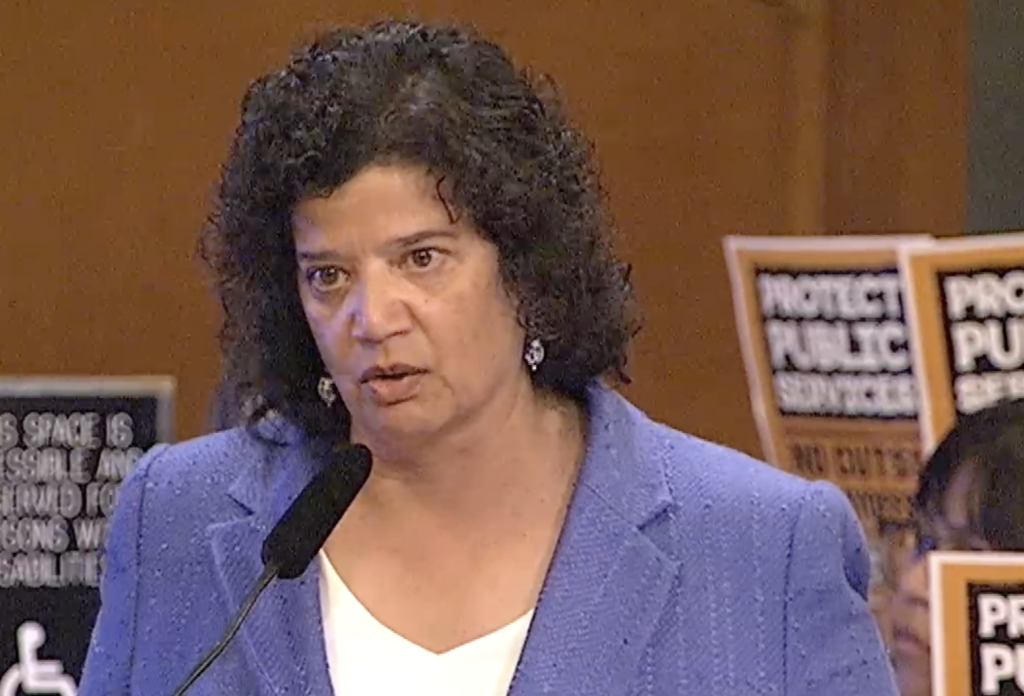
Shireen McSpadden, director of the Office of Homelessness and Supportive Housing, was trying to convince the supervisors to approve a deal to add a dormitory-style shelter for 82 people to an existing cabin village on Jerrold St in the Bayview.
Sup. Shamann Walton, who represents the district, said that nobody in the community supports the plan, and that the Mayor’s Office failed to follow the directive that the supes made when they approved the small-homes site three years ago.
The original plan that the supes approved called for 60 cabins and 20 safe parking spaces for RVs. Those 20 spaces never appeared. McSpadden said that happened because the Lurie Administration “changed its approach” to people living in RVs.
Yes: Changed it to making them illegal.
Then Sup. Rafael Mandelman, who appeared to support Walton’s position, said that if short-term shelters really made neighborhoods better, then “the Tenderloin would be sparkling and amazing.” That approach doesn’t seem to work.
McSpadden: “What we’re trying to do really here is meet the mayor’s campaign promise that the streets are cleaner.”
In other words: Get people into any type of inside facility so nobody can see them on the streets anymore.

“Now the truth is coming out,” Walton said.
Yes: The truth is that this brutal budget is all about appearances, and not at all about long-term solutions to city problems. It’s about more cops, more jails, more sweeps, more temporary warehouses that we call “shelters,” so that systemic problems like a lack of affordable supportive housing and treatment for addiction and mental health aren’t so visible to tourists and wealthy residents.
This won’t work. The cuts to nonprofits that provide street-level services will have long-term impacts; The People’s Budget Coalition suggests that the cuts will lead to at least 1,000 layoffs in the nonprofit world, which will mean more evictions, more homelessness, more mental health and addiction problems … and even though the city is essentially opening a new jail, there’s no way to arrest everyone who is suffering on the streets.
Another telling moment: Phil Ginsburg, the director of the Recreation and Parks Department, presented his budget—which demonstrated that the cuts to nonprofits are only a part of the problem. Ginsburg is proposing, among other things, to cut by 25 percent the money that funds affordable summer camps for kids—one of the things that Rec-Park does right, and well, and that’s a lifeline for working families who can’t afford private child care when schools are closed.
Under the proposal, 2,500 kids would be unable to attend the summer camps next year. That will have a massive impact on working-class parents.
At the same time, he talked about charging for parking in Golden Gate Park, and charging for reservations at tennis and pickleball courts, and privatizing the golf courses. It’s probably the case that many of the people who use the city’s tennis courts and golf courses can afford to pay a little more. The parking meters, labor leaders said, would impact unionized workers at the DeYoung Museum, who would have to pay $3 an hour, or $24 a day, to park at work.
But no matter how you look at it, all of these “revenue solutions” are taxes on people who use public parks.
Labor leaders are adamantly against the privatization of the golf courses, since most of the people who work there are unionized city employees, and private contractors would probably hire non-union workers at lower pay.
Ginsburg said that all of the workers who lose their jobs would probably be reassigned to other jobs at Rec-Park.
Sup. Connie Chan asked for a guarantee: Do we have something in writing that makes clear that contracting out won’t cost union jobs? Suppose, she asked, that the supes approve the new parking fees (which people will hate) and the reservation fees (which people will hate) and the privatization; will that be enough money to make up for some of the other cuts?
Ginsburg couldn’t give a definitive answer.
This is the fundamental problem that nobody seems to want to talk about.
It’s not just this year’s budget. San Francisco has operated for about half a century on the idea that a bustling downtown with highrises filled with finance, insurance, real-state, Pacific Rim trade and tech would be the economic salvation of the city.
That created a monocrop economy (the city destroyed tens of thousands of blue-collar jobs in the mad rush to develop highrise office buildings), and now it’s collapsing, as monocrop economies do when there’s a shock to the system.
This city can’t possibly continue to offer the public services people need and want unless we find a new way to generate revenue. Parking meters in Golden Gate Park aren’t going to be enough.
In essence, either we follow the mayor’s approach, and become a city that does very little for its people except “keep the streets clean” and arrest anyone who is unhoused or troubled (which means a failed city)—or we fundamentally rethink how we finance San Francisco.
That’s the discussion nobody wants to have—but if we don’t start now, next year will be even worse.