In the win-or-lose world of mainstream entertainment reporting—where any middle ground is considered borrring—there are usually one or two movies per year that get a lot of gloating attention as giant flops. (Probably the most famous examples are Heaven’s Gate and Ishtar.) Since theater has much less popular appeal these days, it’s relatively rare that a stage work attracts similar publicity. But in the last couple weeks, that kind of media pile-on has occurred to The Queen of Versailles, an expensive Broadway musical starring Kristin Chenoweth that will close prematurely after getting poor reviews, no doubt at a huge financial loss.
It’s from composer-lyricist Stephen Schwartz (of Godspell and Disney cartoon fame), who is simultaneously having a huge hit with the second Wicked movie. Queen probably isn’t that bad. But it probably isn’t very good either—I’m certainly not going to fly to New York to find out. Nonetheless, it has acquired that least-desired kind of notoriety, as a famous failure.
There are some talents, however, so beloved that even (or especially) their flops get pored over obsessively by acolytes who seek to shore up their reputations. That’s certainly the case with Schwartz’s near-contemporary, late fellow composer-lyricist Stephen Sondheim. And probably no Sondheim “failure” has been more doggedly revived and (while he was still alive) revised than Merrily We Roll Along, which only lasted 16 performances after opening on Broadway in late 1981.
Even then, no one was gloating over the demise of a musical that had so many wonderful, memorable components, yet somehow…didn’t…quite…work. No matter how many times it’s rejiggered, that result stays more or less the same. Still, there’s excitement all over again whenever the next reclamation attempt is announced.
Merrily is a favorite for many in part because it’s a theater piece about lives in theater—it’s the ultimate insider piece, relatable to everyone who’s ever had such aspirations. Freely adapted from a lesser-known 1934 straight play by luminaries George S. Kaufman and Moss Hart (which was also a commercial dud), it charts the fortunes of three close friends over several years’ course, from youth to middle age. Songwriter Frank, lyricist-playwright Charley, and aspiring journalist (turned eventual drama critic) Mary are initially inseparable as they struggle to get a toehold on the ladder of success.
But when it finally arrives, it gradually tears their bonds apart. As the one conventionally handsome, charming, and sociable member of the trio, Frank magnetizes hangers-on who want to place their bets on a winning horse. Helpless to resist money and fame, he accepts new commitments (including Hollywood contracts) that betray his old ones. That embitters Charley, who’s only confident within their collaborative team, and Mary, whose romantic pining for Frank is obvious to everyone but him. Nor does his own rise make Frank happy, as he accrues ex-wives, false new friends, and a sense that he’s sold his soul to the highest bidders.
The story’s structural hook is that this saga is told backwards, beginning with the jaded lead characters facing permanent estrangement. It then rewinds one setpiece and a few years at a time—until we finally arrive at their first meeting, as newly minted adults full of a hopeful idealism we know will slowly get crushed. Sprawling from 1957 to 1977 (or rather the other way round), Merrily gives Sondheim leeway to both exploit and mock the rapidly changing showbiz conventions and musical styles of that timespan. It generated some of his most endearing as well as cleverest songs, while George Furth’s book also has wit and depth. Yet somehow what often glitters on a scene-by-scene basis never quite translates into an organic whole. The greatness this show keeps touching may well always stay just out of reach as a cohesive evening.
Though it no doubt seemed a very long shot for screen translation in 1981, Merrily’s cult following is such that soon there will be two movie versions. One is from Richard Linklater, who’s filming it like he did Boyhood—in pieces over a long span, allowing the actors to actually age like their characters. (Don’t expect that project to finish until circa 2039.) More immediately, there’s Maria Friedman’s record of her 2022 off-Broadway revival, which transferred to Broadway the next year, and was shot for posterity at the Hudson Theater a year after that. Opening nationwide this Fri/5, it’s got the inevitable cinematic limitations of a filmed stage performance. But it’s also got the considerable plusses of being very likely the best Merrily we’re likely to get for some time, in any form.

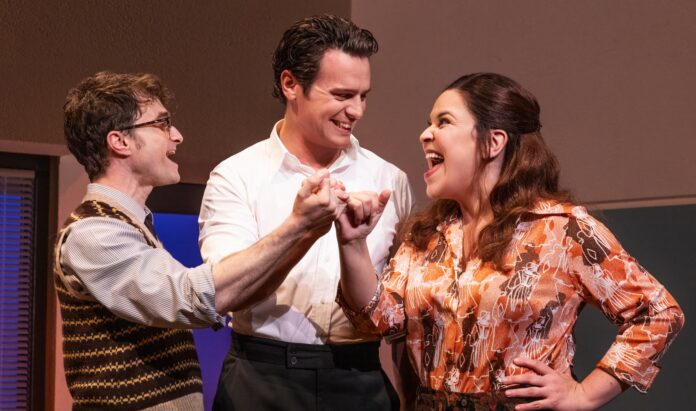
I don’t love all Friedman’s staging ideas, and have seen some individual numbers done better. But using a text that draws on various prior revisions, she unifies the dramatic arc as much as possible, and the actors (which include a supporting company playing various roles) are fine. The key is Jonathan Groff: Alone among the leads, he really does seem to get younger with each sequence, and his Franklin isn’t a cad so much as a well-intentioned easy mark too weak to resist any/every temptation going.
Erstwhile Harry Potter Daniel Radcliffe’s rather small voice (which is very sweet on the memorable “Good Thing Going”) is apt for his disheveled, self-defeating Charley, for whom Frank’s abandonment becomes fuel for rage. Lindsay Mendez is solid as Mary, who copes with a perpetually unrequited love via naive nostalgia, verbal snipes, and alcoholism. Krystal Joy Brown and Katie Rose Clarke etch Frank’s successive wives—the former maybe a bit too showily, given the director’s lean toward presenting Merrily as an ensemble piece. (Admittedly, she is actually playing a Broadway star.) This isn’t the most ingenious visualization of a demanding work, but it’s functional. And needless to say, the score is a lot more than that.
Other film openings and events this week:
Documentary Roundup: Librarians, Feminists, Prophets & Poets
Kim Snyder’s The Librarians examines one of the prime battlegrounds in today’s culture wars: School and public libraries, where conservative forces often funded by “dark money” and propelled by religious zealots are busy trying to ban from access any materials they disagree with. That can mean The Color Purple, Handmaid’s Tale, or Maus; histories of oppressed or oppressing groups, whether the subject is slavery, LGBTQ+ history, or the KKK; plus whatever else gets labeled as “race-based teachings,” “woke ideology,” and “gender identity” material.
We see reactionary hysterics in Texas and Florida claim students are being “groomed” by “Satanic cartoon porn”—nevermind what the actual content of the targeted books are, or how they are limited to age-appropriate groups in library distribution. The ideological/political purpose of these attacks, which increasingly involve arrest and death threats, is clear. Though as ever, the gullibility of activists who think they’re “saving the children” from largely imaginary perils amazes, and infuriates. The Librarians plays SF’s Roxie (Thu/4-December 13), Berkeley’s Elmwood (Mon/8) and other Bay Area venues, with Snyder present for Q&A’s afterward. For a complete schedule and other info, go here.
Filmmakers will also be present at some screenings for Sara Khaki and Mohammadreza Eyni’s Cutting Through Rocks, another portrait of bravery under fire. Sara Shahverdi is a divorcee in a remote Iranian village whose father, anticipating a boy, largely raised her like one. As a result, her own assertive refusal to conform to gender stereotype is grudgingly accepted by neighbors. But when she becomes the first female to win a seat on the local council (by a landslide of women’s votes), there is angry resistance among local men. They consider her spreading ideas “against tradition” to other women and girls as an existential threat. It’s an intriguing, singular character study that opens at the Roxie Fri/5 and plays Marin’s Smith Rafael Film Center on Tues/9.
Considered by some an inheritor to the Beat Generation, poet Anne Waldman has published over sixty books, collaborated with many artists in diverse media, been an activist, Buddhist, and much more. (See her early 1980s wade into synthpop, above.) Presented by Martin Scorsese, Alystyre Julian’s Outrider provides an overview of the very youthful 80-year-old’s life and work from the early 1960s onward, featuring various luminaries in archival footage, plus latterday interviews with folk like Patti Smith and Amiri Baraka. Waldman remains rooted in Greenwich Village where she was raised, and whose “bohemian atmosphere” she continues to bear the torch for. She and the director will appear after the Roxie’s sole Sat/6 show, and hold a book-signing for her latest tome Mesopotopia. More info here.
Likewise, appearing in person at the Great Star Theater on Thu/4 will be the subject of Gabe Polsky’s The Man Who Saves The World? Bay Area-based Rev. Patrick McCollum is an “eccentric spiritual leader” who over the decades has left his mark in the realms of jewelry design, martial arts, peace negotiation, advocacy for religious rights in prison, environmental activism around the world, and much more. This one-night event will feature him in post-screening conversation with Dr. Bia Labate, a “leading voice in psychedelic science and social justice;” the film itself features McCollum’s recently deceased good friend Jane Goodall, and was executive-produced by heavily Hollywood hitters Peter Farrelly, Danny McBride, David Gordon Green and Jody Hill. Info is here.
Retrospectives: Jerry Ross Barrish, Akira Kurosawa
Two auteurs are getting their work revived in series at Berkeley’s BAMPFA starting this week. Native San Franciscan Barrish has been a soldier, a bail bondsman, an actor, and a painter-sculptor of objets d’art assembled from found junk—the lasting latter pursuit granted center stage in William Farley’s documentary Plastic Man: The Artful Life of Jerry Ross Barrish, which kicks things off this Sat/6. But for a few years he was also a pioneer in the Amerindie cinema movement, prying open a door for others even if his own works were relatively little-seen.
The 1981 narrative anthology Dan’s Motel (which was shot on the fly over several preceding years); 1984 melodrama Recent Sorrows, involving a fateful paths-crossing between aggrieved parties in one straight and one gay relationship; and 1989’s pleasingly modest coastal character study Shuttlecock all had their admirers on the festival circuit. Each feature was better-crafted and acted than the last. Still, they were too unshowy to gain him much commercial or career footing, so ultimately he turned to other creative outlets. All three will be getting rare theatrical revivals at the PFA through Sun/14, with Barrish himself participating in post-screening conversations after each program.
Definitely not appearing live will be Kurosawa, the famed Japanese director who passed away in 1998. But he will be showcased in four recent restorations that are going to be shown repeatedly at BAMPFA between this coming Wed/10 and Feb. 20. The earliest is 1952’s Ikiru, with Takashi Shimura as a milquetoast civil servant whom a terminal diagnosis turns into a droll underminer of staid authority.
The other three star Kurosawa’s brilliant discovery and frequent lead actor, Toshiro Mifune. In the sprawling action-adventure Hidden Fortress (1958) he is a medieval warlord, both fierce and comical; a cunning 19th-century mercenary in 1961’s Yojimbo, which would prove a great influence on spaghetti westerns; and a wealthy corporate executive forced to deal with the kidnappers of his chauffeur’s son in 1963’s modern-day High and Low, drawn from a U.S. pulp novel. The entire series schedule is here.
Size Matters: More Is More In ‘Kill Bill,’ ‘Castration Movie Anthology II’
It’s a truism of our times that the same viewers who’ll gladly binge-watch an entire TV series in a day or weekend will frequently balk at a single movie that’s over two hours’ in length. That theory will get challenged by two long sits arriving this weekend.
Quentin Tarantino apparently always intended his female-driven action revenge epic Kill Bill to be seen as a single entity, but instead it was broken into two separate features released in 2003 and 2004. This Fri/5 sees his dream realized in the form of Kill Bill: The Whole Bloody Affair, which puts hitwoman turned avenging bride Uma Thurman through her paces—involving lethal standoffs with characters played by Lucy Liu, Vivica A. Fox, Michael Madsen, Daryl Hannah, Gordon Liu, Michael Parks and David Carradine—over 275 uninterrupted minutes. (Well, there will be an intermission.) It’s “uncut, unrated” and with previously unseen footage added. Some theaters, including SF’s Alamo Drafthouse New Mission, will be showing it in 70mm.
In contrast to that engorged action spectacle, there’s the very DIY Castration Movie Anthology II: The Best of Both Worlds, which Movies for Maniacs and Frameline co-present at SF’s 4-Star Theatre on Sat/6. It’s a 300-minute (yes with intermission) “labyrinthine post-modern epic about gender” with Alex Walton as a trans woman who begins having doubts about the ketamine-fueled separatist cult she lives in. The Kickstarter-funded tale from Canadian writer-director-editor Louise Weard was preceded by a Part I. But you don’t need to have seen that one—this a stand-alone story whose intense multigenre mashup boasts “extreme mature content.” (No one under 18 will be admitted.) Yes, a third installment is planned, to be released next year.