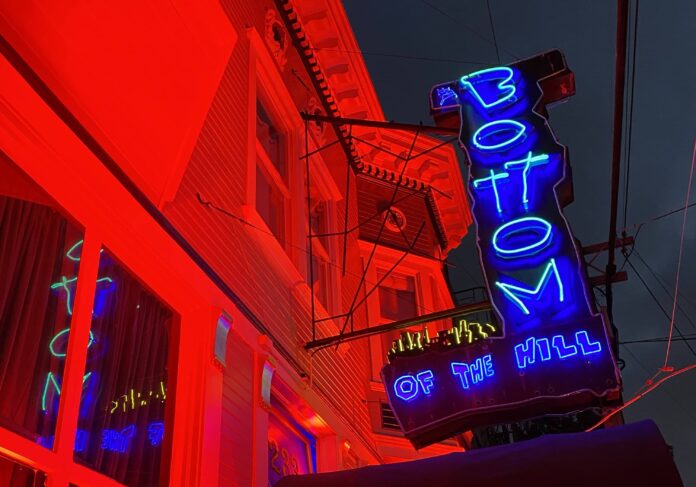
JOHN-PAUL SHIVER: So let’s get at it. Why did Rolling Stone call Bottom of the Hill the “best place to hear live music in San Francisco” in 1999? Numerous, countless, innumerable reasons. And they all ran through my head upon hearing that the independently owned and operated venue, open since 1991, would close its doors at the end of 2026.
This week, Bottom of the Hill owners Ramona Downey, Kathleen Owen, and Lynn Schwarz announced online and shared with Coyote Media that they will use the final year as a victory lap for the venue’s last year.
In an email message sent exclusively to 48Hills, these owners expressed nothing but gratitude and humility at the outpouring of emotion in reaction to their decision:
“The owners of Bottom of the Hill are so grateful for the many heartfelt testimonials we’ve seen since announcing our upcoming closure at the end of 2026. It breaks our heart that we will be leaving such a big void in the venue ecosystem, but we are still here for a year and hope that you will come celebrate with us. We are curating amazing shows as we speak!”
The announcement hits hard for the local live music scene, especially after legendary indie performance space Edinburgh Castle and rock star haven Phoenix Hotel closed this year.
I first started hitting BOTH in the mid-’90s for their Sunday BBQ, which featured all-you-can-eat burgers and dogs for either five or seven bucks. As a DJ, with gigs Thursday through Saturday, Sunday was the only day I could go check out local bands. So I’d split my time between Kilowatt, where I actually caught a Pavement show for five bucks on a Sunday (I think it was the Crooked Rain tour), and BOTH, where I could meet up with friends and other DJs who needed time away from the decks, and hopefully catch whoever was burning up the SF stages.
On a Sunday in ’97, it could be the local Oakland band Lunchbox, or fast-forward into the early aughts, SF band Von Iva, ripping shit up with their all-girl electro soul punk aesthetic. As you walk in, you’d see women and/or people of color working the soundboard, a thing I vehemently check for at all shows still to this day. You could order an Anchor Steam beer, make your way to the back room, and just get visually hi-jacked, lost in the wild, unconventional, pushing-the-envelope art of SF concert poster maestro Frank Kozik, whose work adorned those walls.
He passed in 2023, but his art left just as much of an impression at BOTH as whoever was commanding that stage. Outsider perspectives without using one word, draped in snark and a love of music that would champion the unknown band and the breakout star equally, let you know: This venue didn’t fuck around when it came to booking performers. You’d feel that in the work he did. Lending that true punk aesthetic to a Jon Spencer Blues Explosion poster (they just played BOTH on their revival tour last February), Supersuckers, or Beastie Boys handbill.
And yes, as much as that famed Beasties “secret show” at BOTH turned into “The Quasar Incident”—Quasar being the name they booked themselves under, in April of ’96, whose LIVE 105 leak caused 1200 fans show up to a 350 max capacity venue in what was supposed to be a small “intimate” performance, eventually required police assistance.
All o’ dat is in the lore of the club.
But it’s the past four or five years where I’ve witnessed this next wave of local artists, Chime School, Mae Powell, and The Reds, Pinks and Purples, bringing their wave of art along. Reshaping the local indie-pop ear, once again. Or be blown away by the cool-ass uncle type blues energy from San Francisco former pro-skater Tommy Guerrero on a chill Noise Pop Sunday show. Where he’s shredding, deep in his funk bag, while his congregation of former or still current skaters, some missing teeth, some not, indeed showed up in tattered trucker hats, thrift store sweaters, with fanny packs tossed over the shoulder, haphazardly waiting for their girlfriends to float back from the bar with more wine or tequila.
Those types of moments, folks, I know Rolling Stone had in mind when they made the declaration. But in a current climate that sees restaurants, live music venues, and tiny coffee shops disappearing daily in this Bay Area, now filled with more driverless cars than ideas, who knows where these authentic moments shall take place once 2026 is done?
MARKE B.: Johnny Ray Huston, who always knows everyone cool, took me to see Sleater-Kinney at the Bottom of the Hill in 1996 when Call the Doctor hit, and hearing Corin Tucker belt out “Good Things”—suspending the club in stupefied silence—changed my life quite a bit, I will say.
It wasn’t my first show there, but meeting Corin and Carrie afterwards was a treat, and I still remember how normal it used to feel hanging out at a show with musicians who were just people like you, but with tremendous talent, whose names are now engraved in ’90s indie/punk amber—Imperial Teen, Jawbox, Red House Painters, Cibo Mato, Dismemberment Plan, and of course perennial local favorites like Tribe8, Stone Fox, Pansy Division See Jane Run, Charming Hostess, Stark Raving Brad, Creeper Lagoon, Groovie Ghoulies, Thrill Pillows, A Minor Forest.
I once offered to buy a member of the Donnas a drink who, sitting in the lap of some fedora’d suitor, coolly refused, saying, “I’m not old enough to drink yet.” I almost died.
The next time Sleater-Kinney came to BOTH, in 1997, they were already rock sensations who’d been featured in Time, of all places, well on their way to the superstardom they’d achieve. But they still made time for BOTH, as the Beastie Boys would, as Green Day, Oasis, and many more famous bands who could have set themselves up in bigger venues would as well.
Being a queerdo into both techno and punk could feel a bit lonely in the ’90s, even though everything was weird as hell. Bottom of the Hill, by programming plenty of queer and queer-friendly acts, banishing any stink of “alternative rock” machismo, embracing fabulous post-Pee Wee’s Playhouse decor, and just simply being a small venue where people could lose themselves in music was a precious place.
It still is! At least for the rest of the year. The above may all sound like ancient history, but Bottom of the Hill has remained such a vital venue to the local scene. Sleater-Kinney immediately sprang to mind the other day as I was kicking myself for being out of town for the awesome-looking Die Spitz show. Our coverage of Teens in Trouble this year threw me back to the Donnas. I’m angling to see Weakened Friends there on January 24. Come and freak out with me—the 22 Fillmore drops you right outside.