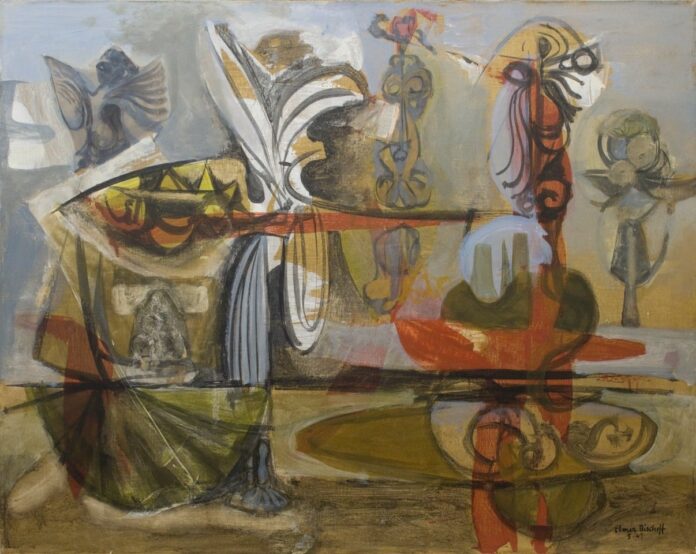
Andy Nelson grew up in the Central Valley, near Fresno. His aunt would take him to San Francisco when he was around eight years old: First they would visit the San Francisco Zoo and then go to the San Francisco Museum of Modern Art. Nelson remembers buying a postcard of Orange Sweater, a painting by Elmer Bischoff (1916-1991).
Now, Nelson feels that’s one of the painter’s master works.
“It checks all the boxes with mastery of a few geometrical shapes that could be perceived as windows. There’s this ethereal figure and some really beautiful, bright colors,” he said. “It’s very meditative. I like the term wistful to describe that style of his. That hung on my bulletin board from my childhood, and I have a strong memory of it.”
Nelson is now the director of the gallery Nelson Duni, named after himself and his sister Lucy Duni, on Bartlett Street in the Mission. When the Bischoff Family Art Trust approached him about showing Bischoff—considered a central member of the Bay Area Figurative Movement along with Richard Diebenkorn, Joan Brown, David Park, William Theopolis Brown, and Paul Wonner—he said yes, and immersed himself in Bischoff’s work.
That was about a year ago, and now Elmer Bischoff, a comprehensive show of the painter’s work from the 1940s to the ’80s, is opening at the Bartlett Street gallery on January 22, during San Francisco’s third annual Art Week. The show will be on view through March 15.
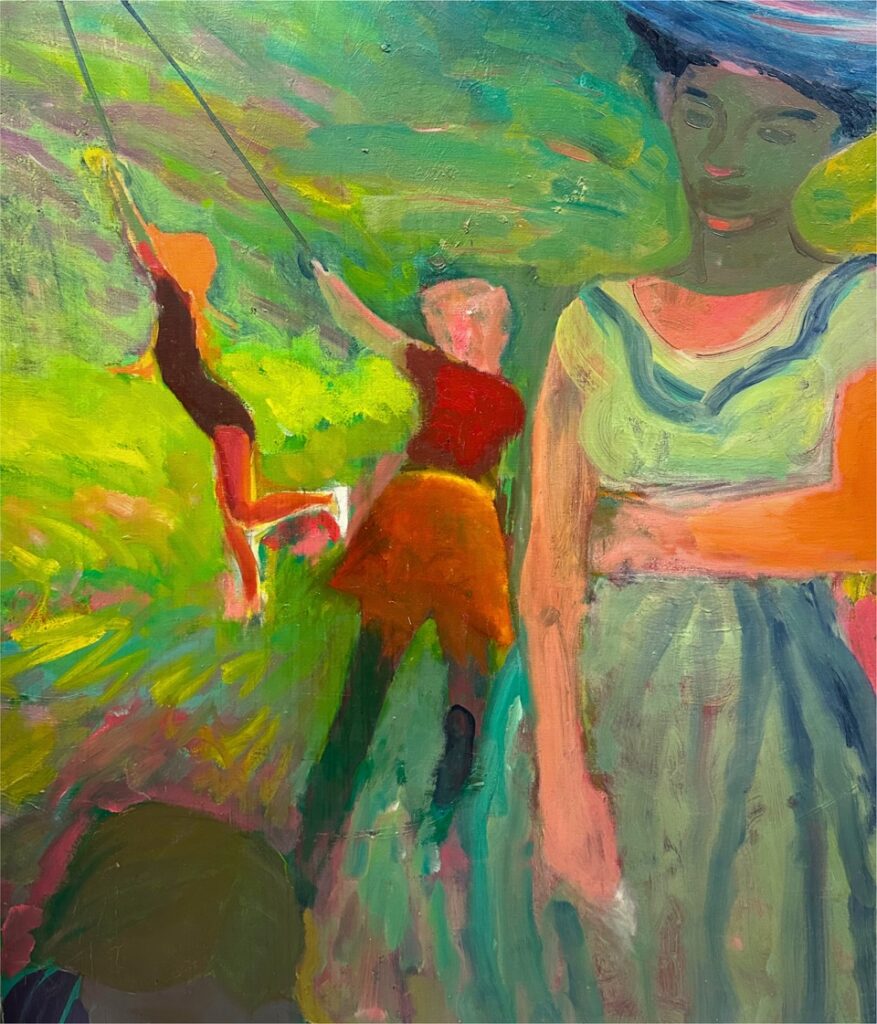
With more than 30 paintings and works on paper, this is the largest show of Bischoff’s art in about 20 years. The first room shows early abstract works from 1947 to 1950. He made the work right after he had stopped teaching at a high school in Sacramento and started teaching at the University of California, Berkeley.
“All the stories about Bischoff always say first and foremost that he was a teacher,” Nelson said during a walkthrough of the show at the gallery. “You hear the most beautiful stories from the students that describe him as very kind, and their favorite teacher ever.”
Nelson pointed to Rococo Figures, 1947, which he said is a homage to a Mark Rothko painting Bischoff saw in 1946. “This is one of my favorite pieces,” he said. “It was at the San Francisco Museum of Art, which would become SFMOMA, and then in George Adams [Gallery] in New York and Berggruen in New York. It was shown in a lot of interesting places.”
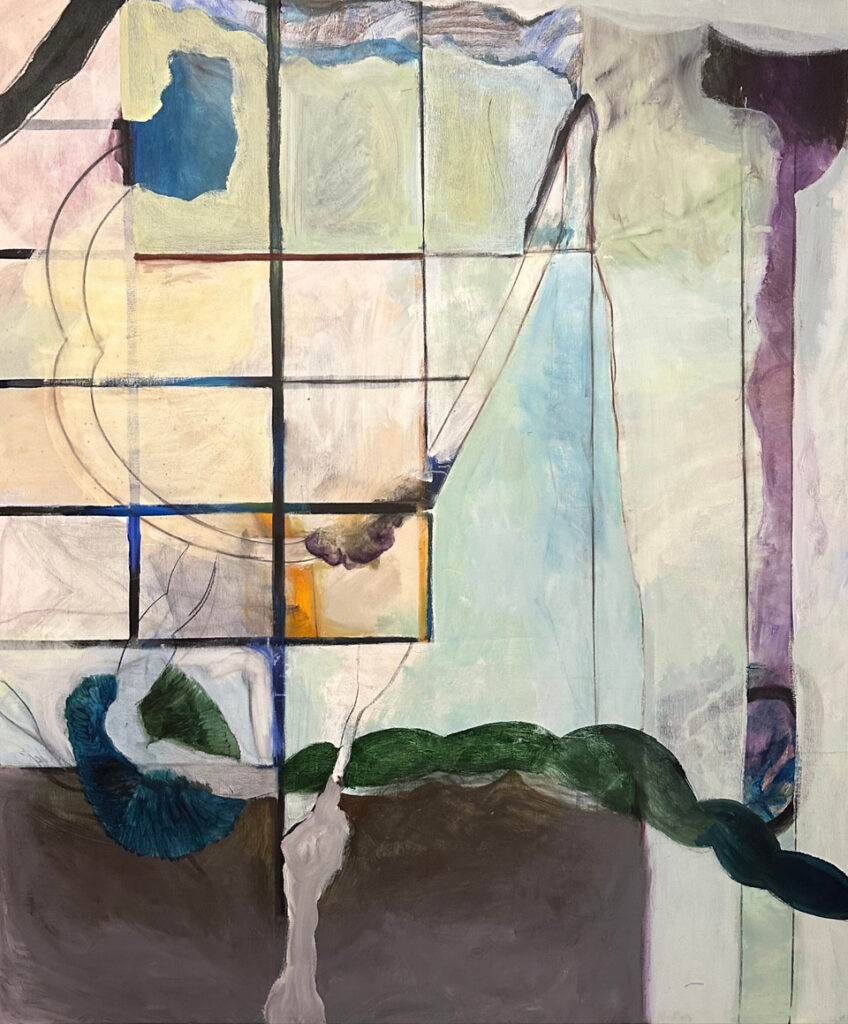
In 1974, Bischoff decided he was done with figuration and started making small abstract paintings. He went back to figuration briefly, Nelson said, then for the rest of his career concentrated on large abstracts. Those hang in the second gallery, all untitled with numbers.
Nelson’s uncle, sculptor Jerry Ross Barrish, owns the building which houses Nelson Duni. His studio is above the gallery, which opened last October with exhibition This Must Be the Place, “a collective meditation on awareness and the poetics of daily life.” It’s a rare example these days of a family legacy of art being passed down in the city.
Asked if he struggled in choosing what to show from such a large number of Bischoff’s works, Nelson said not so much. “I’m learning to both to follow my gut instinct, and also to sit with things and stay curious,” he said. The objective of this particular show is to continue putting Bischoff in the art conversation.
John Bischoff, the painter’s son and a member of the Elmer Bischoff Family Trust, trusts what Nelson is doing. A composer and performer who taught at Oakland’s Mills College’s renowned music department, John would like the exhibition to attract a young audience and generate interest.
“I was over at the gallery yesterday, and Andy’s done a lot of work on the space. He really thought a lot about how to present this,” John said. “I think it looks great. I was a little uncertain about having so many different kinds of work, but if you spend some time in there, things really grow on you. I’m just excited that they have the work looking really great.”
ELMER BISCHOFF runs Thu/22- March 15, Nelson Duni, SF. More info here.