As I write, the news remains dominated by a woman who almost certainly died at the hands of supposed law enforcement simply because she refused to be awed or intimidated by a wee man hiding behind a mask and a gun. Well, he showed her, didn’t he. Showed her… the lethal extent of male fragility that this administration is encouraging to work itself into a perpetual froth? If we ever see the light at the end of this particular era’s tunnel, let’s hope it’s filled with the cheering sight of MAGA allies heading to prison.
In any case, it’s certainly a prime moment for female role models, preferably those who are not going to take anyone’s crap. Several movies opening this week happen to sport such heroines—not all of them entirely sympathetic, some even a little scary, but each of them impressively non-fuck-giving in their own way.
The biggest release among them is The Testament of Ann Lee from Mona Fastvold, who co-wrote creative partner Brady Corbet’s prior directorial features (including The Brutalist), and on her own directed 2020’s The World To Come, an adaptation of a Jim Shepard story that flew under most people’s radar—it certainly did mine. Perhaps in reaction to that quietly effecting film’s very modest reception, her sophomore feature makes a lot of noise, its energy and singularity defying anyone to have a neutral response.
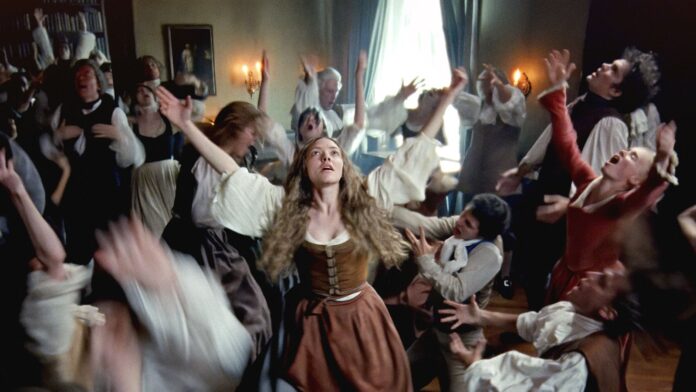
Lee (played here by Amanda Seyfried) was an 18th century Englishwoman born to a large, poor family in Manchester; she never learned to read or write. But after giving birth to four children who all died in infancy, she had a spiritual awakening—and/or, perhaps, a nervous breakdown—that led her to splinter from the Quakers she’d previously been aligned with. Her new beliefs encompassed states of religious ecstasy involving group dance and song. She also insisted that any sexual activity, even between husband and wife, was inherently sinful, and that her followers should practice absolute celibacy. (In the movie, this eventually leads to spouse Abraham, played by Christopher Abbott, leaving her for another woman.)
Add to the mix that she regarded herself as a sort of Second Coming, and it will not surprise that Lee’s sect—eventually dubbed the Shakers—were hounded by rumors, fears, persecutions and arrests. Like the original Pilgrims before them, they moved to the “New World” in search of greater religious freedom, roughly around the time of the Revolutionary War. They were forward-thinking in many respects (esp. as far as gender equity), innovative in approaches to many things, from agriculture to furniture-making. But they remained suspect for their “strange” ways, frequently attracting violence from hostile mobs—something that led to Lee’s own death before reaching age 50.
Testament is boldly conceptualized as, more or less, a musical—not in the traditional Broadway sense, but rather as a stylized extension of the Shakers’ own fervent embrace of vocalizing and movement as worship. So this biopic is equal parts sermon and near-constant production number, as realized not just by the director-writers or performers but also composer Daniel Blumberg’s incantatory variations on hymns, William Rexer’s cinematography and Celia Rowlson-Hall’s choreography. The effect is unique—even if complexities of financing required this movie to be shot not on location, but in Hungary.
The effect can also be wearying. Seyfried’s performance is committed yet nonetheless left me with little insight into a charismatic figure who remains an abstraction. Other worthy actors including Lewis Pullman, Thomasin McKenzie, Tim Blake Nelton, Stacy Martin, Matthew Beard, and David Cale likewise impress, but don’t get the chance to let us very far in. I found the music and movement more repetitious than rapturous. All these choices are intelligent, deliberate, and make sense within the historical context—they just didn’t engage me. On the other hand, my companion at an advance screening was enthralled…and he’s no pushover. So, in the end I don’t really know whether to recommend Testament of Ann Lee, which opens in Bay Area theaters this Fri/23—it’s admirably ambitious and unusual, but it either works for you or it doesn’t. For me, probably the best thing about it was that it made me retroactively aware of The World to Come, which I found more moving.
Another movie lauded in some circles that left me more puzzled than pleased was Mascha Schilinski’s own sophomore directorial feature, Sound of Falling. Germany’s current entry in the Oscars’ Foreign Language awards competition, it’s a 155-minute minimalist epic depicting life over at least 110 years’ course on a farm—one that after WW2 winds up on the Eastern side of the Cold War division. Our primary focus is on girls of each generation, their experiences scrambled in non-chronological order. So within any given few minutes we might leap from the 1940s to the 1980s, back to the 1910s, then to the present day…and repeat. Gradually we realize that amongst these cryptic vignettes of everyday life there lurk all kinds of unhealthy relationships, not excluding domestic violence and incest.

There is a concision to the film’s aesthetic, in particular Fabian Gamper’s academy-ratio cinematography. This aesthetic is, well, ascetic, handsome yet forbiddingly stripped-down—not unlike the screenplay Schilinski wrote with Louise Peter. I felt almost guilty to be so stubbornly unabsorbed by a film that intends to be a sort of harsh palate-cleanser, particularly since many other critics have been knocked sideways by it all. But I’ll admit Sound often bored me—it seemed simultaneously mannered, heavy-handed, and withholding, despite an arresting surface. In the end it felt like a gallery installation, “interesting” but remote. You may well feel differently, and I hope you do. Sound of Falling opens at SF’s Roxie on Fri/23.
While the women in the two movies above exist in communities, united either by blood ties or faith, the female principal figures in three more new films are strikingly isolated—whether by grief, estrangement, or supernatural otherness.
Maxime Giroux’s Canadian In Cold Light has Maika Monroe from Longlegs and Watcher as Ava, an addict and dealer who gets caught during a party-house raid. Two years later, she’s released from prison, nobody is particularly glad to see her, least of all her horse ranch-owning father (deaf actor Troy Kotsur of CODA). It burns her that she’s considered the family “bad seed,” while her brother (Jesse Irving) has managed to escape blame—simply because Dad doesn’t know he was just as deep in illegal doings. It also ticks Ava off that the operation she put together and took the fall for has now been hijacked by her former flunkies. Worse, they don’t even want her involved again, since as an ex-con on parole she might draw unwanted police attention.
But from this unpromising start things abruptly go very much further south, so that Ava finds herself a fugitive blamed for a murder she witnessed, pursued by both corrupt cops and organized crime. It is the extremity of that mess—plus the unexpected burden of having to protect innocents also caught up in the thresher—that gradually turns our highly unsympathetic protagonist into a heroine. A gritty rural thriller, Light isn’t particularly original, but it has enough conviction and drive to transcend potential cliches. I was unenthused about guest-star Helen Hunt’s late appearance (she just doesn’t carry the kind of menace needed for this bad-guy role), but otherwise In Cold Light is a satisfying crime drama that works craftily toward an ending that feels satisfyingly hard-won—a bittersweet triumph. At presstime no SF theaters were confirmed, but it’s opening Fri/23 at AMC Bay Street 16 in Emeryville and AMC Eastridge 15 in San Jose.
Considerably further up the socioeconomic ladder is Claire Foy’s Cambridge researcher-scholar in H is for Hawk, which veteran British TV director Philippa Lowthorpe adapted with Room novelist Emma Donoghue from Helen MacDonald’s acclaimed memoir. Some have complained the book’s complex mix of personal, literary, natural-science and philosophical themes gets flattened out here to favor what’s most easily dramatized—a relatively straightforward portrait of coping with grief. But as such, it is thoughtfully crafted and acted, to ultimately touching results.
The Helen that Foy plays is a popular and admired teacher whose life falls apart once father Alisdair (Brendan Gleeson), a highly esteemed photojournalist, unexpectedly collapses and dies. He is clearly the most important person in her life, to the point where her mother (Lindsay Duncan) and brother (Josh Dylan) scarcely register. In disarray, she hits upon the somewhat bizarre idea of acquiring a Goshawk, a demanding and rather intimidating sort of “pet” that can be trained to hunt its prey in tandem with a human keeper.
Dubbing her new charge “Mabel,” Helen takes the fierce-looking raptor nearly everywhere, rather aggressively forcing its company on others, stirring both curiosity and annoyance. There’s a remarkable sequence here in which we’re privy to both beings’ excitement as Mabel breaks loose to track a rabbit through a forest. But it also becomes clear that this obsessive novelty in Helen’s life is a means of denying all other reality, including the mourning that’s building up like a toxic gas about to explode inside her. As she becomes ever more depressed and reclusive, we wonder whether she’ll even be able to pull herself together in time for her father’s public memorial. That event provides a notably articulate, moving light at the end of what’s become this character’s long narrative tunnel. H is for Hawk opens at Bay Area theaters including the Smith Rafael Film Center on Fri/23.
Also intimately connected to nature is the character played by Tobey Poser in Mother of Flies, my favorite of this week’s lot, though after playing the festival circuit it’s only “opening” this weekend on the genre streaming platform Shudder. Solveig is, well, a witch—a woman, or maybe a spirit in the form of a woman, who lives deep in the Northeast woods. She is tracked down by Mickey (Zelda Adams) as a last resort, as this collegiate youth’s cancer has returned, and medical science has no further solutions. So, dragging along reluctant, widowed father Jake (John Adams), Mickey places herself at the disposal of this wild-haired, very odd-acting crone, with the understanding that the “cure” she’s to undergo will not be easy or pleasant.
The Adamses—John and Tobey are parents to Zelda and sister Lulu, who plays a smaller role here—are a filmmaking family who had a breakthrough with their first horror movie, 2019’s The Deeper You Dig. That was a very nice, spare, creepy piece of work; the two they’ve issued since then were more indulgent, particularly towards the fam’s sideline as a goth-rock project. But Mother is more than just a rebound—it’s a rather stunning piece of poetical cinema whose very pores exude a love/fear of Mother Nature as crux of a pagan universe.
There are icky elements, but they never feel exploitative. Indeed, the whole feels less like “horror” than a supernatural voyage through the looking glass, an almost avant-garde experiment in organic textures barely squeezed into narrative shape. (Be warned: The trailer above makes it look a lot more conventionally hyperbolic.) In its way, it’s just as much a movie about faith as The Testament of Ann Lee. Those expecting standard frights, let alone “kills,” will doubtless be frustrated. But Flies is well worth a look, if only for the extraordinary detail of its production design (imagine if Andy Goldsworthy designed a “house”)—and for Poser’s remarkable performance as a being you can quite fully accept as something other, or more, than simply human.