48 Hills tech reporter Leah Isobel was at the 2026 GDC Festival of Gaming (formerly Game Developers’ Conference), March 9-13 at the Moscone Center. Read her coverage from last year’s conference here, and stay tuned for more coverage this week.
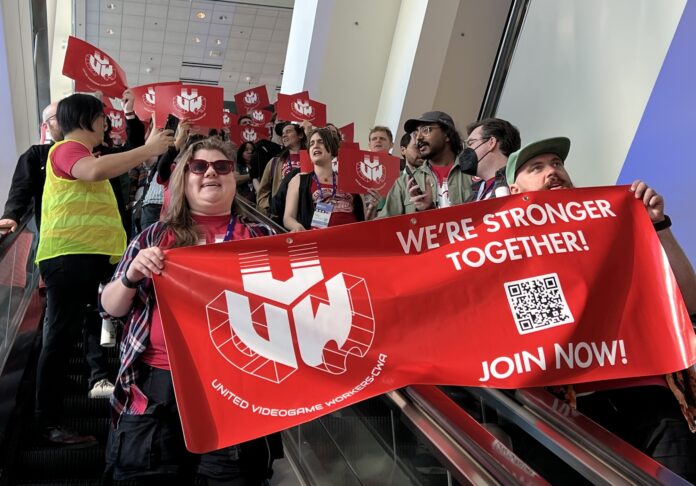
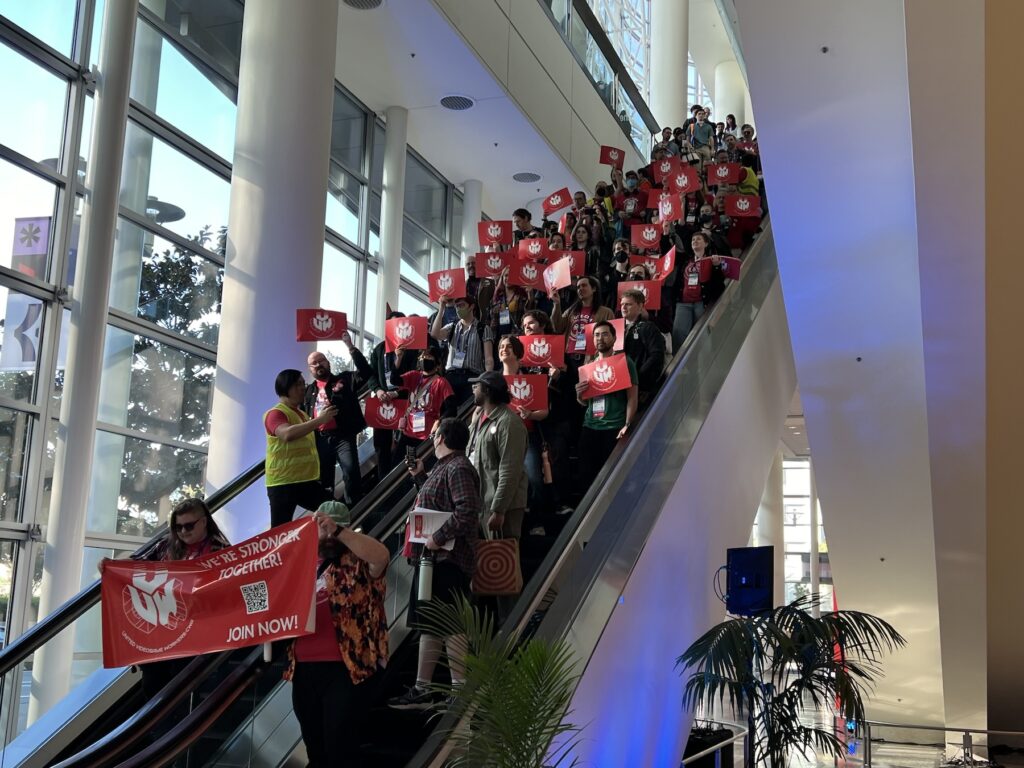
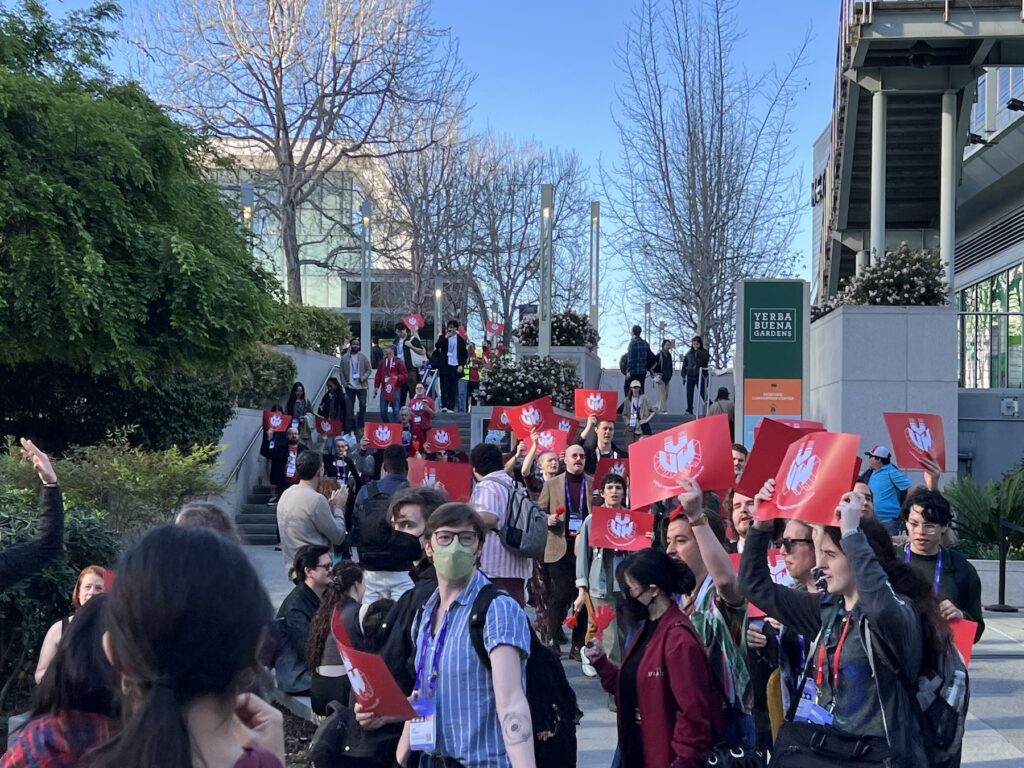
At last year’s Game Developers’ Conference, the Communications Workers of America announced the formation of the United Videogame Workers-CWA Local 9433. The UVW is a direct-join organization that, according to organizers, is meant to provide a channel into activism and organizing for workers in a fragmented industry. The day of the organization’s launch, its membership swelled to triple digits, and CWA members led an impromptu march from a panel discussion in Moscone’s West Hall to the bandshell in Yerba Buena Gardens, accompanied by cheers from passersby.
That rally indicated to me that game-workers were excited to take on the challenges facing their industry; despite back-to-back years of record layoffs, there was a hope that, perhaps, the worst was over.
But the year that followed was not quite so encouraging. While fewer workers were laid off in 2025 than 2024, estimates still place the number of workers who lost their jobs last year at around 9,000. And there were other worrying developments. In the UK, Rockstar Games—the developers of the staggeringly popular Grand Theft Auto and Red Dead Redemption games—fired 31 workers in alleged retaliation for attempting to unionize.
Electronic Arts was acquired by the Saudi Arabian government in a $55 billion leveraged buyout partially engineered by Jared Kushner’s Affinity Partners. (News broke just this week that EA is laying off an unknown number of the workers responsible for Battlefield 6, the biggest-selling game of 2025.) Tariffs led to higher prices for the current generation of video game consoles, while the computer parts required to manufacture the next generation of consoles became scarcer due to the generative AI push. And the Trump administration’s cruel and discriminatory immigration policies have further stressed an industry characterized by remote work and international collaboration.
This overarching environment—marked by new and controversial technologies, ever-increasing corporate consolidation, hostility to organized labor, and harsh political headwinds—was evident at the conference.
“The vibes are off,” said Anna C. Webster, an organizer with the UVW, when I ask her on Wednesday morning about what it’s been like at the conference this year. “It’s much smaller. There aren’t as many people. People aren’t coming internationally because they don’t want to get detained and deported, and even, like, those who are American [citizens], they might not have a job or the ability to attend because it’s so expensive.” When I speak with the UVW’s president, Aurelia Augusta, they put it succinctly: “There’s not a lot of great feelings.”
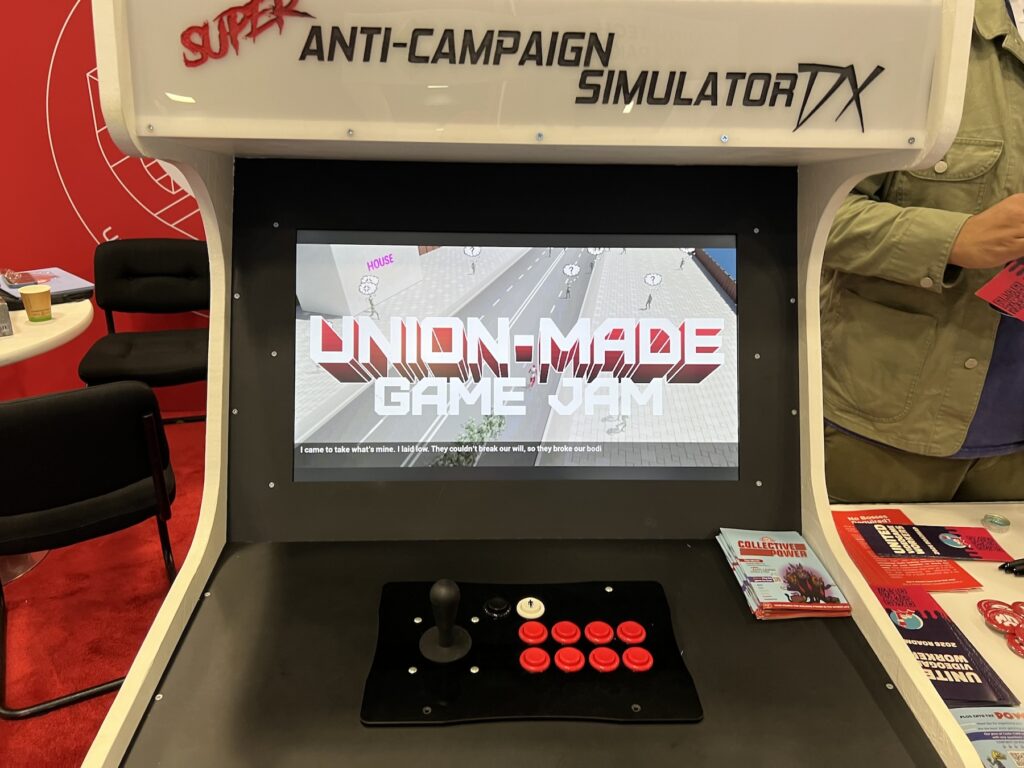
But it’s not all doom and gloom. Last year, the UVW was a purely theoretical venture; a direct-join organization was a new tactic in a young unionization effort, and its capabilities were still untested. Now, there’s more evidence of what it can do.

“We’re here to organize the industry. And that comes in two forms,” Augusta said. “One part is helping people form sort of shop unions at companies, your traditional ‘I’m a Blizzard worker. And now here’s a union for my unit.’ And then there’s also freelancers, we have contractors, we have co-ops, we have all sorts of different other forms of employment and participation in the games industry. Let’s organize that. Let’s make it so that we have standard rate tables, standard contracts…. There are so many ways that games are made that we want to be a union that, like, organizes the entire industry as it is, not according to some idealized model.”
These efforts are bearing some fruit. Augusta said that both the UVW and the broader CWA’s membership has grown considerably over the past year. Earlier this week, workers at the indie studio Heart Machine (best known for their 2016 hit Hyper Light Drifter) announced that they had secured voluntary union recognition from their management; last summer, ZeniMax—a studio under the Microsoft umbrella—ratified their first union contract after two years of negotiations. And both Augusta and Webster allude to underground union campaigns still in progress. “There is a strong understanding that this is a movement that needs to exist, and exists to help us all, as game workers, get what we deserve,” Augusta said.
The wins hopefully set workers up for greater successes down the line as well. Webster chairs the UVW’s freelancing committee, which is currently working towards providing insurance for all union members, not just freelancers. “I do think companies are going to start getting nervous, because insurance so often [is] their, like, carrot they dangle on a stick to keep you at a bad job. And that gives us so much power and so much leverage,” she said.
But such an initiative won’t come to fruition overnight. Webster explained, “Traditionally, there’s a giant pool of money that’s known as a Taft-Hartley account, and to start one of those from scratch is crazy difficult. So we are pursuing other avenues right now, until we have such a membership that we can create something like that.”
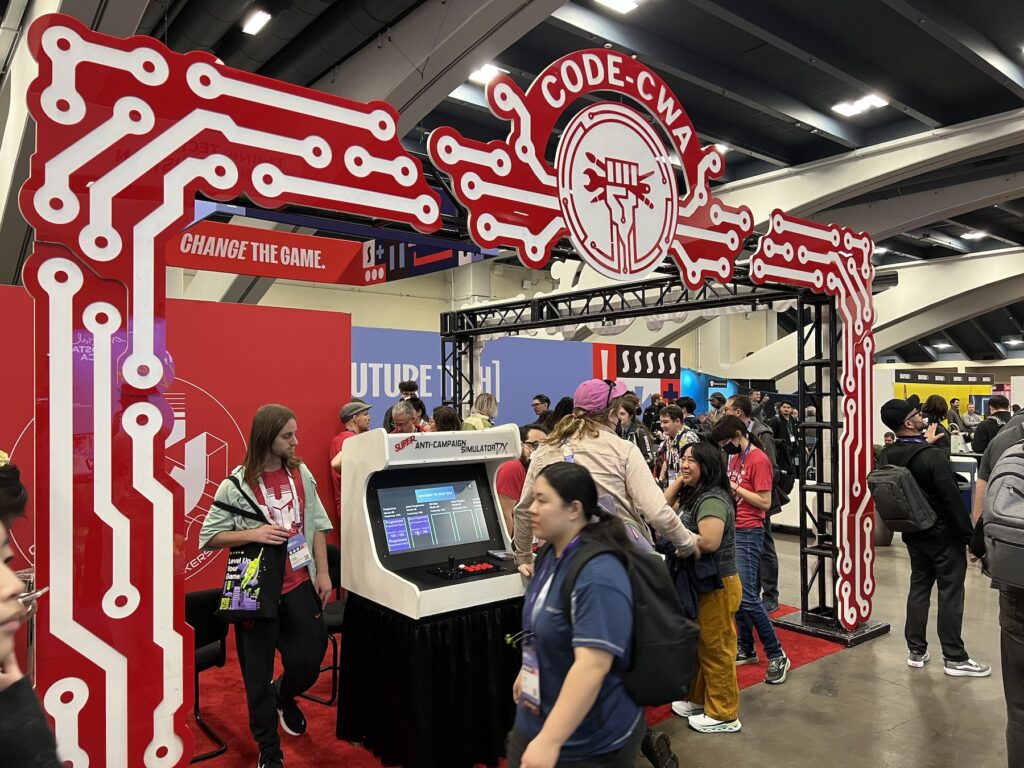
Building up that membership, against increasing precarity and corporate disinterest, presents unique challenges in many different arenas. There is corporate union-busting, as in the case of Rockstar UK, but there are still more avenues where union discussion is seemingly discouraged. In December, a source told me that GDC’s administration refused to approve any of the talks that the CWA had proposed for this year’s conference. The union does have a booth on the Expo Floor, which it paid for, and they held one panel discussion on Wednesday afternoon. Last year, in addition to their booth, the union sponsored three talks and events.
I bring up the tip I received to Augusta, and ask her how it had been to interact with GDC administration this year. They respond, “We applied for a variety of talks. The only panel we were able to give is the one that we paid for as part of our delegation and booth.” She cites the conference’s annual State of the Industry report from earlier this year, which states that 82% of workers support the industry’s unionization efforts, and that 62% are interested in joining a union themselves; this would seem to indicate that events around unionization, run by the union itself, would be welcome and relevant to GDC’s audience.
But, Augusta said, “There has been a real feeling of organizational disinterest… I don’t know what’s going on in their intent. I don’t know their capital flows.” (A request for comment from GDC’s administration was not returned by press time.) Augusta said the union will keep trying to reach people. “We are working on a pilot version of a Game Workers’ Conference for May 22nd and 23rd,” they told me. “It’s like, if it’s not going to be given to us, we’ll do it ourselves.”
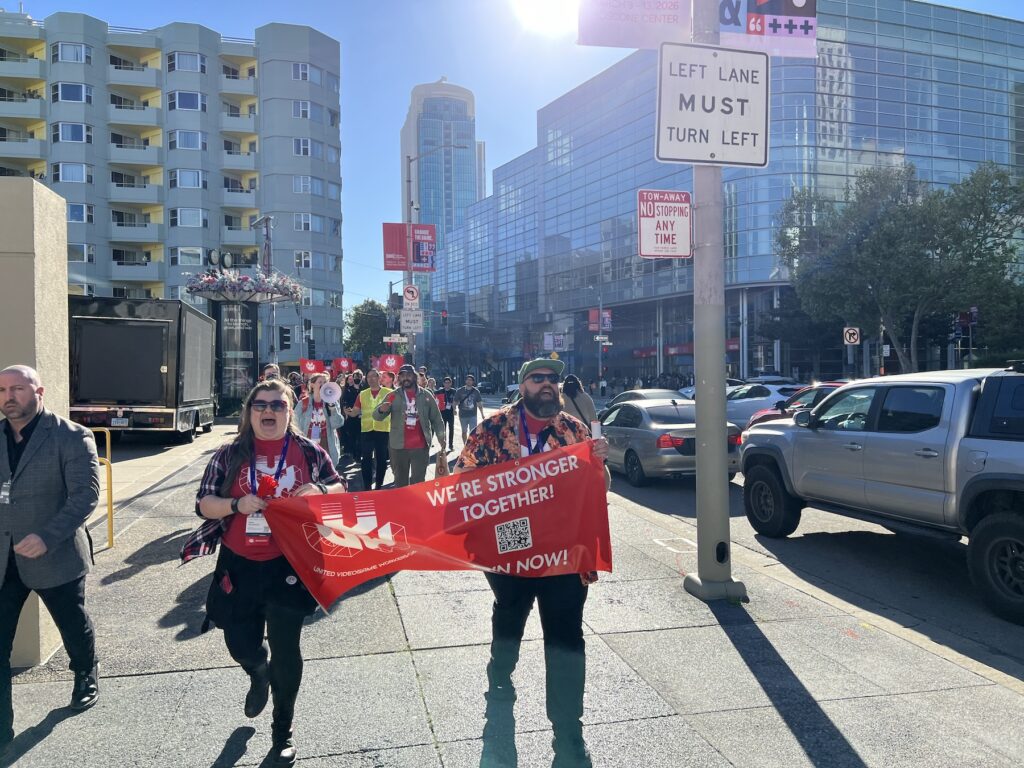
After speaking with Augusta and Webster in the morning, I attended the sole UVW-CWA panel in the afternoon. The audience seemed smaller than last year’s, but the panel still culminated in a march to Yerba Buena Gardens, picking up some stragglers and earning cheers along the way. After a short rally, the demonstration evolved into a town hall, where organizers split attendees into smaller discussion groups and passed around the first draft of their proposed Game Workers’ Bill of Rights.
The crowd dwindled, but those who stayed spoke passionately about the industry that they wanted to see. In my group, we read off the various provisions one by one. There was one item that the workers in my group agreed was the most important. It read, “Neutrality agreements for workers organizing a union.”