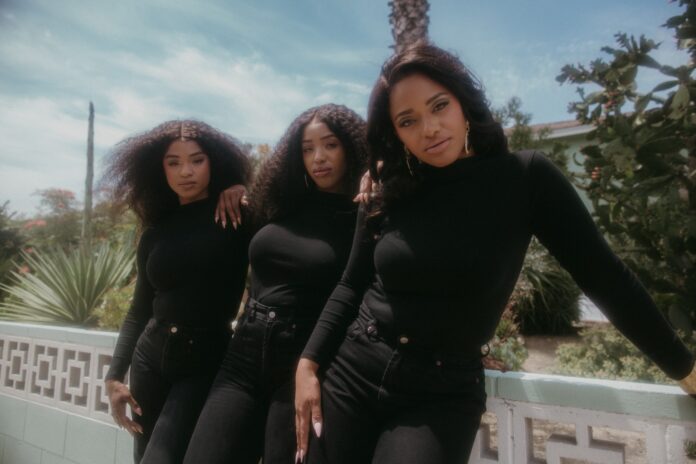
Well, hello, lovers of music and culture. We are Under the Stars, a quasi-weekly column that stays on message with strong-ass opinions, presenting new music releases and upcoming shows. Just a reminder, it’s Spring again. So let’s keep it moving, hustling with the changes, thinking outside the margins. Hop in, spend some time with us.
THE WOMACK SISTERS
It’s one thing to make inspiring ’60s soul compositions that unfurl with anticipatory woodwinds, tubular bells, and “pocket” grooves before a cadre of R&B voices directly informs you where it’s at. But hearing BG, Zeimani, and Kucha Womack, aka The Womack Sisters, with that legacy and tradition in their voices and genes, presents a whole ‘nother type of thang.
To snag a YouTube quote, because those folks know how to keep it a bean, “When your grandfather is Sam Cooke and your uncle is Bobby Womack, you know you’re on to something really good and soulful.” Add to those facts, these voices have linked up with producer Gabriel Roth (aka Bosco Mann) and will be releasing on the imprint Sharon Jones built and Charles Bradley (“The Screaming Eagle of Soul”) maintained, Daptone Records.
In 2016, a mutual friend introduced the Sisters to Daptone co-owner and producer Gabriel Roth, who heard them sing and fell quickly and deeply in love with their voices. Soon after, they met up at Daptone’s Penrose Studios in Riverside, CA to cut their first 45 together, “If You Want Me” b/w “I Just Don’t Want You (To Say Goodbye).”
That’s synchronicity, like a mug. I’ll admit it here. Sometimes these designed retro acts feel a bit too programmed, where the arrangement is just a bit too much for a vocalist who may be too green to get into the grit of a project. Not the case here.
The Womack Sisters carry those hurts like they are emoting from a faraway era in soul music, one very familiar with the church, the blues, and the pop music format. All those experiences, growing up on stages and in studios all over the world, singing behind their superstar elders? You just can’t teach. That spot-on blended harmony hits legit the first time. Welcome to the era of the Womack Sisters, who will be performing at The Greek in Berkeley on August 15, one day after hitting the Hollywood Bowl in LA with Al Green . More info here.
JESSE APPELMAN, WHERE WE GO

When this Oakland resident, mandolinist, and vocalist decided that he was done with nonprofit work, he made the full pivot—recording an album based on “the principles of his West Coast string band lineage: tone, melody, groove, interaction, and a balance of polish and grit.”
That’s right, people. There is a philosophy attached to these cross-string patterns.
Jesse Appelman grew up playing that mandolin. Flatpicking bluegrass, Brazilian choro, new acoustic, jazz, and more throughout his life. So this Palo Alto native, who calls Oakland home, got busy with what he knew all his life and made an album of “newgrass.” It’s a collection of different types of stylized folk music that runs flush with stories, twang, and instrumental fluidity on this inviting debut. Where We Go provides a broadband selection of access points for all listeners to get familiar with and find their footing with Appleman’s mosaic. You can just imagine sipping something warm, surrounded by people you enjoy sharing a chuckle or a smile with, while dropping in on this time-traveling record.
It features six original instrumentals, four vocal covers, and a mid-set deconstruction of the folk classic “Freight Train” along with sweeping arrangements, ear-pleasing melodies, and a satisfying blend of instrumentals and vocal-led tracks. Fortified with a deep bench of acoustic contributors—John Mailander, Sami Braman, Emily Mann, Eli West, Allison de Groot, Caleb Klauder & Reeb Willms, Laurie Lewis & Kathy Kallick, AJ Lee, and more— Appelman’s debut never feels stiff or like a boring formal affair. I’m convinced those who are new to bluegrass will enjoy this assortment of instrumental improvisations and high-pitched vocal harmonies just as much as veterans of the folksy genre.
Grab it here.
ROCKETSHIP AT THE CHAPEL, APRIL 9
I wish I had the hardwiring to pull full, lived-in memories of the watercolors-meeting-Polaroid pictures visage that Rocketship unfurled to the world with their 1996 full-length debut, A Certain Smile, A Certain Sadness. Albeit in those days, I was in and out of Modlang Records on University Avenue in Berkeley; it’s a said “hangout” of Slumberland Records artists and aficionados, so I’m sure I rubbed elbows with somebody from that clique while snatching up my Björk “Miss You (Sunshine Remix).” But Rocketship was not on my radar.
However, numerous folks who drew inspiration from said group did.
So now, 30 years past, getting close and personal with Stereolab-like A Certain Smile, A Certain Sadness, it feels like reading the crib notes after informally passing the exam. All that friendly-sweet indiepop, those scurry-flutter organs, Jetsons hazy soundscapes, and machine-like rhythms—it’s a vision into the future which became now. An intersection of boldly mixed-and-matched art-inspired ideas that is loaded with enthusiasm for modernity; when two versions of a sound are comfortable attempting to make space as one.
Whether it’s the twee-induced “I’m Lost Without You Here” or the big-swing sweet and droney objet d’art “Carrie Cooksey,” Rocketship fits into the larger picture of today’s sonic palette with ease. This show, a 30th anniversary tour for said mini-masterpiece, is sure to be an affair unto itself. Supporting local heavyweights The Umbrellas and Chime School, both of which bands, upon listening to Rocketship, I have a far better appreciation for, are indeed positioned to play at their finest. Get there early for the pop-smith brilliance of DJ Jessica B as well. Such a show, peeps.
Doors open at 7, show starts at 8. Tix here.
AUGUST LEE STEVENS AT SF JAZZ’S JOE HENDERSON LAB, SAT/4 & SUN/5
Interested in discovering emerging jazz vocalists in the Bay Area? The Joe Henderson Lab continues to serve as a nurturing ground for upcoming talented black voices. Following in the footsteps of artists like Dani Offline, Satya, and Veotis Latchison, you can now add August Lee Stevens to this impressive lineup of performers. Originating from Hercules in the East Bay, Stevens blends adult contemporary, soul, jazz, and modern folk to create her own unique expression of human emotion. She will return to the Joe Henderson Lab this weekend for two nights of captivating performances. Don’t miss the chance to witness the rise of another star in the making.
Grab tickets here.
BOB POWER, 1952-2026
He had a personal mantra, “Make good music with good people,” which guided his journey producing what would become foundational hip-hop albums in the late 20th century.
Known as “the den mom,” Power, according to Questlove, made the drums “Crispy & Loud” and the bass “full.” Intending to learn from young Black artists—20 years younger than him—Power, the musician, producer, and engineer behind classics by A Tribe Called Quest, De La Soul, Erykah Badu, The Roots, D’Angelo, and Me’shell Ndegeocello, became the name that artists and music-buying patrons looked out for. It was a seal of legitimacy.
He made it possible for others, outside of Calliope studios, the quintessence of hip-hop activity in the late ’80s and early ’90s, to hear the inventiveness happening in hip-hop.
At a time where many didn’t have time, didn’t want to invest the time or just believed the worst in this “urban” genre, Power saw the future and made sure the world heard it clearly, too.
After working and gigging in San Francisco musician in the ’70s and ’80s, Power moved back to New York City in the late ’80s and started working with the groundbreaking hip-hop group Stetsasonic, and from there his work with this burgeoning genre took off. Power died on March 1 at the age of 73, according to NYU’s Clive Davis Institute, where he worked as a professor.
His legacy, sculpting a new sound for hip-hop and R&B in the late 20th century revealed more of a modal sonic texture and applied it to a new generation of artists who yearned for their own production identity. What Brian Eno and Daniel Lanois did for mid ’80s U2, Power did for early ’90s hip-hop groups who looked for new ways of expression.
While earning a Grammy nomination in 1996 for Best Engineered Album (Non-Classical for Me’shell Ndegeocello’s “Place Beyond Passion”), Power was energized by this new terrain. His engineering calling card was the album that garnered universal attention and cemented hip-hop artistry, A Tribe Called Quest’s The Low End Theory. He always referred to it as the Sgt. Pepper’s of hip-hop due to its sonic innovation, production complexity, and transformative impact on the genre. Power’s credits also included Badu’s Baduizm, D’Angelo’s Brown Sugar, De La Soul’s De La Soul Is Dead, and several Roots albums, including Do You Want More?!!!??! and Things Fall Apart.
With numerous adulatory quotes from hip-hop artists speaking to his in-studio craftsmanship, the bulk of accolades speak to the man, the human, and the person he was in life. Powers’ input, humanity, and love of this new art form, which joyfully sought out and celebrated his studio intellect, did, in fact, push the culture forward.