
I’ve been to a fair number of jails in my life, mostly as a reporter, but before today, I’d never been to San Quentin. I knew its reputation: The notorious facility held the state’s death row and execution chamber, and was known for overcrowding and violence (by both residents and guards).
It was a place that represented everything that was wrong with the criminal justice system: Mass incarceration, particularly of Black men, long sentences with little hope, and an approach that was far more about punishment than the “rehabilitation” part of the so-called California Department of Corrections and Rehabilitation.
Not a place where a group of journalists, men and women, would walk freely among residents, shaking hands, chatting, doing interviews and hearing presentations, accompanied only by an unarmed lieutenant who is the chief public information officer.
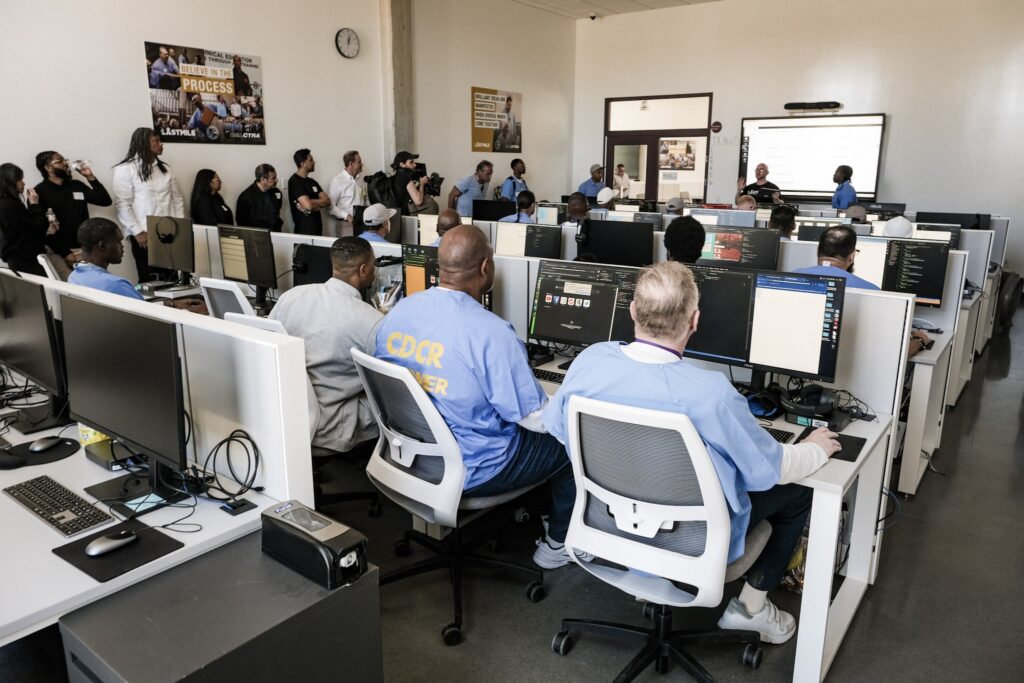
But that’s what we did Thursday, and for a prison, it was remarkably chill. Lt. Berry met us as the door, and after going through a couple of old (actually historic) metal gates, we walked out into a sunny open space where people were playing baseball, basketball, and tennis. An inmate band was jamming. The guys smiled and joked with Berry, and she did the same. We were not surrounded by guards; in fact, a group of inmates signed us in to a new education center and offered us water and tangerines.
Some of this may well have been designed and orchestrated for our benefit.
Still, it’s a very different San Quentin today. CDCR has closed Death Row and moved those inmates to another facility (Gov. Gavin Newsom has paused all executions). The landmark prison has been downgraded from a Level 4 (high security) facility to what the guards called a “soft Level 2,” relatively low security. The guards I talked to couldn’t be happier; coming to work back in the day was scary and unpleasant. Today, they told me, it’s not a bad job.
It’s also part of an unusual experiment: With the help of a group called The Last Mile, the focus at San Quentin has shifted from punishment to rehabilitation, and dozens of residents are now full-time students, learning job skills and preparing for the time when most of them will re-enter society—with support, counseling, housing assistance, and in some cases, jobs waiting.
We were there to celebrate the completion of a $239 million complex that has turned old walls into open classrooms, and to meet some of the people who have turned their lives around. Kenyatta Leal, who was sitting across the aisle from me during the introductory program, spent 19 years at San Quentin, learned coding through The Last Mile, had a job waiting at RocketSpace even before he won parole, and now runs an apprenticeship program at Slack.

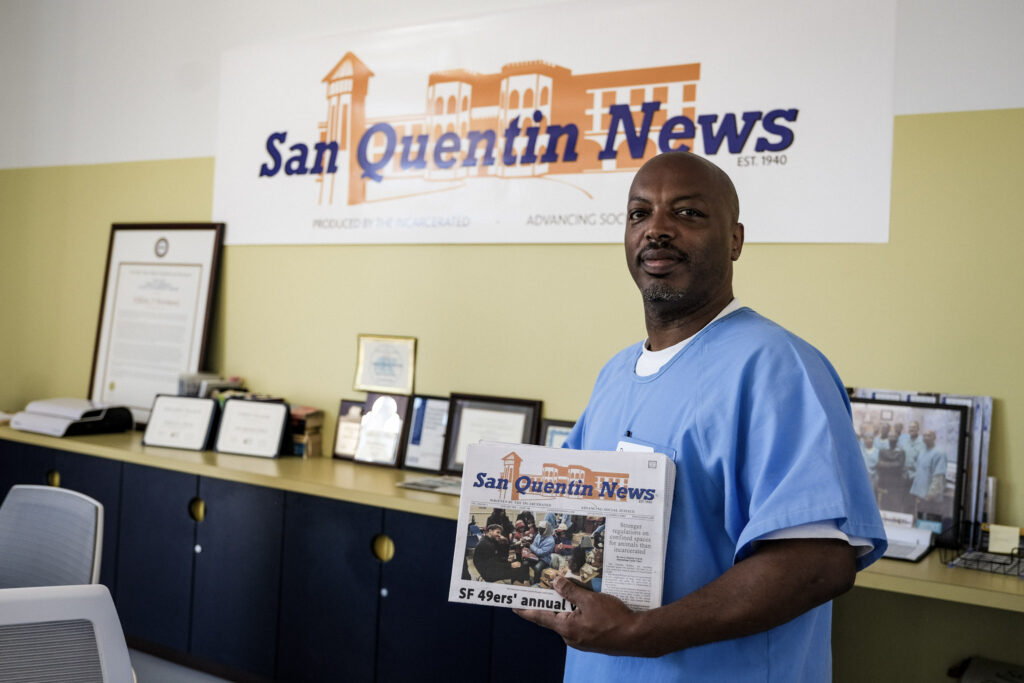
We toured the Audio Lab, the Video Lab, the San Quentin News office, and the place where the award-winning the Uncuffed podcast is created. The San Quentin News puts out a monthly paper that is circulated nationally and covers a wide range of issues—with no Internet access and no phone access. Those guys are amazing journalists.
The chairs were not bolted to the floor. Residents could come and go without a jailer with a ring of keys. The students are all issued laptops, which they can take to their cells at night.
Chris Redlitz and Beverly Parenti started The Last Mile in 2010, with the idea of training inmates for jobs in tech. “At that point, we were told that by 2020, the US would have a shortage of 1 million coders,” Redlitz said. Teaching inmates that skill would allow them to leave prison and move into good-paying jobs.
Today, the market is different; tech workers need to be familiar with AI—which is hard to learn in a prison where nobody has Internet access. But The Last Mile has come up with workarounds and samples.
The next program will involve solar roofing installations, since skilled trades work will be in heavy demand for at least the next decade.
Most of the residents at San Quentin are in for long sentences, some for life—but they are all eligible for parole. Berry told me that the vast majority will be released at some point, and will be back in the community.
So many of the people I met on the tour said the same thing: Your life shouldn’t be defined forever by the worst thing you ever did.
The recidivism rate for TLM graduates is less than five percent.
This is all very inspiring.
And yet.
I met Demitrius, a middle-aged man who has trained as a web designer. He’s also trained as an optician; he can make lenses and glasses, and diagnose eye problems. We talked for a while, and I left that conversation with the same feeling I had when I walked out the gates two hours later:
Why are all these talented, well-trained, Black men (and a few white and Latino men) still locked behind bars?
Why is Gov. Newsom, who cut the ribbon on the new facility recently, adding $1 billion more money to the CDCR budget and not moving to close more prisons?
From Californians United for a Responsible Budget:
“The Governor’s own budget numbers make the case for prison closure,” said Amber-Rose Howard, Executive Director of Californians United for a Responsible Budget (CURB), a coalition of more than 100 organizations that asserts at least six more state prisons can close. “California is wasting more on CDCR while incarcerating fewer people. That is not fiscal discipline. It is a reckless commitment to prioritizing punishment as the answer to public safety. It is a political choice to protect unnecessary prison spending while communities are told there is not enough money for care, housing, food, health, education, and survivor services. This is negligent budgeting.”
Berry told me that the population at San Quentin tends to be older—and all the data shows that the older people get, the less likely they are to reoffend.
And yet: All these Black men are still spending the night locked in a cage, unable to be with their families, unable to access the sorts of things that most of us take for granted, in a system rooted in ancient punitive philosophy that never made any sense.
I told some of the other reporters in my group that I wasn’t a big fan of prisons in general, that I didn’t get the concept of long, even life sentences for many crimes, and that for all the reforms, what I was seeing at San Quentin wasn’t my idea of justice.
My colleagues pushed back: These people have committed very bad, violent crimes. They “owe a debt to society.”
Well: American society has so badly abused, violently oppressed, marginalized, traumatized, and undermined the humanity of Black men for so long that maybe society owes a debt to them, too.
Maybe ending mass incarceration, and letting the graduates of The Last Mile get their diplomas outside the prison gates, for good, would be a start.